#Yarn & Fiber
Textile Exchange report shows growth of preferred fiber and materials market needs to be accelerated
The report is a unique annual publication about global fiber and materials production, availability, and trends, including those associated with improved social and environmental impacts, referred to as ”preferred.” The comprehensive report includes quantitative data, industry updates, trend analysis and inspiring insights into the work of leading companies and organizations as they create material change.
The results show that between 2019 and 2020 the market share of preferred cotton increased from 24 to 30 percent and recycled polyester from 13.7 to 14.7 percent. Preferred cashmere increased from 0.8 to 7 percent of all cashmere produced while Responsible Mohair Standard certified fiber expanded from 0 to 27 percent of all mohair produced worldwide in its first year of existence in 2020. The market share of FSC and/or PEFC certified MMCFs increased to approximately 55-60 percent. While the market share of recycled MMCFs is only 0.4 percent, it is expected to increase significantly in the following years.
Brands’ increased interest in the use of preferred fibers and materials was also demonstrated by an impressive 75 percent increase in the total number of facilities (to 30,000) around the world becoming certified to the organization’s portfolio of standards in 2020. These standards include the Global Recycled Standard (GRS), Organic Content Standard (OCS), Recycled Claim Standard (RCS), Content Claim Standard (CCS), Responsible Down Standard (RDS), and Responsible Wool Standard (RWS), Responsible Alpaca Standard (RAS) and the Responsible Mohair Standard (RMS). In early 2021, Textile Exchange launched the Leather Impact Accelerator (LIA) to address the major sustainability challenges throughout the bovine leather supply chain from farm to finished leather, including an Impact Incentives program.
However, the report also notes that despite the increase, preferred fibers only represent less than one-fifth of the global fiber market. Less than 0.5 percent of the global fiber market was from pre- and post-consumer recycled textiles.
Indeed, global fiber production has almost doubled in the last 20 years from 58 million tonnes in 2000 to 109 million tonnes in 2020. While it is not yet clear how the pandemic and other factors will impact future development, global fiber production is expected to increase by another 34 percent to 146 million tonnes in 2030 if the industry builds back business as usual. If this growth continues, it will be increasingly difficult for the industry to meet science-based targets for climate and nature.
“Whether for current or post-pandemic business, the production and use of preferred fibers and materials must be a non-negotiable decision,” says La Rhea Pepper, Textile Exchange Founder and CEO. “Now is the time to accelerate a transition to increasingly sustainable practices to reduce conventional fiber and material production’s footprint on the planet.”
Textile Exchange aims to be the driving force for urgent climate action, and its Climate+ strategy calling for the textile industry to reduce greenhouse gas emissions by 45 percent by 2030 compared to a 2019 baseline in the pre-spinning phase of textile fiber and materials production, while also addressing other impact areas interconnected with climate such as water, biodiversity, and soil health.
“Increasing the uptake of preferred fibers and materials, proliferating regenerative practices, mitigating land-use change, supporting the transition to renewable energy, and encouraging innovation and circularity are known solutions towards Textile Exchange’s Climate+ goal,” says Liesl Truscott, Textile Exchange Corporate Benchmarking Director. “Acceleration of such solutions have to guide us in the next nine years that are so decisive for the future of our planet and all life on earth.”
Textile Exchange encourages companies to commit to its 2025 Sustainable Cotton Challenge and/or 2025 Recycled Polyester Challenge which call for the apparel industry to commit to source all their cotton from the most sustainable sources and increase the amount of recycled polyester used from 14 to 45 percent (or 17.1 million metric tons), respectively, by 2025.
Textile Exchange invites brands, retailers, manufacturers, and suppliers to track and benchmark their progress by participating in the annual Material Change Index (MCI) survey (open through September; email: CFMB@TextileExchange.org).
Textile Exchange also invites participation in the organization’s 2021 Textile Sustainability Conference in Dublin, Ireland, November 15-19 including the preferred fiber and materials Round Tables Summits, held in conjunction with the event.
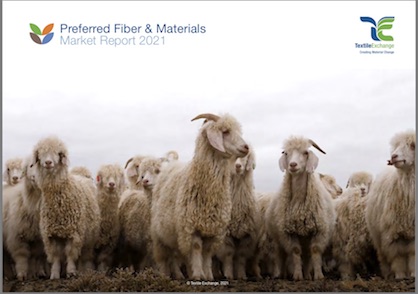
https://textileexchange.org/wp-content/uploads/2021/08/Textile-Exchange_Preferred-Fiber-and-Materials-Market-Report_2021.pdf