[pageLogInLogOut]

#Techtextil 2015

Modular coating system

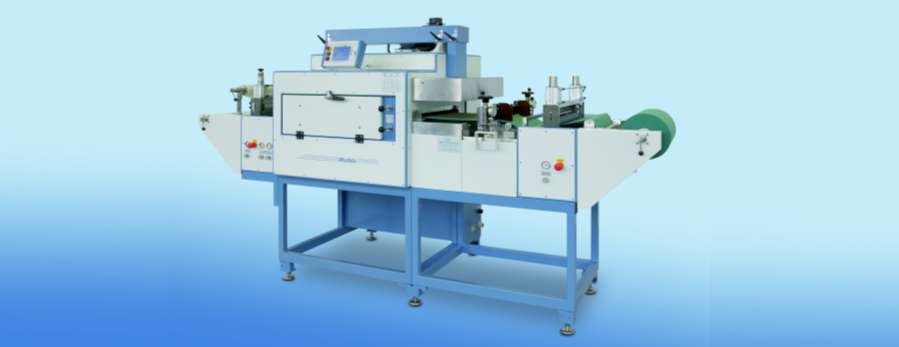
The continuous coating system KTF-S can be customised very easily due to its modular design. (c) 2015 Werner Mathis
The Swiss company Werner Mathis AG will present the new continuous coating system KTF-S at the Techtextil show (Hall 3.0, Stand J27) in Frankfurt. The system, which is available with a working width of 300 mm, 450 mm, or 600 mm, consists of a doctor knife coating module and a subsequent drying unit.
The KTF-S is ideally suited for various applications in textile industry, pharmaceutical industry, foil and paper manufacturing, or in research and development laboratories. It is the perfect solution in all cases, where a larger machine cannot be operated efficiently. In the basic set-up the material is guided by an unroll device through the doctor knife coating and the drying unit. At the outlet the material is rolled up automatically. The heart of the system is the hot-air dryer, which is divided into an upper and lower nozzle section. Two flaps can be adjusted to regulate the drying process accordingly. The combination of powerful air circulation and regulated heating guarantees an optimal drying capacity.

The KTF-S can be customised with various add-on modules. Examples include an infrared pre-dryer, a laminating device, which can be installed before or after the dryer, or an additional hot-air dryer. Alternative coating devices, like slot die, engraved roller, reverse roll coater, hot melt, powder scattering system and rotary screen can be used as well.

An optional infrared radiation pyrometer can be used to measure the surface temperature of the sample during drying process. Material holders for discontinuous process such as pin frames are available for standardized sample sizes. Temperatures, sample speed, fan speed and other parameters are monitored and documented seamlessly.

Due to the modular design of the system all process-oriented add-on components can be installed when needed. The user has therefore a very flexible system, which can be tailored to actual requirements of an application.

Even greater flexibility is achieved by combining the KTF-S with other system from Mathis, like the horizontal vertical padder type HVF which is used for dyeing the textile material prior to drying these samples on the KTF-S, either continuously or smaller samples with the material frames.

More News from Werner Mathis AG

More News on Techtextil 2015

Latest News

#Heimtextil 2027

Heimtextil celebrates Milan Design Week honoring partnerships with Patricia Urquiola and Alcova Milano

Heimtextil is represented at Milan Design Week with its strong design partners Patricia Urquiola and Alcova. At Villa Pestarini, the leading trade fair spotlighted its dynamic collaborations with acclaimed designer Patricia Urquiola and Alcova Milano.

#Texprocess 2026

Kornit Digital expands digital production into footwear and technical textiles with Presto MAX PLUS

Kornit Digital (NASDAQ: KRNT) (“Kornit” or the “Company”), a global pioneer in sustainable, on-demand digital fashion and textile production, today unveiled the Kornit Presto MAX PLUS, a new roll-to-roll system expanding digital manufacturing into footwear, automotive interiors, military camouflage, high-performance sportswear, and high-end furnishings. Debuting at Texprocess 2026 in Frankfurt, Presto MAX PLUS enables entirely new applications for on-demand textile production.

#Textile processing

NATULON® zipper series surpasses 50% of YKK’s global zipper sales

YKK Corporation (Headquarters: Chiyoda-ku, Tokyo; President: Koichi Matsushima; hereafter, YKK) announces that the global sales share of its NATULON® zipper series—zippers that incorporate recycled materials—has exceeded 50%.

#Smart Textiles

Covestro, FILK Freiberg, and OUT e.V. develop flexible, conductive polymer smart textile system

As the smart textiles market continues to grow across healthcare, personal protection, sportswear, and automotive applications, developers are seeking new ways to integrate electronic functionality directly into textiles, without the rigidity and complexity of conventional wiring. To address this challenge, FILK Freiberg Institute, an independent research institution with expertise in polymer coatings for textile applications, collaborated with Optotransmitter-Umweltschutz-Technologie (OUT) e.V. The joint project, funded under the German Industrielle Gemeinschaftsforschung (IGF) program of the Bundesministerium für Wirtschaft und Energie (BMWE), focused on developing flexible, conductive polymer surfaces for next-generation smart textiles.

TOP