[pageLogInLogOut]

#Sustainability

VAUDE eliminates PFAS from all products

High-performance weather protection without harmful forever chemicals
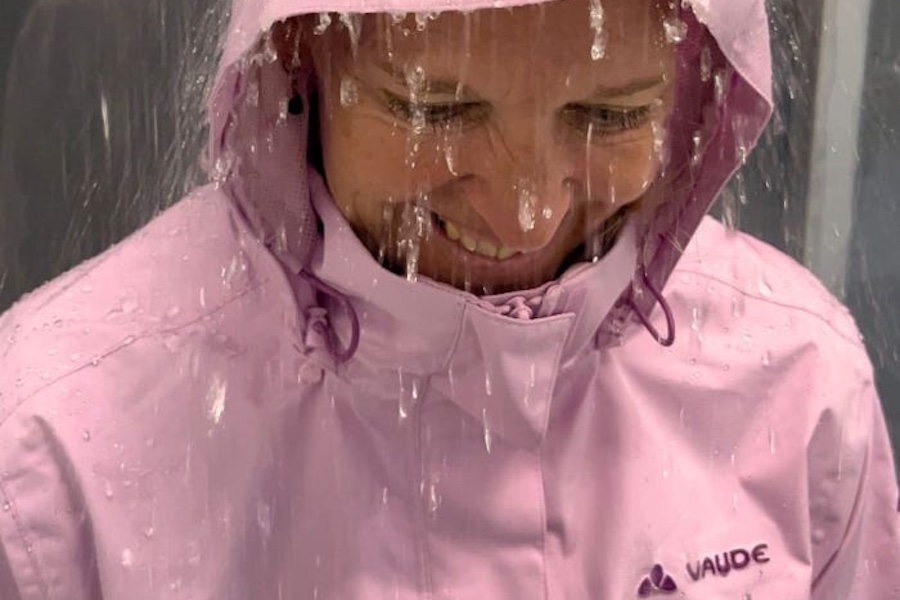
Vaude's Antje von Dewitz takes a shower to demonstrate a PFAS free rain jacket © 2026 Laude
PFAS (per- and polyfluoroalkyl substances) are now detectable worldwide – in drinking water, soil and the human body. These so-called “forever chemicals” are considered hazardous to health and potentially carcinogenic, as they do not break down and remain in the environment permanently. Despite these risks, PFAS are still used in a wide range of products. More than 15 years ago, VAUDE made a strategic decision to gradually eliminate PFAS from all product categories.

With the Spring/Summer 2025 collection, this transformation is complete: VAUDE now fully avoids PFAS – from weather protection apparel to backpacks, sleeping bags, footwear and waterproof tents.

This complete phase-out required many years of intensive development. For a long time, PFAS were considered the technical standard for waterproof performance in the outdoor industry. High-performing alternatives were initially very limited. VAUDE therefore invested specifically in materials research, collaborated with innovative partners and conducted extensive lab and field testing to ensure that the high functional requirements could also be met without PFAS. 

Strategic PFAS phase-out – consistently implemented 

“Phasing out PFAS was a strategic business decision, not a communications move,” says Dr. Antje von Dewitz, CEO of VAUDE. “It shows that high-performance weather protection is possible without relying on harmful forever chemicals. Reaching this milestone is a major achievement for VAUDE – and the result of close collaboration and strong commitment from many colleagues and partners.” 

A key role was played by VAUDE’s chemicals management system, which has been working systematically for years to identify and implement alternatives to fluorinated chemistry. All product categories were converted step by step – including technically demanding components such as waterproof zips and tent fabrics. 

How can PFAS-free solutions become the industry standard?

VAUDE’s successful transition shows: high-performing PFAS-free solutions are technically available today. A clear EU-wide regulatory framework would significantly accelerate the widespread adoption of these alternatives across the industry. Binding requirements would create a level playing field and provide planning security for companies that choose to invest early and take responsibility. 


More News from VAUDE Sport GmbH & Co. KG

More News on Sustainability

#Natural Fibers

Global Standard gGmbH launches second public consultation for GRTS Draft 2 for the textile industry (1–30 April 2026)

Global Standard gGmbH is pleased to announce the release of Draft 2 of the Global Responsible Textile Standard (GRTS) for its second public consultation. The consultation will be open from 1 April 2026 to 30 April 2026, inviting stakeholders across the textile and apparel value chain to provide input and contribute to the further development of this new Standard.

#Sustainability

Practical toolkit to drive coordinated climate action launched

An open-access workshop toolkit enables brands, suppliers, policymakers and investors across the textile industry to apply the System Map in their own work, identifying leverage points to halve emissions and enable a just transition.

#Raw Materials

Textile Exchange publishes cotton Life Cycle Assessment study to strengthen impact data

Textile Exchange has published the first in a series of seven Life Cycle Assessment (LCA) studies designed to improve the quality and robustness of environmental impact data for raw material production across the fashion, textile, and apparel industry. The first LCA study focuses on cotton and addresses critical data gaps and methodology variability through new high-quality data across key producing countries. The study includes organic, regenerative, recycled, and country averages for conventional cotton production systems, providing a clearer picture of the associated environmental impact.

#Sustainability

Experts publish APAC policy priorities

Cascale today announced the publication of its APAC Policy Priorities Paper, developed by the Asia-Pacific (APAC) Policy Member Expert Team (MET) to identify key regional sustainability challenges and provide practical, aligned recommendations for policymakers and industry stakeholders across Asia-Pacific.

Latest News

#Techtextil 2026

AI, Start-ups, Research: Techtextil and Texprocess bring together players in the textile industry

From start-ups to universities and research institutes: at Techtextil and Texprocess, the world’s leading innovation trade fairs in Frankfurt am Main, exhibitors present future-oriented concepts for the global textile industry. With the international Campus & Research area, a strong participation from start-ups and the latest AI applications for textile processing, both trade fairs showcase current developments in the textile industry. By bringing together innovation, research and application, they enable new partnerships across the textile value chain.

#Techtextil 2026

IVGT joint stand brings innovation and networking to Techtextil 2026

At Techtextil 2026 and the parallel Texprocess 2026, key transformation topics such as artificial intelligence, digitalisation, sustainability, recycling and the circular economy will be reflected across the show. Against this backdrop, the IVGT, together with 16 member companies, will present its joint stand in Hall 12.1 (Stand D62) as a platform for exchange and networking.

#Man-Made Fibers

Indorama Ventures supports Southeast Asia’s textile customers with reliable regional supply and global innovative portfolio

Indorama Ventures, one of the leading global polyester fiber and filament yarn suppliers globally, will participate in Indo Intertex 2026 in Jakarta this April, making its diverse global portfolio available to apparel, home textile, and hygiene customers across Southeast Asia.

#Raw Materials

New study shows low environmental impact by Cotton made in Africa Organic Cotton from Tanzania

Today, the Aid by Trade Foundation (AbTF) is announcing the results of a comprehensive life-cycle analysis (LCA) for cotton produced in Tanzania under the Cotton made in Africa Organic (CmiA Organic) standard. The study emphasises the small ecological footprint of CmiA Organic verified cotton. This can largely be traced back to the absence of synthetic pesticides, artificial fertilisers, and artificial irrigation. Consequently, CmiA Organic cotton can help the textile industry meet regulatory requirements as well as science-based targets. The results also show that the consequences of climate change threaten the livelihoods of these cotton farmers, even though the type of agriculture they practise barely contributes to climate change.

TOP