[pageLogInLogOut]

#Sustainability

Inditex renews its support for Caritas’ clothing reuse and workplace inclusion drive in Spain, pledging €8.5 million
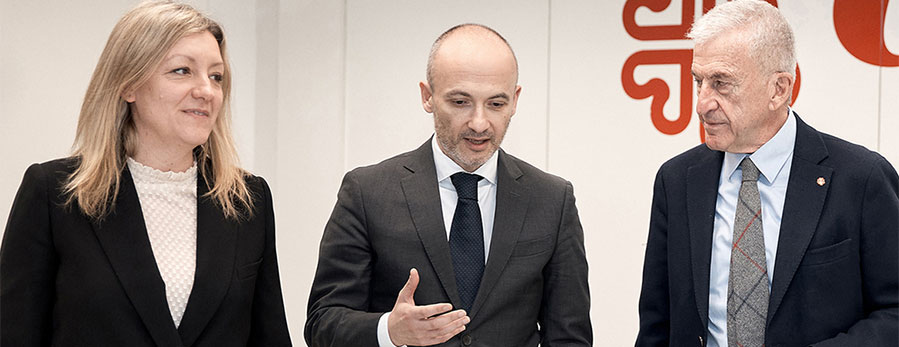
Inditex’s CEO, Óscar García Maceiras, and the president of Caritas in Spain, Manuel Bretón Romero, officially extended the two organisations’ collaboration until 2025 this morning in Madrid © 2023 Inditex
Inditex will contribute €8.5 million to Caritas during the next three years to reinforce its clothing collection and reuse initiative, known as Moda Re-, and continue to fund upskilling, training and inclusion projects for people in need in Spain. Óscar García Maceiras, CEO of Inditex, and Manuel Bretón Romero, president of Caritas in Spain, signed a new agreement this morning in Madrid, extending the collaboration between the two entities, which dates back to 2007, until 2025.

The Moda Re- programme, to which Inditex will earmark €3.5 million out of the €8.5 million pledged under the agreement, is Caritas’ community project devoted to the full-cycle management (collection, reuse via donation or charitable sale and recycling) of using clothing, an activity that has enabled the NGO to create 1,200 jobs, half of which inclusion-driven.

Between 2023 and 2025, the money donated by Inditex to the Moda Re- scheme will mainly go to reinforcing clothing collection capacity and the related traceability systems and expanding its 129-store chain of charity shops with new openings. In order to give new life to any products collected that cannot be reused, Moda Re- will continue to innovate at its textile processing facilities in Bilbao, Barcelona and Valencia, where it extracts fibres and raw materials of value for the industry.


Caritas’ employment and training programme, meanwhile, will receive €5 million of funding to continue to carry out projects that provide labour skills to vulnerable people at risk of social exclusion and those left behind in order to increase their chances of inclusion. With that money, Caritas will also roll out social economy and selfemployment initiatives.

Since 2007, the year it began to work with Caritas, Inditex has donated over €32 million to the NGO’s humanitarian aid and emergency, international cooperation and community work projects in Spain. During today’s signing ceremony, Manuel Bretón, Caritas’ president in Spain, underscored that “Inditex’s support will allow us to articulate proposals for social transformation that shape a society based on respect for human rights, dignity, cooperation and justice, all framed by care for our planet”.




More News from TEXDATA International

#Texprocess 2026

Texprocess 2026: Automation, digitalisation and AI redefine textile processing

Making investment decisions in textile processing has become significantly more demanding. Increasing energy costs, a shortage of skilled labour and ongoing geopolitical uncertainties are compelling companies to focus on technologies that deliver clear gains in efficiency and process reliability. This applies equally to apparel manufacturing and to the processing of technical textiles and high-performance materials. As a result, modernisation initiatives are assessed more carefully – even as the need to upgrade production systems continues to intensify.

#Techtextil 2026

Techtextil 2026: Between innovation pressure & market reality

From 21 to 24 April 2026, Techtextil in Frankfurt am Main will once again become the central meeting point for the international technical textiles and nonwovens industry. Running in parallel, Texprocess will focus on the industrial implementation of textile processing technologies as the leading platform in this field. Together, the two trade fairs form a closely integrated presentation and working platform along the entire textile value chain – from material development to finished applications.

#Techtextil 2026

Between geopolitical pressure and industrial resilience

In this interview, Dr. Janpeter Horn (VDMA) discusses the current challenges facing textile machinery manufacturers, shaped by geopolitical tensions, regulatory developments and subdued investment. He also outlines why innovation strength, integrated solutions and strategic positioning remain key to global competitiveness.

#Texprocess 2026

Between investment restraint and modernization pressure

Texprocess 2026 takes place in a complex market environment shaped by uncertainty and innovation pressure. In this interview, Elgar Straub (VDMA) explains why the trade fair is particularly relevant this year and which technologies are driving efficiency and competitiveness.

More News on Sustainability

#Man-Made Fibers

The updated poster on biodegradable Polymers in various environments has been released

As part of the PerPlacsBio project, nova-Institute has updated its popular poster on the biodegradability of polymers in different environments. The updated version reflects current standards, certifications and the latest scientific findings. The poster can be used to assess biodegradable alternatives for use in agriculture and forestry, and it is now available in German for the first time.

#Sustainability

A new standard to combat plastic waste in forests

With DIN SPEC 35808 “Tree Shelter for Forestry Applications,” the testing and research service provider Hohenstein, in collaboration with Rottenburg University of Forestry, as well as forestry authorities and industry partners, has established a clear framework for bio-based and fully biodegradable tree shelters. The pre-standard defines requirements and practical testing methods designed to reduce plastic waste in forests and strengthen the long-term protection of soil and the environment.

#Denim

Denim moves towards sustainability

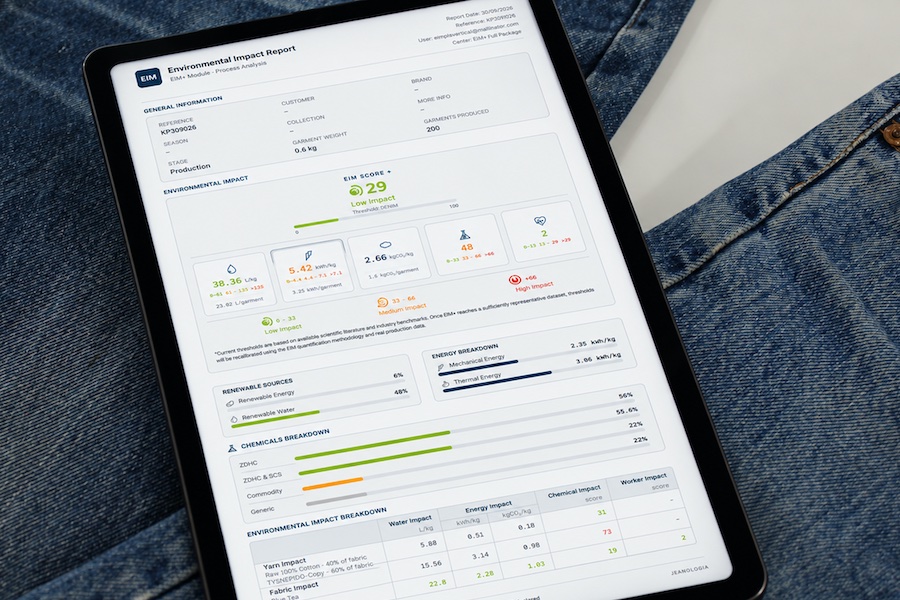
EIM (Environmental Impact Measurement), the global reference platform for measuring the environmental impact of garment finishing, presents the second edition of its annual report Denim Industry Progress & Insights 2025. The study analyses over 100,000 real denim finishing processes, providing an accurate and up-to-date view of the industry’s evolution towards more sustainable models.

#Recycling / Circular Economy

Europe’s textile future at a turning point: New 2030 Circularity Blueprint aims to scale recycling and unlock investment opportunities

The EU textile system is at a critical crossroads. Today, less than 1% of discarded garments are recycled into new garments, despite EU-wide obligations for separate collection. In response, Global Fashion Agenda (GFA) is launching the 2030 Circularity Blueprint, in partnership with ReHubs. This ambitious initiative is designed to support the transformation of the EU textile ecosystem to advance textile-to-textile recycling and drive the transition to a circular economy.

Latest News

#ITM 2026

SHIMA SEIKI to show complete knitting and cutting workflow at ITM 2026

Leading computerized flat knitting technology provider SHIMA SEIKI MFG., LTD. of Wakayama, Japan, together with its Turkish representative TETAS IC VE DIS TICARET A.S., will participate in the ITM 2026 International Textile Machinery Exhibition in Istanbul, Türkiye this month with a full product lineup. In addition to flat knitting machines and design software, visitors will also have the opportunity to experience the full range of SHIMA SEIKI textile machinery with its automatic cutting machine exhibit, all geared toward the fashion apparel market as well as non-apparel related businesses.

#Raw Materials

Global Cotton area and production are projected to decline in the 2026/27 Season

The June 2026 issue of Cotton This Month projects a modest contraction in global cotton area, production, and trade during the 2026/27 season, reflecting weaker demand sentiment, rising production costs, and shifting environmental factors across major producing nations.

#Natural Fibers

European Flax-Linen & Hemp step into advanced manufacturing: Enabling filament winding, 3D printing and high-performance composite processes

The Alliance for European Flax-Linen & Hemp announces a new wave of technological advancements demonstrating how flax-linen and hemp fibres are now being successfully integrated into advanced composite manufacturing processes. These developments mark a transition beyond traditional hand lay-up techniques, positioning natural fibres as credible, scalable solutions for high-performance industrial applications.

#ITM 2026

SETEX turns dyeing and finishing data into daily production control

At ITM 2026, SETEX will show how textile mills can use machine, recipe, quality and energy data for more reliable daily production decisions — not as another reporting layer, but as part of the running dyeing and finishing process. With OrgaTEX X3 MES, E390x/C390x controllers, CamCOUNT and FabricInspector Portable, SETEX connects planning, machine execution and fabric-related quality insight within existing mill structures.

TOP