[pageLogInLogOut]

#Sustainability

UNIFI's REPREVE® receives first Higg MSI Scores

Long regarded as the global leader in recycled fiber, REPREVE, made by Unifi, Inc. (NYSE: UFI), is now even more transparent. The company’s flagship recycled brand has received its Higg Materials Sustainability Index (Higg MSI) scores. The Higg MSI (version 3.2) is the most comprehensive tool for sustainability analysts, designers and product developers who want to make more informed materials choices.

Sustainability scorecard indicates strong benefits in choosing REPREVE

The Higg MSI study confirms that U.S.-manufactured REPREVE reduces the global warming potential by 21% compared to generic, mechanically-recycled polyester and 42% compared to conventional virgin polyester. The Higg MSI global warming potential is related to greenhouse gases. Based on the score, REPREVE is verified to have a lower carbon footprint than comparable materials. By using REPREVE, organizations and consumers can greatly reduce their environmental impact compared to using generic rPET (recycled Polyethylene Terephthalate), one of the most commonly used plastics in the world. Additionally, REPREVE is the only eco-performance fiber with U TRUST® verification to certify recycled content claims. 

“We continue to build on our commitment to transparency by having the results of our REPREVE Life Cycle Assessment verified and accepted into the Higg MSI,” said James Cooper, Unifi Sustainability Manager. “REPREVE manufactured in the U.S. has a lower global warming potential than standard rPET, providing our customers with a verified pathway to lower their environmental impact and meet their sustainability goals.”

The Higg MSI scores are used to communicate credible data about a product’s performance and validate sustainability progress. These results serve as a public scorecard for sharing the profile and data of a product’s environmental impact, which provides designers and consumers alike with information to make sustainability-based purchasing decisions.


A Life Cycle Assessment (LCA) tool measures the environmental impacts over the whole life cycle of a product or service, including emissions and consumption of material resources. In addition, it provides a more accurate estimate of environmental trade-offs that allows organizations to use more reliable and transparent data to prioritize impact reduction in products and services. The Higg MSI scores are based on an LCA reviewed by the global, multi-stakeholder nonprofit alliance for the consumer goods industry, Sustainable Apparel Coalition, and its technology partner, Higg Co.

“At Unifi, we’re working today for the good of tomorrow, and these scores validate our belief that we are having a positive impact on the future through the growth of REPREVE,” said Unifi CEO Eddie Ingle. “This assessment assures consumers and brands that by purchasing or using REPREVE recycled fibers, they are making a more conscious and sustainable impact on the present and the future. To our shareholders, this transparency reinforces our commitment to REPREVE and the growth potential it has with consumers and brands as they increase their focus on sustainable alternatives.” 



More News from TEXDATA International

#Texprocess 2026

Texprocess 2026: Automation, digitalisation and AI redefine textile processing

Making investment decisions in textile processing has become significantly more demanding. Increasing energy costs, a shortage of skilled labour and ongoing geopolitical uncertainties are compelling companies to focus on technologies that deliver clear gains in efficiency and process reliability. This applies equally to apparel manufacturing and to the processing of technical textiles and high-performance materials. As a result, modernisation initiatives are assessed more carefully – even as the need to upgrade production systems continues to intensify.

#Techtextil 2026

Techtextil 2026: Between innovation pressure & market reality

From 21 to 24 April 2026, Techtextil in Frankfurt am Main will once again become the central meeting point for the international technical textiles and nonwovens industry. Running in parallel, Texprocess will focus on the industrial implementation of textile processing technologies as the leading platform in this field. Together, the two trade fairs form a closely integrated presentation and working platform along the entire textile value chain – from material development to finished applications.

#Techtextil 2026

Between geopolitical pressure and industrial resilience

In this interview, Dr. Janpeter Horn (VDMA) discusses the current challenges facing textile machinery manufacturers, shaped by geopolitical tensions, regulatory developments and subdued investment. He also outlines why innovation strength, integrated solutions and strategic positioning remain key to global competitiveness.

#Texprocess 2026

Between investment restraint and modernization pressure

Texprocess 2026 takes place in a complex market environment shaped by uncertainty and innovation pressure. In this interview, Elgar Straub (VDMA) explains why the trade fair is particularly relevant this year and which technologies are driving efficiency and competitiveness.

More News on Sustainability

#Man-Made Fibers

The updated poster on biodegradable Polymers in various environments has been released

As part of the PerPlacsBio project, nova-Institute has updated its popular poster on the biodegradability of polymers in different environments. The updated version reflects current standards, certifications and the latest scientific findings. The poster can be used to assess biodegradable alternatives for use in agriculture and forestry, and it is now available in German for the first time.

#Sustainability

A new standard to combat plastic waste in forests

With DIN SPEC 35808 “Tree Shelter for Forestry Applications,” the testing and research service provider Hohenstein, in collaboration with Rottenburg University of Forestry, as well as forestry authorities and industry partners, has established a clear framework for bio-based and fully biodegradable tree shelters. The pre-standard defines requirements and practical testing methods designed to reduce plastic waste in forests and strengthen the long-term protection of soil and the environment.

#Denim

Denim moves towards sustainability

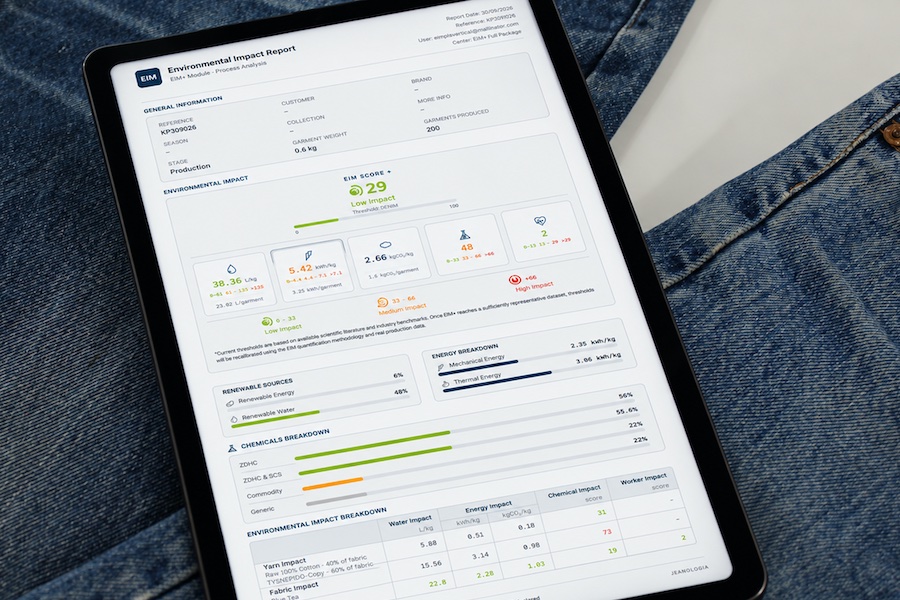
EIM (Environmental Impact Measurement), the global reference platform for measuring the environmental impact of garment finishing, presents the second edition of its annual report Denim Industry Progress & Insights 2025. The study analyses over 100,000 real denim finishing processes, providing an accurate and up-to-date view of the industry’s evolution towards more sustainable models.

#Recycling / Circular Economy

Europe’s textile future at a turning point: New 2030 Circularity Blueprint aims to scale recycling and unlock investment opportunities

The EU textile system is at a critical crossroads. Today, less than 1% of discarded garments are recycled into new garments, despite EU-wide obligations for separate collection. In response, Global Fashion Agenda (GFA) is launching the 2030 Circularity Blueprint, in partnership with ReHubs. This ambitious initiative is designed to support the transformation of the EU textile ecosystem to advance textile-to-textile recycling and drive the transition to a circular economy.

Latest News

#ITM 2026

New Monforts systems deliver round-the-clock production for Kipaş

As a valued Monforts customer for many years, Türkiye’s Kipaş Textile has just installed a new Thermex dyeing range and a Monfortex sanforizer at its new dyeing and finishing plant in Kahramanmaraş.

#ITM 2026

SHIMA SEIKI to show complete knitting and cutting workflow at ITM 2026

Leading computerized flat knitting technology provider SHIMA SEIKI MFG., LTD. of Wakayama, Japan, together with its Turkish representative TETAS IC VE DIS TICARET A.S., will participate in the ITM 2026 International Textile Machinery Exhibition in Istanbul, Türkiye this month with a full product lineup. In addition to flat knitting machines and design software, visitors will also have the opportunity to experience the full range of SHIMA SEIKI textile machinery with its automatic cutting machine exhibit, all geared toward the fashion apparel market as well as non-apparel related businesses.

#Raw Materials

Global Cotton area and production are projected to decline in the 2026/27 Season

The June 2026 issue of Cotton This Month projects a modest contraction in global cotton area, production, and trade during the 2026/27 season, reflecting weaker demand sentiment, rising production costs, and shifting environmental factors across major producing nations.

#Natural Fibers

European Flax-Linen & Hemp step into advanced manufacturing: Enabling filament winding, 3D printing and high-performance composite processes

The Alliance for European Flax-Linen & Hemp announces a new wave of technological advancements demonstrating how flax-linen and hemp fibres are now being successfully integrated into advanced composite manufacturing processes. These developments mark a transition beyond traditional hand lay-up techniques, positioning natural fibres as credible, scalable solutions for high-performance industrial applications.

TOP