[pageLogInLogOut]

#Sustainability

“Autoneum Pure.”: new sustainability label for products

Technologies with an excellent environmental performance throughout the entire product life cycle – that is what “Autoneum Pure.” stands for. In future, components that meet the highest standards in terms of sustainability and eco-friendliness can be identified at a glance under this label. This also includes the innovation “Mono-Liner” for wheelhouse outer liners.

As innovation leader in acoustic and thermal management, Autoneum continuously invests in the development and production of resource-saving components that make cars lighter and thus more climate-friendly. In view of an increasing sustainability awareness and the correspondingly greater information needs on environmentally-friendly vehicle components, the Company has now launched Autoneum Pure. The label determines particularly sustainable technologies, thereby guiding car manufacturers in product selection for future models.

Autoneum Pure is based on a comprehensive set of criteria assessing the sustainability performance of a product in all four phases of its life cycle: material procurement, production, use and end of life. For example, components with a high content of recyclable materials or those that achieve significant weight savings compared to comparable standard components qualify for the “Autoneum Pure.” label. Autoneum already offers various multifunctional technologies that meet the high standards for Autoneum Pure products: Ultra-Silent for underbody systems or battery undercovers, Di-Light for carpet systems, Prime-Light and IFP-R2 for inner dashes and floor insulators as well as Hybrid-Acoustics PET for e-motor encapsulations and engine-mounted parts, which was launched in fall 2019.


With Mono-Liner, the latest innovation for wheelhouse outer liners is also included in the Autoneum Pure portfolio. Among other things, the Mono-Liner-based components convince thanks to their lightweight construction, thereby contributing to lower vehicle weight with correspondingly less fuel consumption and emissions. The excellent life cycle assessment is also based on their particularly resource-saving manufacturing: Production cut offs of the components, which consist to a large extent of recycled PET fibers, can be processed into pellets and completely returned to the manufacturing process as fibers. An SUV and a crossover model from a US vehicle manufacturer already benefit from Mono-Liner wheelhouse outer liners.

Anahid Rickmann, Head of Corporate Communications & Responsibility, explains: “With Autoneum Pure we are the first automotive supplier to establish a sustainability label in the field of acoustic and thermal management. Autoneum Pure is part of the Company’s Advance Sustainability Strategy 2025 and sets industry standards in product communication.”

Detailed information on all Autoneum Pure products and the corresponding sustainability performance are available at https://pure.autoneum.com.



More News from TEXDATA International

#Texprocess 2026

Texprocess 2026: Automation, digitalisation and AI redefine textile processing

Making investment decisions in textile processing has become significantly more demanding. Increasing energy costs, a shortage of skilled labour and ongoing geopolitical uncertainties are compelling companies to focus on technologies that deliver clear gains in efficiency and process reliability. This applies equally to apparel manufacturing and to the processing of technical textiles and high-performance materials. As a result, modernisation initiatives are assessed more carefully – even as the need to upgrade production systems continues to intensify.

#Techtextil 2026

Techtextil 2026: Between innovation pressure & market reality

From 21 to 24 April 2026, Techtextil in Frankfurt am Main will once again become the central meeting point for the international technical textiles and nonwovens industry. Running in parallel, Texprocess will focus on the industrial implementation of textile processing technologies as the leading platform in this field. Together, the two trade fairs form a closely integrated presentation and working platform along the entire textile value chain – from material development to finished applications.

#Techtextil 2026

Between geopolitical pressure and industrial resilience

In this interview, Dr. Janpeter Horn (VDMA) discusses the current challenges facing textile machinery manufacturers, shaped by geopolitical tensions, regulatory developments and subdued investment. He also outlines why innovation strength, integrated solutions and strategic positioning remain key to global competitiveness.

#Texprocess 2026

Between investment restraint and modernization pressure

Texprocess 2026 takes place in a complex market environment shaped by uncertainty and innovation pressure. In this interview, Elgar Straub (VDMA) explains why the trade fair is particularly relevant this year and which technologies are driving efficiency and competitiveness.

More News on Sustainability

#Man-Made Fibers

The updated poster on biodegradable Polymers in various environments has been released

As part of the PerPlacsBio project, nova-Institute has updated its popular poster on the biodegradability of polymers in different environments. The updated version reflects current standards, certifications and the latest scientific findings. The poster can be used to assess biodegradable alternatives for use in agriculture and forestry, and it is now available in German for the first time.

#Sustainability

A new standard to combat plastic waste in forests

With DIN SPEC 35808 “Tree Shelter for Forestry Applications,” the testing and research service provider Hohenstein, in collaboration with Rottenburg University of Forestry, as well as forestry authorities and industry partners, has established a clear framework for bio-based and fully biodegradable tree shelters. The pre-standard defines requirements and practical testing methods designed to reduce plastic waste in forests and strengthen the long-term protection of soil and the environment.

#Denim

Denim moves towards sustainability

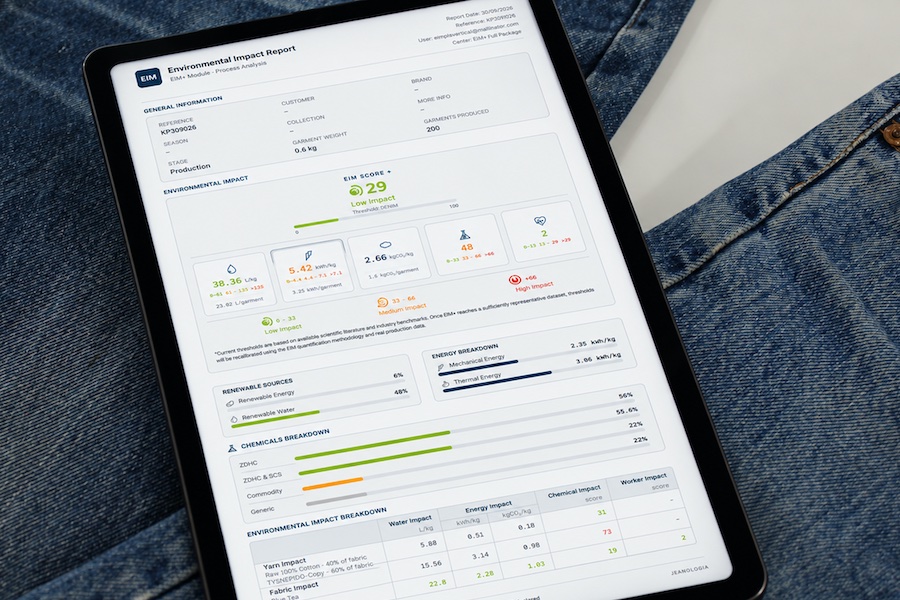
EIM (Environmental Impact Measurement), the global reference platform for measuring the environmental impact of garment finishing, presents the second edition of its annual report Denim Industry Progress & Insights 2025. The study analyses over 100,000 real denim finishing processes, providing an accurate and up-to-date view of the industry’s evolution towards more sustainable models.

#Recycling / Circular Economy

Europe’s textile future at a turning point: New 2030 Circularity Blueprint aims to scale recycling and unlock investment opportunities

The EU textile system is at a critical crossroads. Today, less than 1% of discarded garments are recycled into new garments, despite EU-wide obligations for separate collection. In response, Global Fashion Agenda (GFA) is launching the 2030 Circularity Blueprint, in partnership with ReHubs. This ambitious initiative is designed to support the transformation of the EU textile ecosystem to advance textile-to-textile recycling and drive the transition to a circular economy.

Latest News

#Technical Textiles

Fifteen years of Autoneum – From spin off to global technology leader

What started as a strategic carve‑out has since become the success story of a global technology leader in acoustic and thermal management solutions for vehicles. Headquartered in Winterthur, Switzerland, Autoneum supplies leading automobile manufacturers worldwide with innovative, lightweight and increasingly sustainable solutions.

#Textile chemistry

The CHT Group GmbH awarded Best Managed Company 2026

The CHT Group GmbH has been honored as Best Managed Company 2026. The seal of approval recognizes excellently managed medium-sized companies and is awarded as part of a program by Deloitte Private, UBS, the Frankfurter Allgemeine Zeitung, and the Federation of German Industries (BDI).

#Nonwoven machines

Kruger, Canada, orders first nonwovens line for sustainable wipes from ANDRITZ

International technology group ANDRITZ has received an order from newly established Kruger Nonwovens to deliver a complete WetlaceTM hybrid line for the Wayagamack mill in Trois-Rivières, Quebec, Canada. With this investment, pulp and paper producer Kruger is preparing to enter the nonwovens market with a new generation of plastic-free, chemical-free materials for sustainable wipes. The line is the first of its kind in Canada and is scheduled to start production in 2028.

#ITM 2026

Picanol to present its leading weaving technology at ITM 2026

Picanol is pleased to announce it will be participating in ITM 2026 in Istanbul. This is a key event for industry professionals to engage with the Turkish textile industry as well as the extensive international audience attending the fair. During the event, Picanol will present its latest innovations to the visitors in Hall 8, booth 802.

TOP