[pageLogInLogOut]

#Sustainability

Suominen is offering a wide range of sustainable nonwovens
(c) 2020 Suominen
Sustainability is a multidimensional issue, and different aspects of it are important to different customers. That is why Suominen has developed a wide offering of sustainable nonwovens that meet the different sustainability needs of their customers – and end users.

"Suominen’s vision is to be the frontrunner for nonwovens innovation and sustainability. We want to do our share in addressing the most topical global environmental concerns of our time, including scarcity of resources, climate change and marine plastic pollution. By constantly developing new and innovative solutions with a reduced environmental impact, we are able to provide a wide range of sustainable nonwovens for our customers", the company recently announced.

Innovation and sustainability are certainly nothing new for Suominen. Already ten years ago they launched the compostable and biodegradable BIOLACE® family of products produced solely from renewable raw materials. Since then, they have further developed and expanded their sustainable offering; the comprehensive Sustainable Product Portfolio was created in 2018.

Sustainability categories for Suominen’s nonwovens

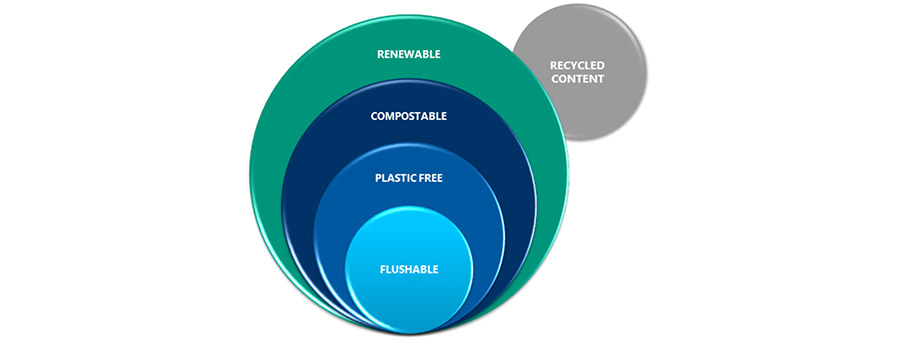
Suominen’s Sustainable Product Portfolio consists of products made from renewable, recycled and/or plastic-free raw materials as well as compostable and totally dispersible nonwovens. By offering solutions in these different sustainability categories, they can meet the varying sustainability-related needs of customers and end uses.


The sustainability categories

  • Recycled content means that the nonwoven contains at least 15% of recycled fibers, such as recycled post-consumer polyester, polypropylene or post-industrial cotton fibers.
  • Renewable means that all the raw materials used are from plant-based sources. We offer nonwovens made from a wide variety of renewable fibers, from biobased plastics to natural fibers.
  • Compostable nonwovens are produced by using fibers from renewable resources that are compostable in industrial composting process as defined by international compostability standards.
  • Plastic-free nonwovens contain raw materials made of biodegradable fibers of a natural origin, such as viscose, pulp and cotton.
  • Flushable products are biodegradable and dispersible in water and comply with or exceed the latest industry flushability standards.

"From our Sustainable Product Portfolio, our customers can choose the sustainability category that is most relevant to them and then decide which of the products in the category are most suitable for their end products. At the same time, we also have a number of sustainable nonwoven alternatives available for various end uses, including baby, household, hygiene, medical, personal care and workplace", the company announced.

More News from Suominen Corporation

#Nonwovens

Suominen launches three-year profitability improvement program and introduces new operating model and leadership team

Suominen is launching a three-year program to improve the company’s profitability. The Full Potential Program targets 10% EBITDA by 2028. Suominen is also introducing a new functional operating model, with a dedicated focus on customers and factories, designed to strengthen expertise and effectiveness.

#Nonwovens

Suominen reports weaker 2025 results amid market pressure and US supply incidents; no dividend proposed

Suominen Corporation has published its unaudited Financial Statements Release for January 1–December 31, 2025, describing the year as an “unsatisfactory performance in a challenging environment”. Net sales and profitability declined year-on-year, reflecting lower volumes, adverse currency effects and intensified competition, while the company points to two significant incidents at its US facilities that constrained supply and weighed on both sales and profitability in the third and fourth quarters.

#Nonwovens

Francois Guetat joins Suominen as COO

Francois Guetat brings over two decades of global experience in operations, supply chain, and manufacturing excellence. Most recently, he served as SVP of Integrated Supply Chain at Kalmar, where he led business across sourcing, manufacturing, logistics and strategy. His leadership has been shaped by 22 years at Volvo, where he held key roles in Sweden, USA, and Poland.

#Nonwovens / Technical Textiles

Suominen reports decline in sales and earnings – Cost savings program and leadership change to drive recovery

Finnish nonwovens manufacturer Suominen Corporation has reported a noticeable drop in both revenue and profitability for the first half of 2025, reflecting a challenging global trade environment, particularly the impact of recent U.S. tariffs, as well as persistently high energy and raw material costs.

More News on Sustainability

#Sustainability

Ying McGuire becomes new CEO of Cascale

Cascale today announced the appointment of Ying McGuire as Chief Executive Officer, effective June 1, 2026.

#Sustainability

VAUDE eliminates PFAS from all products

PFAS (per- and polyfluoroalkyl substances) are now detectable worldwide – in drinking water, soil and the human body. These so-called “forever chemicals” are considered hazardous to health and potentially carcinogenic, as they do not break down and remain in the environment permanently. Despite these risks, PFAS are still used in a wide range of products. More than 15 years ago, VAUDE made a strategic decision to gradually eliminate PFAS from all product categories.

#Sustainability

OEKO-TEX® chooses TextileGenesis to advance digital traceability for organic cotton

OEKO-TEX® today announced a full collaboration with TextileGenesis, a Lectra company, to digitally trace and authenticate organic cotton, strengthening fraud prevention across the supply chain. This announcement follows a successful pilot and brings together OEKO-TEX®’s certification expertise and closed testing system with TextileGenesis’ digital traceability platform to deliver a secure, end-to-end solution for managing certified organic cotton flows.

#Europe

ICAC to support European Commission on pending PEF legislation

The International Cotton Advisory Committee (ICAC) is proud to announce that it has been included as a member of the European Commission’s Technical Advisory Board (TAB) on the Product Environmental Footprint methodology. The Commission developed the Product Environmental Footprint (PEF) to assess and communicate the life cycle environmental performance of products and organizations.

Latest News

#Technical Textiles

Sustainable, lightweight, and sound absorbing: Polyester-based front trunk solution for BEVs

As car manufacturers look to further reduce their carbon footprint, Autoneum has developed an innovative front trunk solution for battery electric vehicles (BEVs), made entirely from polyester-based textile. The Ultra-Silent Frunk offers significant weight reduction, improved acoustic and thermal insulation, and uses up to 70 percent recycled material, supporting sustainable and efficient vehicle design. Autoneum, global technology leader in acoustic and thermal management for vehicles, has already received orders for the new frunk from three major OEMs in Asia and Europe to be built in three BEV models. Series production for two BEVs has been underway in China and Germany since last year.

#Raw Materials

Modern testing methods for raw cotton

The 38th International Cotton Conference Bremen will take place from 25 to 27 March 2026 at the Bremen Parliament. This conference has traditionally stood for in-depth expertise and international exchange. The program will focus on technical innovations, market trends, and regulatory frameworks across the entire value chain – from agriculture to the circular economy. With high-profile speakers, the conference is regarded as the key meeting point for the global cotton industry. Today’s focus: Cotton quality and testing methods.

#Spinning

Rieter responds to higher raw material prices

Global political and economic developments have been leading to rising raw material and energy costs for some time. The textile machinery industry is also affected by this trend. Rieter machines and components consist to a large extent of steel, copper, aluminum and electronics. These materials in particular have seen higher demand and higher prices in recent months.

#Weaving

Stäubli demonstrates how innovation translates into real benefits for weaving mills at SITEX 2026

One of India’s most prominent textile industry events, SITEX 2026, is held from February 21 to 23 in Surat. Committed to empowering Indian weaving mills with state‑of‑the‑art solutions tailored to regional needs, Stäubli will present a selection of solutions designed for performance, reliability, and power efficiency. Through its weaving preparation, cam and dobby shedding solutions and Jacquard technologies, Stäubli highlights its global expertise tailored to the specific needs of the local market.

TOP