#Sustainability
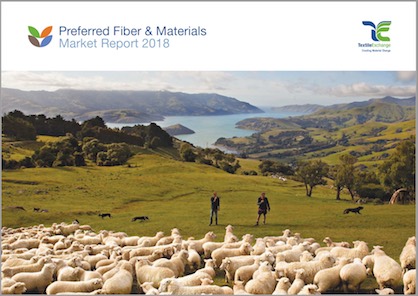
Textile Exchange releases 2018 Preferred Fiber and Materials Market Report
The collection includes two in-depth market reports (the Preferred Fiber & Materials Market Report and the Organic Cotton Market Report) both of which focus on the industry’s supply side, analyzing production volumes, availability and emerging fiber trends. The third report (the Preferred Fiber & Materials Benchmark Insights Report) tracks brand-driven demand, measuring usage of preferred fibers and materials among participating brands and retailers, and analyzing strategies implemented by the companies to continue increasing the adoption of more sustainable fibers.
Overall, the reports—released at the organization’s annual conference this week in Milan, where 800 apparel and textile leaders have gathered to discuss the industry’s sustainability challenges and opportunities—found that some of the world’s most renowned apparel brands and retailers are leading users of preferred fibers and materials, managing ever-expanding preferred fiber portfolios while production on the industry’s supply side grows steadily and drives innovation with new alternative fiber sources.
WHO ARE THE LEADERS?
Among the 111 textile and apparel companies that participated in the Benchmark Insights report—a 17% increase in participants over 2017’s report—H&M ranked as the top user of preferred cotton, preferred down, preferred man-made cellulosics and Lyocell.
“The Textile Exchange Preferred Fiber Benchmark is a great example of driving industry-wide, credible increases in the use of preferred fibers, with traceability from raw material to final product,” said Mattias Bodin, Sustainability Business Expert, Materials & Innovation at H&M. “We use the benchmark and market reports for industry insights and as support in driving traceability initiatives.”
Meanwhile, Nike topped the list of recycled polyester users, C&A lead on organic cotton usage, IKEA ranked as the biggest user of recycled cotton,and Deckers Brands, the makers of UGG, is the top user of preferred wool. Others that placed in the top 10 lists—which are called “Leaderboards”— include: Inditex, the company behind Zara (second largest user of Lyocell and fourth largest user of preferred manmade cellulosics); Target (third largest user of recycled polyester and fifth largest user of preferred down); and The North Face (second largest user of preferred down.)
“The 2018 benchmark leaders show a deep commitment to scaling their global value chains of preferred fibers and to benchmarking their progress against the industry,” said Liesl Truscott, Director of Europe and Materials Strategy for Textile Exchange. “These companies have also made significant investments in developing the supply chain needed to achieve the necessary measures of scale in preferred fiber production. And we are particularly excited about the growth of the 100% club, those who have converted completely from conventional fibers.”
NEW TO THE BENCHMARK REPORT
This year’s Benchmark report introduces the Leaders Circle, highlighting examples of companies developing strategies beyond usage volume to identify best practices in ensuring fiber integrity and responsible sourcing of their preferred fibers. It features brands and retailers of different sizes and sectors including Patagonia, the popular sportswear brand, as well as giants like C&A, H&M and Tchibo, and others such as Loomstate and MetaWear. Together, the 15 companies in the Leaders Circle represent great examples of emerging best practices for certain fiber categories. (While this year’s leaders were identified using the Benchmark report’s existing criteria, next year that criteria will undergo review and may expand for future reports.)
“As a brand that is purpose-driven and committed to sustainability, we use the Preferred Fiber and Materials annual surveys to benchmark our fiber use and practices against the industry, and gain insights into our internal operations and processes surrounding preferred materials,” said Katina Boutis, Sustainability Director of Loomstate. “The Benchmark insights are an invaluable resource for understanding the global systems impacting these fibers.”
Also new this is year, the report establishes The Founders Club, which includes the 43 brands that have participated in the Benchmark for three consecutive years and who have performed better than average in terms of accelerating use of preferred fibers and materials.
“We have found that companies using our benchmarking data are able to accelerate their progress because the data better informs their decisions and understanding of their position in the marketplace,” said LaRhea Pepper, Managing Director for Textile Exchange.
GROWTH STEADY. DISRUPTION AROUND THE CORNER.
Such continued commitment on behalf of brands and retailers to accelerate usage of preferred fibers and materials is set against the backdrop of a supply side where growth is steady if somewhat slow, but where innovation is poised to disrupt traditional fiber sources. The report found that Lyocell production increased to 4.5% of all man-made cellulosics, up from 3% in 2016, and recycled polyester held steady at about 14% of total polyester fiber production while preferred cottons (which include organic and Better Cotton Initiative) remained 19% of total virgin cotton production.
The Organic Cotton Market Report showed global organic cotton production grew 10% over the prior year, with the largest volumes coming from India, China, Turkey and Kyrgyzstan. While organic still occupies less than 1% of global cotton production, many countries have growth in the double-digits: Senegal increased by 427%; Brazil by 155%; Uganda by 155%; Benin by 72%; Egypt by 70.3%; China by 52%; and Tanzania by 17%. Paving the way for continued growth are substantial areas of land in transition to organic (a potential increase of 50% over existing hectares) a three-year process to reach certification by farming organically and meeting the required standards.
The call for more organic production is being answered by brands, which are increasingly setting targets and committing to investing in organic cotton. This year’s Benchmark showed that 96% of the 92 companies reporting on organic cotton use have set targets for uptake—a 20% growth over 2017 reporting.
In addition, the report revealed that increased innovation in alternative feedstocks, including bio-based, and recycled content, is certain to bring disruption to traditional fiber sectors. For example, man-made cellulosics saw exciting new category entrants from RefibraTM, NaiaTM and Orange Fiber. And in biosynthetics, biobased polyester, nylon and spidersilk represent emerging fibers, which are being pioneered by Fulgar’s EVO®, and Bolt Threads’ Microsilk. In addition, the number of leather alternatives is growing considerably with Modern Meadow’s ZoaTM, Apple Peel Skin and Vegea gaining traction.
All three reports, produced by Textile Exchange through the generous support of members, are freely available at the following links:
2018 Preferred Fiber & Materials Benchmark
2018 Preferred Fiber & Materials Market Report
2018 Organic Cotton Market Report
https://textileexchange.org/publications/