[pageLogInLogOut]

#Spinning

Less waste with the Smart Factory
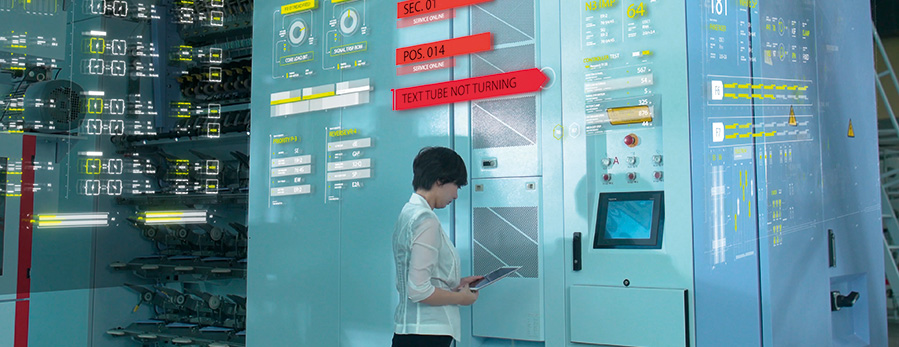
In the smart factory, all process steps are digitally networked. This increases process reliability and allows early corrective intervention in the production process in case of anomalies. © 2020 Oerlikon
A typical manmade fiber system produces well over 600 tons of yarn a day. This equals in around 700 winders in filament yarn production or 3 systems in staple fiber production. These figures show just how important smooth production processes are.

Oerlikon Manmade Fibers goes digital

If an error creeps into the process at any point, the daily waste increases dramatically. It is obvious that all yarn manufacturers want to prevent this happening to ensure their production facilities operate efficiently. Here, digitalization provides invaluable support. A Smart Factory that networks all steps within the production chain – including all auxiliary processes – identifies and reports quality deviations at an early stage. Yarn manufacturers can quickly intervene in the production process and hence avoid generating waste.

Digital solutions ensures process reliability

And the Smart Factory is also the focus of Oerlikon Manmade Fibers. Here, it comprises considerably more than the Plant Operation Center, a system that has been well-established within the market for many years now. “This is about absolute transparency and traceability. At the end of the process, yarn manufacturers are able to track at which position its finished textured yarn packages were spun and even have information on the processed granulate and the specific production conditions”, comments Ivan Gallo, responsible for digital products at Oerlikon Manmade Fiber. In this way, the Smart Factory ensures process reliability, above all. The data are automatically entered into the system and the product assessed at each stage of yarn production at which values and data are recorded – such as during visual inspection and when weighing. In the event of anomalies in the intermediate laboratory and quality checks, this allows yarn producers to intervene in the production process and correct these anomalies.

Information on the chip feeding, on the drying and on the masterbatch are available, as are data on the climate control, on the compressed air supply and on further auxiliary systems. With this, yarn manufacturers have at all times a complete overview of the ongoing production process, including comprehensive information on quality and production costs.


As a total solution provider, the Manmade Fibers segment of the Oerlikon Group rounds off its Smart Factory concept with the associated services: Operation, updates, further development of the software and services are part of the scope of services.

“Digitalization has long been part of our everyday lives. Here, COVID-19 has merely acted as an accelerator. Particularly over the last few months, we have tried out so many things, learned a lot from our mistakes and have taken a giant step forward. The intelligent factory is no longer a vision, it has long become reality. Digital solutions have become fixed elements of our products and services – and everything is inextricably linked. But we have not reached the end of this exciting development by a long way yet: new technologies and solutions require new methods and new knowledge. In other words, we have to remain ‘agile’, constantly adapting to the changing situations and tasks at hand”, states Oerlikon Manmade Fibers Segment CTO Jochen Adler.
More News from Oerlikon Textile GmbH & Co. KG

#Nonwovens / Technical Textiles

Crimper repair workshop begins operations

Since the beginning of the year, Oerlikon Textile Inc. has been offering a crimper repair service, making it the company's first location worldwide to do so. The workshop in Charlotte specializes primarily in Fleissner and Neumag crimpers.

#Spinning

Oerlikon Manmade Fibers Solutions hosted successful Technology Day 2025 in India

Oerlikon Manmade Fibers Solutions recently hosted its highly anticipated Innovation and Technology Day at the Deltin Hotel in Daman by end of January 2025. The event attracted over 300 participants, including industry experts, partners, and stakeholders, who gathered to explore the latest advancements and trends in the manmade fibers industry in India.

#Spinning

Industrial yarn producer sees growth potential in tire cord sector

The Chinese Junma Group has expanded its HMLS capacities by 20 positions, hence becoming one of the largest tire cord manufacturers in China. At present, the company has 64 positions of HMLS systems, all of which are from Oerlikon Barmag.

#Spinning

Oerlikon reports third quarter 2024 results, highlights strong execution in a challenging market landscape

In the third quarter of 2024, Oerlikon reported a stable operational Group EBITDA margin, despite challenging market conditions, thanks to a focus on pricing, cost management, and efficiency across both divisions. Group order intake saw a 4% year-over-year decline at constant FX, attributed to temporary market softness in Surface Solutions, while orders in Polymer Processing Solutions showed signs of stabilization.

More News on Spinning

#Spinning

Rieter responds to higher raw material prices

Global political and economic developments have been leading to rising raw material and energy costs for some time. The textile machinery industry is also affected by this trend. Rieter machines and components consist to a large extent of steel, copper, aluminum and electronics. These materials in particular have seen higher demand and higher prices in recent months.

#ITM 2026

The hub of smart and sustainable transformation in yarn technologies: ITM 2026

With global fiber production projected to reach 169 million tons by 2030, yarn manufacturing is becoming one of the most strategic fields within the textile machinery industry. Located in Halls 6, 7, and 10, the Yarn Hall at ITM 2026 is set to bring together industry professionals with innovative solutions developed around automation, energy efficiency, digitalization, and circular production.

#Spinning

Barmag: DTY efficiency for the future of fancy yarns

Fancy yarns continue to gain importance in the textile market: Whether in fashion, home textiles or the automotive industry - the trend towards individuality is fueling the demand for textured, haptically differentiated and at the same time comfortable yarns.”

#Spinning

Perfect quality through collaboration: Machinery from Trützschler, Toyota and Murata at Zirve Tekstil

In today’s textile industry, excellence is not achieved by chance – it’s the result of deliberate decisions, technical expertise, and the courage to go beyond conventional paths. The Turkish company Zirve Tekstil has done just that: by combining the best technologies from Trützschler, Toyota and Murata, they’ve created a production setup that delivers outstanding yarn quality – recognized worldwide.

Latest News

#Sustainability

Ying McGuire becomes new CEO of Cascale

Cascale today announced the appointment of Ying McGuire as Chief Executive Officer, effective June 1, 2026.

#Technical Textiles

Sustainable, lightweight, and sound absorbing: Polyester-based front trunk solution for BEVs

As car manufacturers look to further reduce their carbon footprint, Autoneum has developed an innovative front trunk solution for battery electric vehicles (BEVs), made entirely from polyester-based textile. The Ultra-Silent Frunk offers significant weight reduction, improved acoustic and thermal insulation, and uses up to 70 percent recycled material, supporting sustainable and efficient vehicle design. Autoneum, global technology leader in acoustic and thermal management for vehicles, has already received orders for the new frunk from three major OEMs in Asia and Europe to be built in three BEV models. Series production for two BEVs has been underway in China and Germany since last year.

#Raw Materials

Modern testing methods for raw cotton

The 38th International Cotton Conference Bremen will take place from 25 to 27 March 2026 at the Bremen Parliament. This conference has traditionally stood for in-depth expertise and international exchange. The program will focus on technical innovations, market trends, and regulatory frameworks across the entire value chain – from agriculture to the circular economy. With high-profile speakers, the conference is regarded as the key meeting point for the global cotton industry. Today’s focus: Cotton quality and testing methods.

#Weaving

Stäubli demonstrates how innovation translates into real benefits for weaving mills at SITEX 2026

One of India’s most prominent textile industry events, SITEX 2026, is held from February 21 to 23 in Surat. Committed to empowering Indian weaving mills with state‑of‑the‑art solutions tailored to regional needs, Stäubli will present a selection of solutions designed for performance, reliability, and power efficiency. Through its weaving preparation, cam and dobby shedding solutions and Jacquard technologies, Stäubli highlights its global expertise tailored to the specific needs of the local market.

TOP