[pageLogInLogOut]

#Recycling / Circular Economy

PRSA 2024: trinamiX presents their portfolio of versatile plastic and textile identification solutions to the Southeast-Asian market
trinamiX GmbH, a leading provider of mobile spectroscopy solutions and subsidiary of BASF, will join the inaugural PRSA, the Plastics Recycling Show Asia 2024 in Singapore, to showcase their versatile plastics and textile identification technology to the Southeast-Asian market. From designing plastics packaging that is sortable, to quality control for in- and outgoing plastics, to cleaner sorting for improved recycling; mobile identification of plastic and textile types adds benefits across the supply chain. Visitors to PRSA can experience the trinamiX Mobile NIR Spectroscopy Solution at trinamiX booth #L44 from November 13-14, 2024.
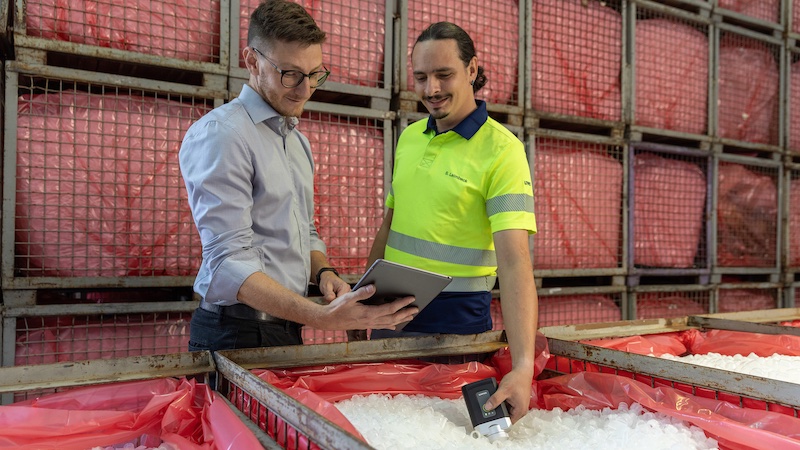
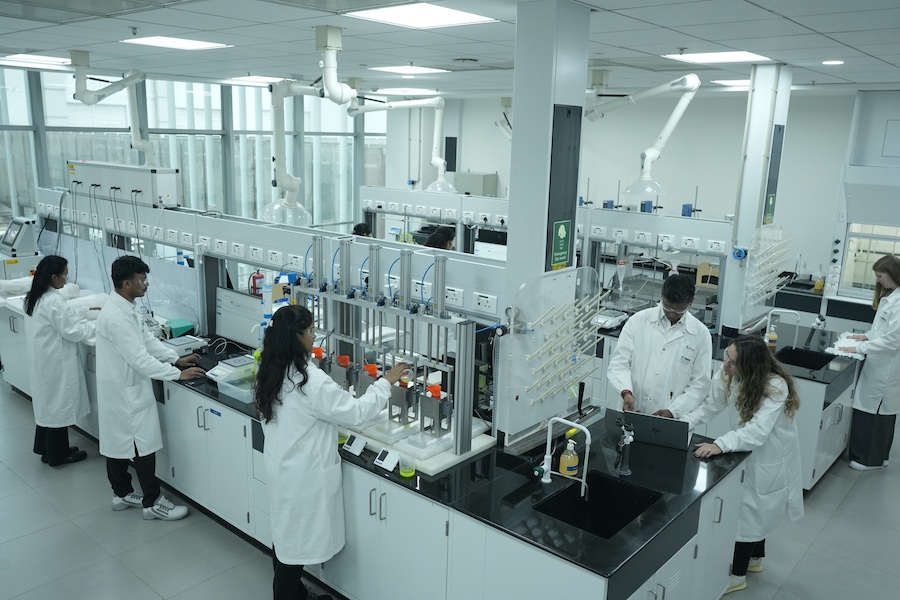
On-the-spot identification and quality control of plastics with trinamiX Mobile NIR Spectroscopy Solutions © 2024 trinamiX GmbH


Adrian Vogel, Segment Lead Circular Economy at trinamiX GmbH, will give a talk about “How mobile NIR technology and smart data management can help in improving the waste management process” on November 13, 2024, at 04:35 pm at the PRS Asia conference. He is sharing insights about the growing demand for recycled plastics and how accessible identification technology and smart data management can help fulfill this demand. “I am looking forward to demonstrating how these advancements can not only improve recycling in areas that are lacking waste management infrastructure but also create economic opportunities for waste pickers and recyclers alike”, says Adrian Vogel.

trinamiX Mobile NIR (Near-Infrared) Spectroscopy Solutions: Accessible plastic identification

trinamiX enables flexible identification of plastics and textiles at the push of a button. The solution consists of a robust, mobile NIR spectrometer, an easy-to-use app backed by advanced cloud data analysis and a customer portal to manage results, download reports, and export data.

The plastic identification solution can reliably identify over 30 types of plastics including consumer plastics like HDPE, LDPE, PP, PET, PS, PVC as well as engineering plastics like PA, ABS, PC, PLA and quantify blends of PE and PP.

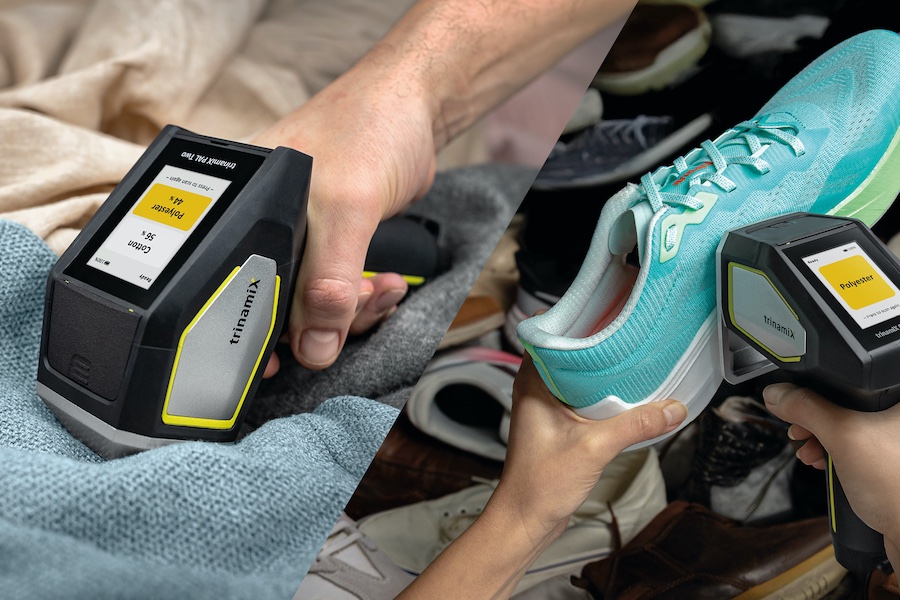
In textile identification, a wide range of fiber materials like acrylic, cotton, elastane, polyamide and its subclasses PA 6 and PA 6.6, polyester, polypropylene, silk, viscose and wool can be detected. In addition, textiles that are made from more than one material can also be analyzed.

To fulfill the specific requirement of recyclers, trinamiX offers a versatile solution that combines the advantages of multiple setups: Whether it is a handheld device that fits into a user's pocket for quick checks, or a semi-automated setup which can be integrated into a sorting table with a sensor for automatically triggered scans.

Hard-to-differentiate plastics and textiles: multi-material films, PE/PP, compostable plastics and PA 6/PA 6.6

Hard-to-differentiate plastics and textiles, such as multi-material films and blends of polyethylene (PE) and polypropylene (PP), pose significant challenges in recycling due to their mixed compositions. Compostable plastics, while environmentally friendly, can complicate sorting processes, especially when they resemble conventional plastics. Polyamides like PA 6 and PA 6.6 are often difficult to separate and recycle, further complicating waste management efforts. The sophisticated models of trinamiX Mobile NIR Spectroscopy Solution have been trained to identify all those materials, helping to close the loop on these materials as well.

Mobile quality control along the manufacturing and recycling process

Quality management in plastic production and recycling facilities is essential for producing high-quality products. A key element for efficient recycling of plastics is the sorting of mixed plastic waste into pure waste streams, as impurities can compromise the quality and integrity of the recycled products. From checking incoming materials to approving bales of sorted plastics or textiles, trinamiX makes quality control simple and easy. It also supports non-conformance management and the efficient management of complaints, reducing the risk of costly errors and delays.

trinamiX’s solutions not only enable companies to perform spot checks, but also to comprehensively document incoming and outgoing material flows, visualize and analyze them, thus creating comprehensive transparency for manufacturers and recyclers of plastics.

Design for recyclability

Packaging design has a significant impact on a product’s sortability, and therefore recyclability. If a container cannot be identified properly by NIR, it has high probability of ending up in a landfill. Packaging features like color, labels, additives and more can impact a packages ability to be identified. With trinamiX, brands can assess the impact of these features to provide insight into product recyclability early in the design process. By designing packaging with recyclability in mind, manufacturers can help to reduce the amount of plastic waste that ends up in landfills. This is a crucial step towards creating a more sustainable and circular economy. 

Upcoming hardware expansion: trinamiX PAL Two

trinamiX will be presenting a new hardware for their Mobile NIR Spectroscopy Solutions at PRSA: the handheld spectrometer trinamiX PAL Two will be showcased with live demonstrations. The new hardware features an ergonomic design and can be operated single-handed. It has a built-in display to show measurement results directly on the device.

More information: www.trinamiXsensing.com


More News from BASF Aktiengesellschaft
Performance Chemicals for Textiles Europe

#Textile chemistry

A flagship for chemical production: BASF inaugurates world-scale Verbund site in China

BASF today (March 26, 2026) celebrated the official inauguration of its newly built, world-scale Verbund site in Zhanjiang, Guangdong Province in southern China. Covering an area of around four square kilometers, it is more than a major BASF project in the chemical growth market of China. “Zhanjiang shows what the future of chemistry looks like: efficient, digital and sustainable by design. The site showcases a smart integrated Verbund structure on an industrial scale,” said Dr. Markus Kamieth, CEO of BASF, at the ceremony attended by representatives from government, customers, business partners and employees.

#Recycling / Circular Economy

trinamiX with new management

BASF is examining strategic options for its subsidiary trinamiX GmbH. trinamiX specializes in biometric imaging and mobile material analysis. These activities are not part of BASF’s core business, on which the company is focusing as part of the implementation of its new strategy.

#Research & Development

How innovations drive BASF’s success

“Innovation has always been part of BASF’s DNA. Especially in these volatile times, it is crucial to leverage our innovative strength to develop competitive solutions that differentiate us as a company in our markets and give us a competitive edge,” said Dr. Stephan Kothrade, Member of the Board of Executive Directors of BASF and Chief Technology Officer, at the company’s Research Press Briefing held today. To achieve this, BASF implemented its “Winning Ways” strategy about a year ago with the clear goal of becoming the preferred chemical company to enable its customers’ green transformation.

#Nonwovens

Turning diaper waste into new value: BASF, Essity and TU Wien pioneer circular solutions

BASF, one of the world’s leading chemical companies and manufacturer of superabsorbent polymers (SAP), and Essity, a global leading hygiene and health company, joined forces together with the Technical University of Wien to revolutionize recycling of absorbent hygiene products (AHP).

More News on Recycling / Circular Economy

#Recycled Fibers

RE&UP partners with Madewell and ISKO on textile-to-textile denim capsule

RE&UP Recycling Technologies is accelerating the shift toward a closed-loop textile economy through a collaboration with American denim brand Madewell and global fabric manufacturer ISKO. By transforming approximately 20,000 pairs of post-consumer jeans into recycled feedstock for a textile-to-textile denim capsule, RE&UP demonstrates the commercial viability of circular systems in the denim sector.

#Recycled Fibers

Syre and JEPLAN Announce Strategic Partnership to Accelerate Textile-to-Textile Recycling

JEPLAN, INC. the Japanese pioneer developing and operating chemical recycling technologies for circularity in packaging and textiles, and Syre, the textile impact company on a mission to hyperscale textile-to-textile recycling, announced today a strategic partnership. Together, the companies aim to extensively accelerate the timeline towards commercialization of next generation textile-to-textile polyester recycling technology.

#Recycling / Circular Economy

Reju secures €135 Million in Dutch NIKI Funding for industrial-scale textile-to-textile regeneration hub at Chemelot Industrial Park, the Netherlands

Reju™, the progressive textile-to-textile regeneration company, has been awarded €135 million in funding under the Netherlands’ Nationale Investeringsregeling Klimaatprojecten Industrie (NIKI) program. The funding will support Reju’s planned industrial-scale Regeneration Hub at Chemelot Industrial Park in Sittard-Geleen, covering both the investment phase and ongoing operations, and represents a critical milestone on the path toward final investment decision.

#Recycling / Circular Economy

eeden is now a Canopy partner

eeden is committed to enable circular textiles by developing recycling technologies that turn textile waste into valuable raw materials. But the commitment goes further – eeden advocates for supply chain solutions that uphold responsible environmental and ethical standards, protecting global ecosystems including Ancient and Endangered Forests.

Latest News

#Techtextil 2026

Sedo Treepoint will exhibit smart technologies for technical textile production

As technical textile production becomes increasingly complex and sustainability requirements intensify, digital integration is evolving from an efficiency tool into a strategic task. At Techtextil 2026 (April 21–24, Frankfurt am Main), Sedo Treepoint will present smart digital systems designed to address the demanding production environments of technical textile manufacturing. The company’s focus will be on practical technologies that enhance process transparency, reproducibility, and efficient resource use. Visitors will meet Sedo Treepoint in Hall 12, Booth D05.

#Techtextil 2026

ITM presents cutting-edge textile research at Techtextil

From April 21 to 24, 2026, the Chair of Textile Machinery and High Performance Material Technology (ITM) at TUD Dresden University of Technology will be presenting its current research at Techtextil, the leading international trade fair for technical textiles and nonwovens. In Hall 12.0, Stand D41, the team will be demonstrating how it combines high-performance fibers, AI-supported digital development tools and innovative machine technologies to develop textile solutions for lightweight construction, construction, medical technology and sustainable production from atom to product.

#Techtextil 2026

CHT Group to showcase intelligent specialty chemical solutions at Techtextil 2026

At this year's Techtextil 2026 in Frankfurt am Main, the CHT Group will be presenting its comprehensive portfolio of tailor-made specialty chemicals and process solutions for technical textiles. As a reliable partner to the global textile industry, the company offers innovative products and in-depth technical expertise across all areas of the textile value chain – from pretreatment, dyeing, and printing to finishing, coating, and fiber auxiliaries.

#Associations

Results of the 37th ITMF Global Textile Industry Survey

The International Textile Manufacturers Federation (ITMF) released findings from its 37th Global Textile Industry Survey (GTIS), conducted in March sharing how regions and segments are impacted by the latest geopolitical disruptions.

TOP