[pageLogInLogOut]

#Recycling / Circular Economy

CARBIOS and Nouvelles Fibres Textiles cooperate to develop the French polyester textile recycling industry

CARBIOS, (Euronext Growth Paris : ALCRB), a pioneer in the development and industrialization of biological technologies to reinvent the life cycle of plastic and textiles, and Nouvelles Fibres Textiles, a French company specializing in the recovery of end-of-life textiles, today announce the signing of a Memorandum of Understanding to establish a contract for the supply of polyester textiles to the world's first PET biorecycling plant currently under construction in Longlaville, France.

The polyester textiles supplied will come from used or end-of-life textiles prepared in France by Nouvelles Fibres Textiles for recycling using CARBIOS' enzymatic depolymerization technology. This contract will enable 5,000 tons a year of these textiles to be redirected towards biorecycling from 2026 onwards, over an initial 5-year period, demonstrating the commitment of industrial players all along the value chain to achieving textile circularity for a more sustainable textile sector.

Nouvelles Fibres Textiles and its various partners opened a unique semi-industrial site with an annual capacity of 1,000 tons in November 2023, the first step towards building a 20,000-to-30,000-ton unit in 2026. This first site, a research center for textile recycling, combines the know-how of Andritz Laroche (world leader in textile recycling), Pellenc ST (French leader in intelligent sorting solutions), Synergie TLC (major French player in collection and first sorting for solidarity) and the Tissages de Charlieu group (major French player in weaving, garment manufacturing and textile recycling). This unit transforms used textiles into high-quality raw materials, supplying the various industries that use textile fibers (non-wovens, insulation, plastic, textiles, etc.) by automatically sorting them by composition, while eliminating hard points (buttons, zips, patches, etc.). 

CARBIOS' biorecycling technology uses enzymes to break down polyester fibers into their basic components. These components are then used to produce high-quality recycled PET materials, such as fibers for the textile industry. This “fiber-to-fiber” solution will enable polyester to become a truly circular fiber on a large scale.
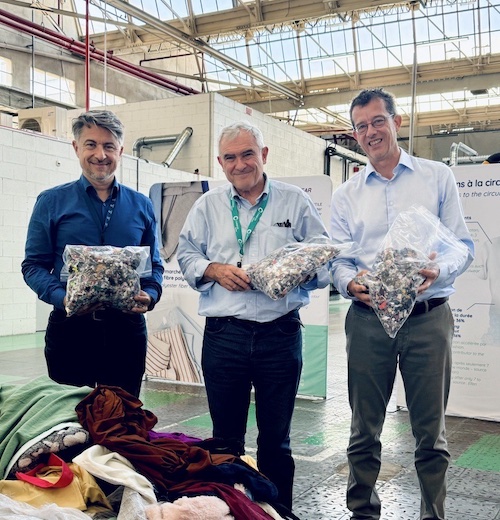
CARBIOS X Nouvelles Fibres Textiles<br />
(L-R) Emmanuel Ladent (CEO, CARBIOS), Eric Boël (Co-director of Nouvelles Fibres Textiles) and Mathieu Berthoud (Strategic Sourcing Director, CARBIOS) © 2024 CARBIOS
CARBIOS X Nouvelles Fibres Textiles (L-R) Emmanuel Ladent (CEO, CARBIOS), Eric Boël (Co-director of Nouvelles Fibres Textiles) and Mathieu Berthoud (Strategic Sourcing Director, CARBIOS) © 2024 CARBIOS


"CARBIOS is known as a biotech company, but we're also a player in the textile industry. We actively collaborate with innovative companies like Nouvelles Fibres Textiles to create a truly circular economy for textiles. As demonstrated in the packaging sector, the introduction of large-scale polyester recycling solutions will catalyze the structuring of collection and preparation infrastructures. Together, Nouvelles Fibres Textiles and CARBIOS demonstrate that the French industry continues to develop, thanks to the complementarity between the various links in the value chain, from collection and preparation to recycling", states Emmanuel Ladent, CEO of CARBIOS.

Eric Boël and Etienne Wiroth, Co-directors of Nouvelles Fibres Textiles, say: "The textile industry represents all the excesses of our over-consumption. One of the most ecologically, economically and socially effective responses is the circular economy, because it preserves resources and boosts industrial sovereignty and local employment. But the extraordinary variety of textiles is holding back large-scale deployment. New technologies, such as CARBIOS' enzymatic depolymerization and automated sorting by composition, are overcoming this obstacle. Above all, the links forged between the companies involved in this new circular value chain are helping to make this sector emblematic of an industry that does good for people and the planet, from producer to consumer."

France, a pioneer and European leader in the quest for textile circularity

Thanks to legislative initiatives such as the AGEC[1] (Anti-Waste for a Circular Economy) and “Climat et Résilience[2]” (Climate and Resilience) laws, support from ADEME[3], the Refashion eco-organization, and committed companies contributing to industrial sovereignty by combining innovation, ecological transition, “Made in France” and growth, France is today at the forefront of accelerating a circular economy for textiles.

At European Union level, separate collection of textile waste will be mandatory in member states from 1 January 2025. The European Union's strategy for sustainable and circular textiles aims to ensure that, by 2030, textile products are largely made from recycled fibers, and that incineration and landfill are reduced to a minimum[4].


[1] https://www.ecologie.gouv.fr/loi-anti-gaspillage-economie-circulaire

[2] https://www.ecologie.gouv.fr/actualites/loi-climat-resilience-bilan-2-ans

[3] The French Environment and Energy Management Agency (Agence de l'environnement et de la maîtrise de l'énergie)

[4] https://ec.europa.eu/commission/presscorner/detail/fr/qanda_22_2015



More News from CARBIOS

#Recycled_Fibers

CARBIOS and Wankai sign strategic PET biorecycling pact

CARBIOS (Euronext Growth Paris: ALCRB) and Wankai New Materials (“Wankai”), a listed subsidiary of Zhink Group, the 3rd largest PET producer in China and 4th worldwide, announce the signing of the definitive agreement establishing a strategic partnership for the industrial rollout of CARBIOS’s PET biorecycling technology in Asia. The first milestone will be the construction of a PET biorecycling plant in China.

#Recycled_Fibers

CARBIOS and Wankai plan 1 million tonnes of PET biorecycling capacity in Asia

CARBIOS and Wankai New Materials, a subsidiary of Zhink Group, are committed to the large-scale deployment of CARBIOS’ PET biorecycling technology in Asia, with the first step being the construction of a PET biorecycling plant in China.

#Recycling / Circular Economy

CARBIOS presents its 2025 half-year results and confirms its objective to build a PET biorecycling plant, with a revised timeline

CARBIOS (Euronext Growth Paris: ALCRB), a pioneer in the development and industrialization of biological technologies aimed at reinventing the lifecycle of plastics and textiles, today announces its 2025 half-year results and confirms its objective to build a PET biorecycling plant in Longlaville, with a revised timeline.

#Recycling / Circular Economy

CARBIOS enters the r-PET market for tire textile filaments

CARBIOS (Euronext Growth Paris: ALCRB) announces the signing of a multi-year commercial agreement with Indorama Ventures, the global leader in PET production. This agreement covers the supply of biorecycled monomers from its Longlaville plant, which will be transformed into r-PET filaments by Indorama Ventures and then integrated by Michelin into the manufacturing of its tires.

More News on Recycling / Circular Economy

#Europe

New EU rules to stop the destruction of unsold clothes and shoes

The European Commission today (Feb 9) adopted new measures under the Ecodesign for Sustainable Products Regulation (ESPR) to prevent the destruction of unsold apparel, clothing, accessories and footwear.

#Recycling / Circular Economy

Sahil Kaushik appointed CEO of Infinited Fiber as the company advances a phased path to commercial scale

Infinited Fiber has appointed Sahil Kaushik as Chief Executive Officer. Kaushik has served as Acting CEO alongside his role as Chief Operating Officer and will continue to oversee operations until a new COO is appointed.

#Recycling / Circular Economy

trinamiX with new management

BASF is examining strategic options for its subsidiary trinamiX GmbH. trinamiX specializes in biometric imaging and mobile material analysis. These activities are not part of BASF’s core business, on which the company is focusing as part of the implementation of its new strategy.

#Recycling / Circular Economy

Reju announces site selection for first U.S. industrial sized facility regeneration hub in Rochester, New York

Reju, the textile-to-textile regeneration company, today announced it has selected the site for its first U.S.-based industrial facility marking a significant milestone in its efforts to scale globally. This future Regeneration Hub will be in Rochester, New York, reinforcing Reju’s commitment to the adoption of circular textile system across key regions worldwide.

Latest News

#Sustainability

Ying McGuire becomes new CEO of Cascale

Cascale today announced the appointment of Ying McGuire as Chief Executive Officer, effective June 1, 2026.

#Technical Textiles

Sustainable, lightweight, and sound absorbing: Polyester-based front trunk solution for BEVs

As car manufacturers look to further reduce their carbon footprint, Autoneum has developed an innovative front trunk solution for battery electric vehicles (BEVs), made entirely from polyester-based textile. The Ultra-Silent Frunk offers significant weight reduction, improved acoustic and thermal insulation, and uses up to 70 percent recycled material, supporting sustainable and efficient vehicle design. Autoneum, global technology leader in acoustic and thermal management for vehicles, has already received orders for the new frunk from three major OEMs in Asia and Europe to be built in three BEV models. Series production for two BEVs has been underway in China and Germany since last year.

#Raw Materials

Modern testing methods for raw cotton

The 38th International Cotton Conference Bremen will take place from 25 to 27 March 2026 at the Bremen Parliament. This conference has traditionally stood for in-depth expertise and international exchange. The program will focus on technical innovations, market trends, and regulatory frameworks across the entire value chain – from agriculture to the circular economy. With high-profile speakers, the conference is regarded as the key meeting point for the global cotton industry. Today’s focus: Cotton quality and testing methods.

#Spinning

Rieter responds to higher raw material prices

Global political and economic developments have been leading to rising raw material and energy costs for some time. The textile machinery industry is also affected by this trend. Rieter machines and components consist to a large extent of steel, copper, aluminum and electronics. These materials in particular have seen higher demand and higher prices in recent months.

TOP