[pageLogInLogOut]

#Recycling / Circular Economy

First automated textile waste sorting and recycling line in France inaugurated
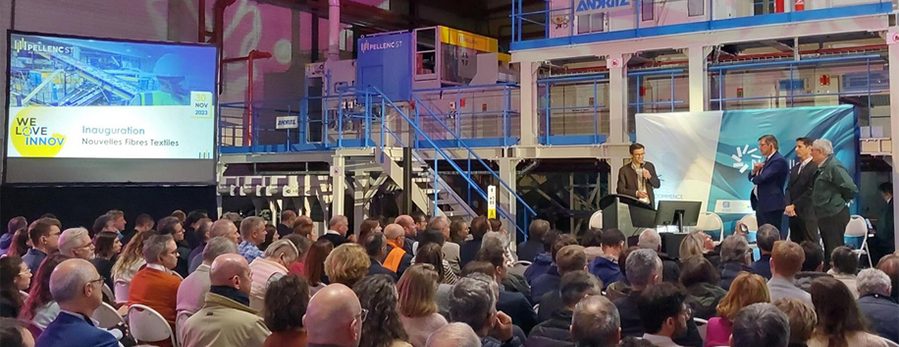
Inauguration of automated textile waste sorting and recycling plant at Nouvelles Fibres Textiles © ANDRITZ
Partnership between Nouvelles Fibres Textiles, Pellenc ST and ANDRITZ promotes circular economy for textiles.

France’s first industrial plant for automated sorting and recycling of textile waste was officially inaugurated at Nouvelles Fibres Textiles, Amplepuis, on November 30, 2023. The plant is the result of an ambitious partnership between textile recycling company Nouvelles Fibres Textiles, waste sorting specialist Pellenc ST and international technology group ANDRITZ, a specialist in textile recycling machinery and processes.

This partnership is a clear contribution to tackling the challenge of textile waste in the EU. The EU's strategy for sustainable and circular textiles aims to ensure that by 2030 textile products are made to a great extent of recycled fibers and incineration and landfilling of textiles are minimized.

Capable of automatically sorting garments by composition and color, the new line meets the needs of both post-consumer and post-industrial waste markets. The line also removes hard parts such as buttons and zippers to prepare the material for further processing in an ANDRITZ tearing machine.

The automated textile sorting line at Nouvelles Fibres Textiles is dedicated to industrial-scale production, customer trials and projects, and the R&D activities of the partners. It will process textile waste to produce recycled fibers for the spinning, nonwovens, and composites industries.

Automated sorting was the last missing link needed to develop a complete ecosystem in France, where the fashion industry, social and solidarity economy actors, waste management companies, and textile producers from different sectors are working together towards a textile circular economy.


Eric Boel, General Manager, Nouvelles Fibres Textiles: “The opening of the new line marks a milestone in our efforts to turn textile waste into resources. And we are already laying the foundations for a second material preparation plant with a capacity to process 25,000 tons of post-consumer textiles per year.”

Alexandre Butte, General Manager, ANDRITZ Laroche: “We are proud to be part of the sustainable transformation. With our technologies and our close partnership with Nouvelles Fibres Textiles and Pellenc ST, ANDRITZ is making a significant contribution to a circular economy for textiles.”



More News from Andritz Küsters GmbH

More News on Recycling / Circular Economy

#Recycling / Circular Economy

Advanced Recycling Conference 2026 to showcase innovations – Call for abstracts

The call for abstracts is now open for the Advanced Recycling Conference (ARC) 2026, taking place on 17–18 November 2026 in Cologne, Germany, and online. Europe’s leading platform for advanced recycling brings together hands-on solutions and cutting-edge research on recycling technologies for various waste streams like plastics, polymers, textiles or automotive, highlighting progress towards a circular renewable carbon economy.

#Recycling / Circular Economy

Reconomy joins leading alliance to accelerate textile recycling in Europe

Reconomy, the international circular economy specialist, announces that it has joined ReHubs, a leading alliance dedicated to accelerating the transition to a circular textile economy across Europe.

#Recycling / Circular Economy

Circ awarded on TIME’s America’s Top GreenTech Companies 2026 list

Circ has been awarded on TIME’s list of America’s Top GreenTech Companies 2026. This prestigious award is presented by TIME and Statista Inc., the leading statistics portal and industry ranking provider. The award list was announced on March 25th, 2026, and can be viewed on TIME’s website.

#Recycling / Circular Economy

Europe needs tipping point to scale textile-to-textile recycling, BCG and ReHubs say

A new report from Boston Consulting Group (BCG) and ReHubs, titled “Advancing Textile Circularity – Europe’s textile waste challenge: Scaling Textile-to-Textile requires enabling mechanisms”, highlights the urgent need for systemic action to tackle Europe’s growing textile waste and scale a circular textile economy.

Latest News

#Spinning

Graf at EXINTEX – Strengthening presence in Latin America

Graf successfully participated in EXINTEX, one of the leading textile exhibitions in Latin America, together with its local agent Eurotecnica. The exhibition provided an excellent platform to engage with customers, partners and industry experts across the region.

#Techtextil 2026

Freudenberg Performance Materials presents Mehlerheytex and Filc at Techtextil 2026

Freudenberg Performance Materials will showcase textile innovations that increase efficiency, performance and sustainability in industry and mobility at Techtextil 2026. For the first time since the merger of Mehler Texnologies and Heytex, the MehlerHeytex brand will make its debut as a leading expert in coated technical textiles. Moreover, Freudenberg Performance Materials Filc (Filc), specialist for advanced needlepunch nonwovens and laminated materials, will present its groundbreaking solutions for automotive applications. Filc customers can benefit from the perfect combination of functionality, comfort and sustainability. The Freudenberg Performance Materials experts are looking forward to welcoming visitors to the trade fair at Stand A11 in Hall 11.0 from April 21 – 24, 2026.

#Sustainability

Practical toolkit to drive coordinated climate action launched

An open-access workshop toolkit enables brands, suppliers, policymakers and investors across the textile industry to apply the System Map in their own work, identifying leverage points to halve emissions and enable a just transition.

#Research & Development

Fraunhofer IAP paves the way for "Green" carbon fibers

A new pilot plant in Guben is set to enable the production of bio-based carbon fibers. The plant is part of the Carbon Lab Factory Lausitz and will make an important contribution to the transformation of the Lausitz region—from a traditionally raw material- and basic industry-oriented region to a hub for innovative high-performance materials. The German federal government and the state of Brandenburg are providing the Fraunhofer Institute for Applied Polymer Research IAP with 53.3 million euros for this purpose.

TOP