[pageLogInLogOut]

#Recycling / Circular Economy

Boer Group advances sorting capabilities with innovative trinamiX solution for textile identification
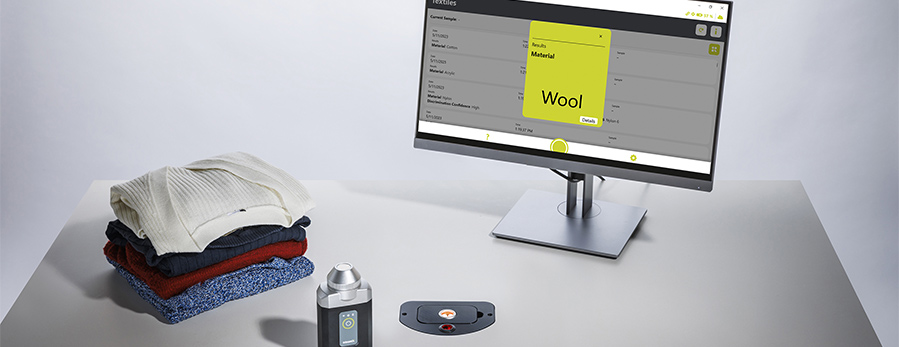
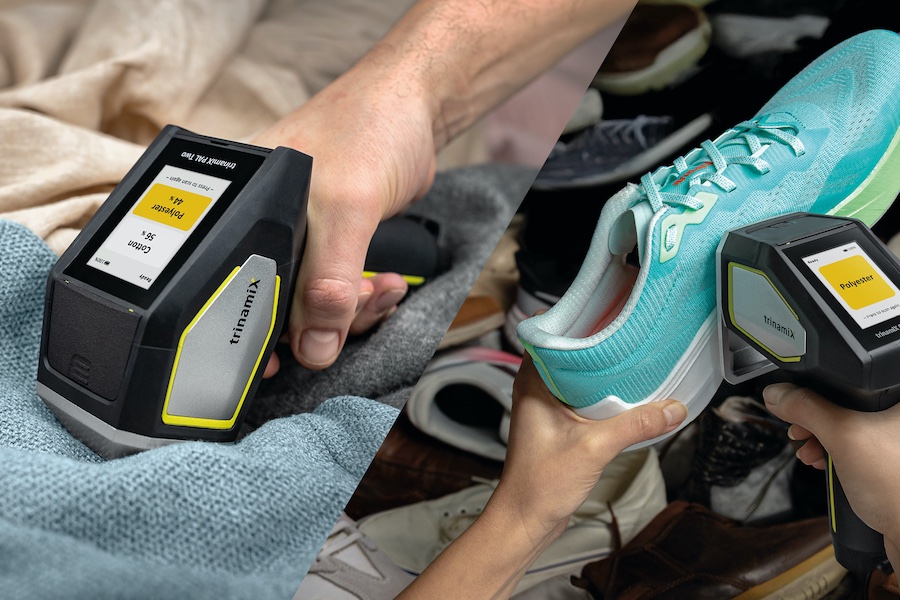
trinamiX combines the advantages of multiple setups in a single versatile solution for fast on-the-spot identification of textiles.
copyright: trinamiX GmbH
Boer Group, an international textile recycling organization, is working with trinamiX GmbH, a leading provider of mobile spectroscopy solutions, to advance its textile sorting capabilities. With the introduction of trinamiX Mobile NIR Spectroscopy Solution at first sorting centers in the Netherlands, Boer Group further enhances the efficiency of identifying and sorting textile material streams.

Boer Group processes more than 400,000 kilograms of used textiles every day, separating them into 350 different types and qualities for re-use or recycling. In this context, the correct identification of textiles and textile blends is critical to sort them into clean waste streams that are required to properly recycle textile waste into new textile fibers and products.

To further enhance its manual sorting process, Boer Group has deployed trinamiX Mobile NIR Spectroscopy Solution to support employees in reliably identifying the most common textiles and textile blends on the spot in a fast and user-friendly way. Based on an established methodology for material identification, the innovative plug-and-play solution quickly detects the types of textiles. After a brief contact with the sample, the intuitive feedback is immediately displayed on a smartphone, tablet or computer display.

The solution supports a wide range of common textile grades used in clothing, furniture and household goods, for example: acrylic, cotton, nylon 6/6.6, polyester, polypropylene (PP), silk, sisal, viscose and wool. Textiles made from more than one material can also be identified. These include blends based on acrylic, cotton, nylon, polyester, silk or wool.

A key advantage for Boer Group lies in the compact design and intuitive handling that allow for flexible integration into existing manual sorting processes and infrastructure. From on-the-spot checks with a handheld device that fits into a user’s pocket to semi-automated setups where customers can integrate the solution into a sorting table for automatically triggered scans: trinamiX combines the advantages of multiple setups in a single versatile solution. Thus, customers are enabled to deploy the solution at any given location or process stage.

“We are constantly working on sustainable ways to reduce residual textile waste to a minimum and find better solutions to keep textiles in the cycle,” says Rainer Binger, COO of Boer Group. “With trinamiX’s solution, we have found a valuable tool that has led to measurable advancements throughout our manual sorting activities”.


“Boer Group is a great example of how an innovative company combines experience with the latest technology to unlock further potential on the transition towards a full circular textile industry,” says Christian Nitschke, Director IR Sensing & Spectroscopy Solutions Business at trinamiX. “We’re excited that they chose our solution to complement their well-established sorting processes, easing the daily work of manual sorters while creating additional value in a key recycling step”.

From June 5-6, the solution will be showcased at Boer Group’s booth #13 as part of the Circular Textile Days in 's-Hertogenbosch, Netherlands. 
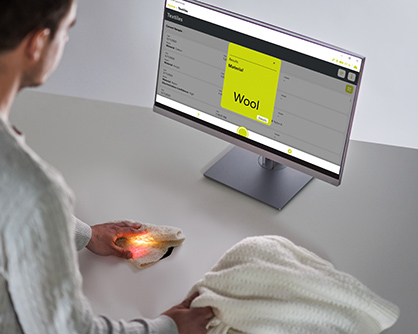

trinamiX Mobile NIR Spectroscopy Solution identifies a wide range of common textile materials used in clothing, furniture and household goods.<br />
copyright: trinamiX GmbH
trinamiX Mobile NIR Spectroscopy Solution identifies a wide range of common textile materials used in clothing, furniture and household goods. copyright: trinamiX GmbH


More News from BASF Aktiengesellschaft
Performance Chemicals for Textiles Europe

#Textile chemistry

A flagship for chemical production: BASF inaugurates world-scale Verbund site in China

BASF today (March 26, 2026) celebrated the official inauguration of its newly built, world-scale Verbund site in Zhanjiang, Guangdong Province in southern China. Covering an area of around four square kilometers, it is more than a major BASF project in the chemical growth market of China. “Zhanjiang shows what the future of chemistry looks like: efficient, digital and sustainable by design. The site showcases a smart integrated Verbund structure on an industrial scale,” said Dr. Markus Kamieth, CEO of BASF, at the ceremony attended by representatives from government, customers, business partners and employees.

#Recycling / Circular Economy

trinamiX with new management

BASF is examining strategic options for its subsidiary trinamiX GmbH. trinamiX specializes in biometric imaging and mobile material analysis. These activities are not part of BASF’s core business, on which the company is focusing as part of the implementation of its new strategy.

#Research & Development

How innovations drive BASF’s success

“Innovation has always been part of BASF’s DNA. Especially in these volatile times, it is crucial to leverage our innovative strength to develop competitive solutions that differentiate us as a company in our markets and give us a competitive edge,” said Dr. Stephan Kothrade, Member of the Board of Executive Directors of BASF and Chief Technology Officer, at the company’s Research Press Briefing held today. To achieve this, BASF implemented its “Winning Ways” strategy about a year ago with the clear goal of becoming the preferred chemical company to enable its customers’ green transformation.

#Nonwovens

Turning diaper waste into new value: BASF, Essity and TU Wien pioneer circular solutions

BASF, one of the world’s leading chemical companies and manufacturer of superabsorbent polymers (SAP), and Essity, a global leading hygiene and health company, joined forces together with the Technical University of Wien to revolutionize recycling of absorbent hygiene products (AHP).

More News on Recycling / Circular Economy

#Recycling / Circular Economy

Reju secures €135 Million in Dutch NIKI Funding for industrial-scale textile-to-textile regeneration hub at Chemelot Industrial Park, the Netherlands

Reju™, the progressive textile-to-textile regeneration company, has been awarded €135 million in funding under the Netherlands’ Nationale Investeringsregeling Klimaatprojecten Industrie (NIKI) program. The funding will support Reju’s planned industrial-scale Regeneration Hub at Chemelot Industrial Park in Sittard-Geleen, covering both the investment phase and ongoing operations, and represents a critical milestone on the path toward final investment decision.

#Recycling / Circular Economy

eeden is now a Canopy partner

eeden is committed to enable circular textiles by developing recycling technologies that turn textile waste into valuable raw materials. But the commitment goes further – eeden advocates for supply chain solutions that uphold responsible environmental and ethical standards, protecting global ecosystems including Ancient and Endangered Forests.

#Recycling / Circular Economy

Infinited Fiber Company’s environmental permit for Kemi advances to statutory appeal phase

Infinited Fiber has reached an important regulatory milestone in Finland, as the environmental permit process for a potential facility in Kemi has progressed to the statutory appeal phase.

#Recycling / Circular Economy

Carbios confirms Longlaville plant in France following financing progress

Carbios has reaffirmed its plans to build its Longlaville plant in France within a project financing framework, targeting the start of production in the first half of 2028. The company also reports a solid cash position of around €60 million at the end of 2025 and has appointed Benoît Grenot as Deputy Chief Executive Officer to support the execution of its strategic projects.

Latest News

#Raw Materials

New study shows low environmental impact by Cotton made in Africa Organic Cotton from Tanzania

Today, the Aid by Trade Foundation (AbTF) is announcing the results of a comprehensive life-cycle analysis (LCA) for cotton produced in Tanzania under the Cotton made in Africa Organic (CmiA Organic) standard. The study emphasises the small ecological footprint of CmiA Organic verified cotton. This can largely be traced back to the absence of synthetic pesticides, artificial fertilisers, and artificial irrigation. Consequently, CmiA Organic cotton can help the textile industry meet regulatory requirements as well as science-based targets. The results also show that the consequences of climate change threaten the livelihoods of these cotton farmers, even though the type of agriculture they practise barely contributes to climate change.

#Raw Materials

Better Cotton Initiative strengthens regenerative focus in standard update

The Better Cotton Initiative (BCI) has strengthened the regenerative focus of its field-level standard with the launch of a new version of its Principles & Criteria (P&C), which marks the next step in the organisation’s journey to becoming a regenerative standards system.

#Man-Made Fibers

Selenis and Kintra Fibers partner to scale 100% bio-based synthetic fiber technology

Selenis, a leading global specialty polyester manufacturer, today announced a strategic manufacturing partnership with materials science company Kintra Fibers to scale Kintra’s patented fiber-grade PBS resin - a 100% bio-based and biodegradable material designed for textile applications.

#Functional Fabrics

PERFORMANCE DAYS proves its relevance as the industry’s key meeting point

Held on March 18–19, 2026, PERFORMANCE DAYS once again confirmed its position as a leading international platform for functional textiles. A total of 3.366 trade visitors and around 560 exhibitors gathered in Munich, with the event already kicking off successfully on DAY 0, which received highly positive feedback for its interactive format. Despite challenging conditions caused by the public transport strike in Munich, the event saw strong attendance and a consistently high level of activity across both exhibition days.

TOP