[pageLogInLogOut]

#Recycling / Circular Economy

Third-party accreditations underline Berry's recycling commitment
© 2022 Berry Global
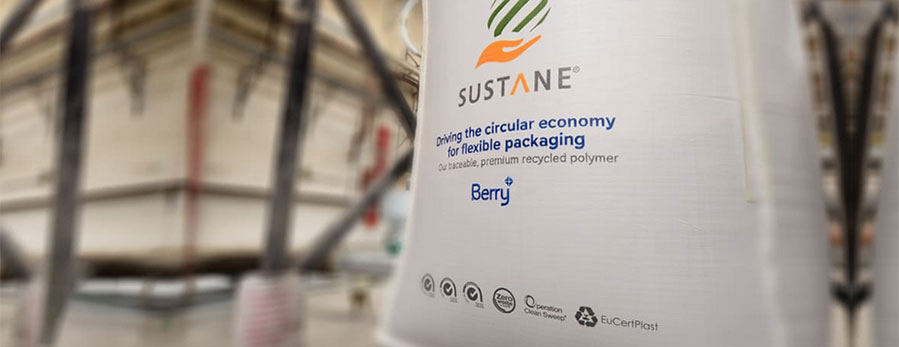
As part of its commitment to support customers in the drive towards a circular economy and reduction in carbon footprint, Berry Global’s European flexible films division is adopting a standard approach to substantiate its recycled content claims, including for its Sustane® range of premium sustainable polymers made from 100% recycled plastic.

Berry is obtaining independent accreditation via EUCertPlast and RecyClass to ensure complete integrity, consistency, transparency, traceability and accurate accounting.

The third-party accreditations will provide customers with full reassurance as to the quality and authenticity of the recycled content present in Berry products. They form a key part of the company’s ambitious target to include at least 30% recycled content across its flexible films product range by 2025, as well as the group-wide commitment to include at least 10% post-consumer recycled (PCR) in all its packaging products by the same date.

“As the use of recycled material increases across Europe, third party accreditation will play a vital role in ensuring the necessary transparency and consistency,” commented Tony Nawar. VP Sustainability, Strategy & Innovation, Berry Packaging Solutions. “This is why we are actively accrediting both our sites and our products through recognised and respected bodies.”

EUCertPlast certification, which works to the European Standard EN 15343:2007, confirms that best practices are being followed throughout the recycling process for pre- and post-consumer waste. It covers stock management of incoming waste, the recycling process, quality management, staff training and qualifications, traceability in the supply chain and environmental protection. For complete customer peace of mind, the chain of custody provides full details of the origins of the waste material and the waste management company from which it was sourced.

Berry’s three recycling operations at Heanor and Dumfries in the UK, and Steinfeld in Germany, have already achieved EUCertPlast accreditation for all the different recycled grades produced across these facilities, including the market leading Sustane®. The remainder of the company’s flexible film manufacturing and recycling facilities are currently undergoing the accreditation process.

RecyClass, which also works to EN 15343:2007, is a comprehensive cross-industry initiative that advances plastic packaging recyclability and ensures traceability and transparency of recycled plastic content in Europe. RecyClass recycled content certification provides independent confirmation of the reliability of recycled content claims for individual products, again delivering customer reassurance.


Berry products which have already achieved RecyClass certification include Sustane® Form Fill and Seal Petro products manufactured at its site in Hardenberg, the Netherlands.

“The availability of high-quality circular resins is critical to companies as they seek to introduce more sustainable packaging to satisfy legislative requirements and consumer demand,” said Tony Nawar.

“By committing to independent, third-party accreditations for all our recycled materials, we can effectively demonstrate their quality and validity as we work with our customers in the development of appropriate solutions.”

For more information about Berry Circular Polymers, visit:

https://www.berryglobal.com/en/sustainability/berry-circular-polymers.


More News from Berry Global Inc.

More News on Recycling / Circular Economy

#Recycling / Circular Economy

AI Circular Economy Conference 2026 fuels innovation at the intersection of AI and Circular Economy

The AI Circular Economy Conference 2026, organised by nova-Institute, brought together 116 participants from 15 countries in Cologne and online to explore the transformation of the chemical and materials industry supported and accelerated by artificial intelligence. During the two-day event, leading experts from industry, research, start-ups and the investment community discussed how AI can maximise the potential of renewable carbon creating efficient circular value chains. The conference featured 24 presentations and multiple panel discussions, highlighting the growing convergence of digital technologies and circular material systems. It demonstrated how artificial intelligence is progressing from the experimental stage to real industrial implementation within the circular economy.

#Recycled_Fibers

Circ deepens access to recycled fibers with Xinxiang Bailu Chemical Fiber Co., Ltd. partnership agreement

Circ®, a global leader in textile‑to‑textile recycling, today announced a new partnership agreement with Xinxiang Bailu Chemical Fiber Co., a Canopy Dark Green Shirt producer and one of the world’s leading producers of viscose filament. The agreement marks a significant step in Circ’s continued expansion in China and strengthens its position within the country’s rapidly evolving circular textile ecosystem; further supporting Circ’s ability to supply recycled fibers near existing fashion supply chains.

#Recycled_Fibers

Worn Again Technologies unveils the Accelerator

Worn Again Technologies unveils the Accelerator, the next major step towards commercialising its pioneering Textile-to-Fibre recycling process and proving the technical and economic feasibility of polycotton recycling.

#Recycling / Circular Economy

Textile‑to‑textile recycling leader Circulose joins Spinnova’s ecosystem to accelerate technology scale‑up

Textile‑to‑textile recycling leader Circulose joins Spinnova’s ecosystem (consortium) to help advance the scale‑up of Spinnova’s technology. Spinnova has actively sought partners to accelerate commercial scale‑up, and Circulose, as a key player in textile recycling, strengthens the ecosystem by providing a raw material that is in high demand across the industry.

Latest News

#Techtextil 2026

DIENES at Techtextil 2026: Flexible pilot lines for bio-based fiber development

The growing relevance of bio-based materials in technical textiles is accompanied by increasing demands for reproducibility, high-quality data, and scalable process routes. Especially when working with cellulose and its derivatives, chitosan, lignin-based approaches, or bio-based PAN as a carbon-fiber precursor, R&D teams face variable feedstock quality, tighter process windows, and the need for reliable comparability across trials. This calls for flexible, data-driven experimental setups that can be reconfigured efficiently when recipes, solvents, and raw-material batches change.

#Texprocess 2026

Gunold showcases embroidery product range and services at Texprocess

At Texprocess 2026, GUNOLD will present numerous hands-on examples related to embroidery in Hall 8, Booth E20. The focus is on creative embroidery designs as well as the extensive product range of threads, nonwovens, and accessories for embroidery and embellishment. “Trade visitors can once again look forward to many new and creative embroidery designs. Of course, we will also showcase the matching products required to bring these ideas to life,” announces Marketing Manager Stephan Gunold.

#Nonwovens

EDANA and more than 70 industry organisations call for consistent exemptions in EU packaging regulation

EDANA, together with more than 70 industry associations and organisations, has issued a joint statement commenting on the European Commission’s Delegated Act under Article 29 of the Packaging and Packaging Waste Regulation (PPWR).

#Raw Materials

A Powerful Opening: Global thought leaders launch the International Cotton Conference Bremen

The International Cotton Conference Bremen will open on 25 March 2026 in the Parliament building of the Free Hanseatic City of Bremen with a keynote session of exceptional calibre. Distinguished international experts will set the stage for the conference by offering incisive perspectives on the most pressing challenges and the defining trends shaping the future of the global cotton trade. Their insights will span a broad spectrum — from geopolitically driven disruptions affecting global supply chains to the opportunities emerging from innovation-led agriculture capable of supporting a growing world population. Together, these opening keynotes will frame the dialogue of the conference, highlighting both the complexity of today’s market environment and the pathways toward a resilient and forward-looking cotton sector.

TOP