[pageLogInLogOut]

#Recycling / Circular Economy

Cooperations for creative and sustainable solutions

Together with partners, Covestro has developed a concept for a smart pole for future mobility and smart cities. Thanks to the use of high-performance polycarbonate materials, the high-tech pole meets requirements for modern urban design, functionality and, not least, sustainable development trends. © Covestro
Knowledge grows faster than companies. And it is through the exchange of knowledge and the contribution of different perspectives that the best ideas are born. When you think about this, it becomes clear that companies need to cooperate to develop solutions to the challenges of our time faster and more effectively. Covestro offers its own "ecosystem" for collaborations and thus a wide range of connecting points for working with partners.

Innovation in a complex world comes from collaboration

Manifold collaborations for innovative smart poles

In addition to material properties and functionality, the focus is increasingly on design options. A current example of this is a smart pole designed for future mobility and smart cities – an intelligent pole with multiple functions that Covestro is presenting at the K 2022 plastics trade fair.

Smart poles must demonstrate stable performance even in harsh outdoor environments, while meeting high requirements for modern urban design, functionality and, not least, sustainable development trends. In addition to its own expertise and many years of experience, as well as a portfolio of suitable polycarbonate plastics and blends, Covestro therefore relies above all on intensive collaboration with technology and innovation partners in the development of such concepts, which include suppliers, customers, OEMs, start-ups, designers and universities.

This starts with product design: designs by students from Sweden's Umeå Design Institute were used to create the 5G small cell in the upper part of the smart pole. As part of a pilot project with this institute and Deutsche Telekom, Covestro investigated how a 5G network infrastructure could be implemented in an urban environment while taking aesthetic aspects into account. Polycarbonates are ideally suited for CMF (color, material, finish) design and enable interference-free transmission of high-frequency radio signals even in harsh weather conditions. To investigate the influence of material and CMF design under different conditions, Covestro operates state-of-the-art test facilities for a wide range of frequencies up to 50 GHz at its Asia-Pacific Innovation Center in Shanghai.

Together with the Umeå Design Institute, design concepts for electric charging stations for different usage scenarios have also been developed, one of which is the charging station design built into the base of the smart pole. Finally, as part of the modern urban landscape, the design of the smart pole must fit into the architectural and cultural context of the city in which it is installed. In addition to durability, the main focus here is on the weather resistance, flame retardancy, diverse light integration options and design freedom of the polycarbonates.


Circularity requires special partnerships

The value of such collaborations becomes even clearer when the complexity of the challenges increases: A circular world often requires the involvement of all partners along a value chain – industrial designers, raw material suppliers, plastics manufacturers, customers, disposers and recyclers. Only when all stakeholders are involved and work closely together can products be developed that can be recycled cleanly, reliably and affordably so that new products can be made from them.
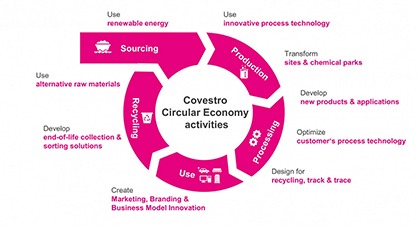
To build complete product cycles, it is often necessary to involve all partners along the value chain. When everyone works closely together, products can be developed that can be recycled cleanly, reliably and affordably. © Covestro


Covestro works with partners from industry and science at all stages of a product cycle to find solutions for a more sustainable future. The exchange takes place with both established companies and start-ups. Covestro will be showcasing the results of these collaborations at the K 2022 plastics trade fair.


More News from Covestro AG

#Smart Textiles

Covestro, FILK Freiberg, and OUT e.V. develop flexible, conductive polymer smart textile system

As the smart textiles market continues to grow across healthcare, personal protection, sportswear, and automotive applications, developers are seeking new ways to integrate electronic functionality directly into textiles, without the rigidity and complexity of conventional wiring. To address this challenge, FILK Freiberg Institute, an independent research institution with expertise in polymer coatings for textile applications, collaborated with Optotransmitter-Umweltschutz-Technologie (OUT) e.V. The joint project, funded under the German Industrielle Gemeinschaftsforschung (IGF) program of the Bundesministerium für Wirtschaft und Energie (BMWE), focused on developing flexible, conductive polymer surfaces for next-generation smart textiles.

#Techtextil 2026

Covestro to exhibit solutions for a more sustainable and productive textile industry at Techtextil 2026

Covestro will present a broad portfolio of material innovations for textile coatings, adhesive films and thermoplastic polyurethanes (TPUs) at Techtextil 2026 (Hall 11.0, Booth C79). The exhibits will demonstrate how advanced solutions can enhance durability, recyclability and manufacturing efficiency across applications such as automotive, infrastructure, protective apparel and sportswear. A particular focus will be on more sustainable coating technologies, including antimicrobial systems based on INSQIN® in combination with AGXX from Heraeus Precious Metals, as well as the integration of Pontacol® thermoplastic adhesive films into Covestro’s offering.

#Technical Textiles

Covestro showcases monomaterial concept in autonomous SUE People Mover

UE | STUDIOS has unveiled the fully autonomous electric minibus “Self-driving Urban E-Shuttle” (SUE), placing strong emphasis on sustainable material design. Developed within a project funded by the Federal Ministry for Economic Affairs and Energy (BMWE) and the European Union, the vehicle will begin public road testing this year. At the core of the concept is the consistent use of recyclable monomaterials to improve circularity at end of life.

#Textile chemistry

Covestro and Heraeus Precious Metals collaborate to enable safer, more sustainable antimicrobial textile coatings

Laboratory tests reveal that AGXX antimicrobial surface technology from Heraeus Precious Metals is fully compatible with Impranil® PU dispersions which are part of the waterborne INSQIN® textile coating technology from Covestro, paving the way for more sustainable antimicrobial textile coatings. This discovery comes at a key moment for the textile coatings industry. As the sharing economy continues to grow, more people are coming into regular contact with high-use surfaces, creating ideal conditions for bacteria, viruses, and other microorganisms to thrive.

More News on Recycling / Circular Economy

#Recycling / Circular Economy

HKRITA signs MoU with Jeanologia and Looptworks to establish the Green Machine Circular Textile Ecosystem

The Hong Kong Research Institute of Textiles and Apparel (HKRITA) yesterday officially signed a landmark Memorandum of Understanding (MoU) with two key global partners, Jeanologia and Looptworks, to establish the Green Machine Circular Textile Ecosystem – a first-of-its-kind collaboration to accelerate the large-scale recycling of blended textiles.

#Spinning

Object Carpet tests production of rPET BCF yarn on Neumag BCF line

In a joint project with Object Carpet GmbH, Denkendorf; the Institute for Textile Technology (ITA), Augsburg; and Next Generation Recyclingmaschinen GmbH (NGR), Feldkirchen, Austria, Barmag investigated the processing of recycled polyester for BCF yarn. The goal was to evaluate the fundamental suitability of 100% recycled carpet material for reuse in carpet yarn production to create a closed-loop system in carpet manufacturing. To date, commercial rPET BCF processes have been based solely on rPET from bottle pellets.

#Recycling / Circular Economy

Albany International reports progress with Cyclezyme on industrial textile recycling project

Albany International Corp. (NYSE:AIN) reports continued progress in the ongoing project with Cyclezyme AB, a leader in advanced enzyme-based plastic recycling, based in Sweden. The project exemplifies leading edge innovation in materials science, focusing on the development of enzyme-based recycling of industrial textiles primarily consisting of polyester and polyamide, where there is currently a significant lack of effective solutions for circular material flows. The objective of the project is to establish enzymatic processes for depolymerization and recycling of technical textiles and high-performance industrial materials.

#Recycling / Circular Economy

The textile industry in transition

Recycling, traceability, eco-design and digitalisation are among the key future challenges facing the European textile industry. The Erasmus+ project Skills4Circularity, involving 21 partners from twelve countries, is investigating the skills required to address these challenges. As the German industry partner, the Industry Association for Finishing – Yarns – Fabrics – Technical Textiles (IVGT) is bringing the industry’s perspective to the project.

Latest News

#Research & Development

2026 general meeting of the Friends and Supporters of RWTH Aachen at ITA

The Friends and Supporters of RWTH Aachen e. V. (proRWTH) looked back on a successful year of support at their 2026 general meeting. The meeting took place at Institut für Textiltechnik (ITA) of RWTH Aachen and was combined with a joint session of the Executive Board and the Administrative Board. Before the general meeting began, participants were given a guided tour of ITA, providing them with fascinating insights into current research and development topics in textile engineering.

#Natural Fibers

Cotton ConneXions Insight to Impact brings supply chain leaders together around cotton innovation

Cotton Incorporated’s Cotton ConneXions Insight to Impact brought together more than 300 industry leaders from 140 companies across 10 countries, including more than 45 top global brands and sourcing organizations, underscoring strong global interest in cotton-rich product development, sourcing and supply chain collaboration.

#Knitting & Hosiery

Footwear innovation enabled by warp knitting technology– insights from New Balance

The future of the athletic shoe is increasingly being shaped on warp knitting machines. For KARL MAYER, the footwear industry is one of the most important growth markets – and one of the sectors where innovative textiles can realize their full potential. In his keynote address at the opening of KARL MAYER’s TEXTILE INNOVATION CENTER in Obertshausen in April, Vishnu Prakash Muthusamy, Senior Textile and Materials Engineer at New Balance, explained the opportunities that warp knitting technology opens up for performance, sustainability, and faster development processes, and why textile manufacturers are transitioning from suppliers to development partners.

#Natural Fibers

Cashmere specialist joins AbTF Board of Trustees

The Aid by Trade Foundation (AbTF) is pleased to welcome Brian Yu, the chief executive officer of the Artwell Group, to its board of trustees. As CEO, Brian Yu developed Artwell into the world’s largest supplier of responsibly produced cashmere knitwear.

TOP