[pageLogInLogOut]

#Recycling / Circular Economy

Recycling of polycarbonate composites
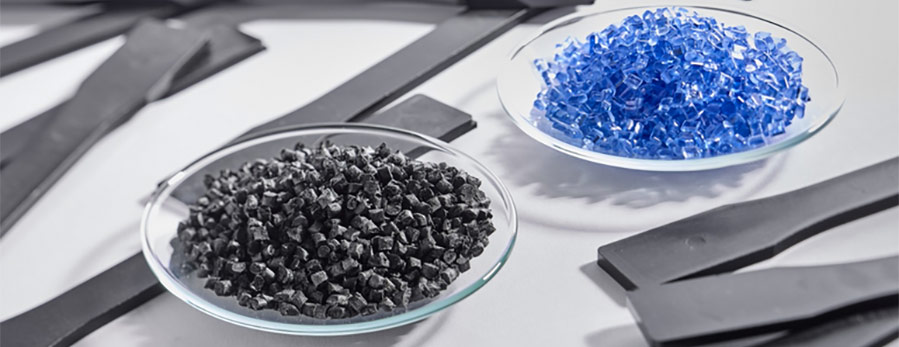
The recycled polycarbonate composite is blended with new polycarbonate – the light blue granules – to form new plastic products (the black granules in front) which are tested before being launched on the market. The black test specimens, on which mechanical properties such as tensile and flexural strength are measured, serve this purpose. © carboNXT®
The Maezio® brand of continuous fiber-reinforced polycarbonate composites (CFRTPs) developed by Covestro are characterized by their extremely light weight, very high strength and exceptional flexibility of design. This means that waste generated during the production of composites also becomes a valuable raw material.

However, because they consist of different materials that cannot be easily separated from one another, the recycling of composites is a challenge. Covestro is cooperating with recycling specialist carboNXT® on this. It has developed a process that allows the waste to be processed on an industrial scale.

  • Production waste is a valuable raw material
  • Reprocessing on an industrial scale possible
  • Contribution to more sustainability and resource conservation


"We are very excited about this joint solution, as we cannot process the materials ourselves for technical reasons," explains Lisa Ketelsen, Head of Thermoplastic Composites at Covestro. "By recycling according to type at our partner's plant, the raw materials can be converted back into valuable products with similarly good properties as those characteristic of virgin materials. The recycling of materials makes it possible to use them again in other products. In this way, we save raw material resources and contribute to the focus on the circular economy."


"Our company has many years of experience in recycling carbon fiber-reinforced thermoplastics and has the necessary plant technologies to process such waste. We were therefore the partner of choice for this task," says Tim Rademacker, general manager at Mitsubishi Chemical Advanced Materials and responsible for the carbon fiber recycling business. "From the processed waste, we produce high-quality new compounds of carbon fiber-reinforced polycarbonate for Covestro at CarboNXT®."

Demand for such recycled products is high because they are valuable raw materials, but also because more and more industrial customers and consumers are looking for more sustainable products. The project will now be further developed to market maturity by Covestro, Mitsubishi Chemical Advanced Materials and possibly other partners. It is part of a global strategic program with which Covestro is focusing all its energy on the circular economy.



More News from Covestro AG

#Smart Textiles

Covestro, FILK Freiberg, and OUT e.V. develop flexible, conductive polymer smart textile system

As the smart textiles market continues to grow across healthcare, personal protection, sportswear, and automotive applications, developers are seeking new ways to integrate electronic functionality directly into textiles, without the rigidity and complexity of conventional wiring. To address this challenge, FILK Freiberg Institute, an independent research institution with expertise in polymer coatings for textile applications, collaborated with Optotransmitter-Umweltschutz-Technologie (OUT) e.V. The joint project, funded under the German Industrielle Gemeinschaftsforschung (IGF) program of the Bundesministerium für Wirtschaft und Energie (BMWE), focused on developing flexible, conductive polymer surfaces for next-generation smart textiles.

#Techtextil 2026

Covestro to exhibit solutions for a more sustainable and productive textile industry at Techtextil 2026

Covestro will present a broad portfolio of material innovations for textile coatings, adhesive films and thermoplastic polyurethanes (TPUs) at Techtextil 2026 (Hall 11.0, Booth C79). The exhibits will demonstrate how advanced solutions can enhance durability, recyclability and manufacturing efficiency across applications such as automotive, infrastructure, protective apparel and sportswear. A particular focus will be on more sustainable coating technologies, including antimicrobial systems based on INSQIN® in combination with AGXX from Heraeus Precious Metals, as well as the integration of Pontacol® thermoplastic adhesive films into Covestro’s offering.

#Technical Textiles

Covestro showcases monomaterial concept in autonomous SUE People Mover

UE | STUDIOS has unveiled the fully autonomous electric minibus “Self-driving Urban E-Shuttle” (SUE), placing strong emphasis on sustainable material design. Developed within a project funded by the Federal Ministry for Economic Affairs and Energy (BMWE) and the European Union, the vehicle will begin public road testing this year. At the core of the concept is the consistent use of recyclable monomaterials to improve circularity at end of life.

#Textile chemistry

Covestro and Heraeus Precious Metals collaborate to enable safer, more sustainable antimicrobial textile coatings

Laboratory tests reveal that AGXX antimicrobial surface technology from Heraeus Precious Metals is fully compatible with Impranil® PU dispersions which are part of the waterborne INSQIN® textile coating technology from Covestro, paving the way for more sustainable antimicrobial textile coatings. This discovery comes at a key moment for the textile coatings industry. As the sharing economy continues to grow, more people are coming into regular contact with high-use surfaces, creating ideal conditions for bacteria, viruses, and other microorganisms to thrive.

More News on Recycling / Circular Economy

#Recycled Fibers

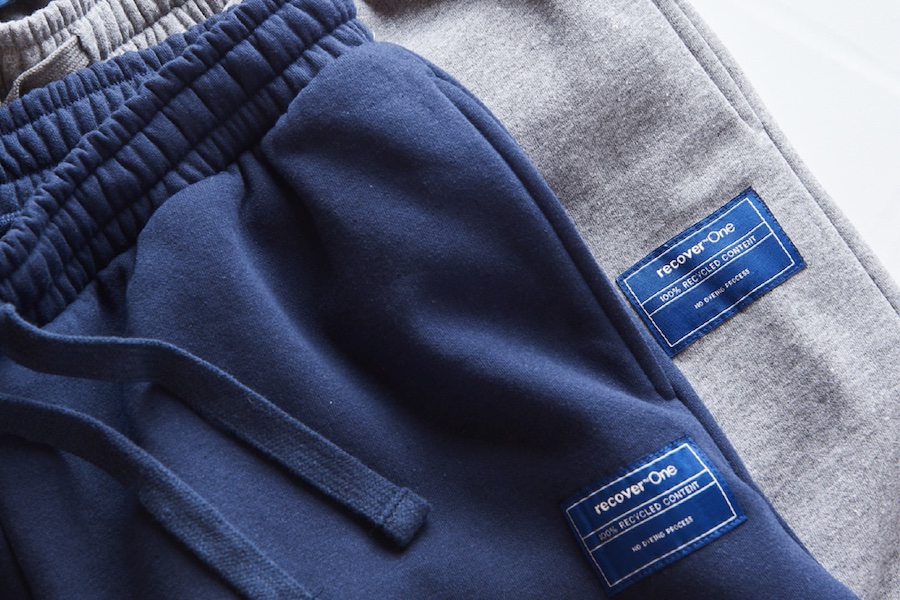
Recover™ and Ünteks Group partner to scale recycled cotton in knitwear

Recover(TM), a global producer of low‐impact, high‐quality recycled cotton fiber, announces a new partnership with Ünteks Group, a vertically integrated textile manufacturer based in Turkey. The collaboration focuses on the development of circular knit fabrics and garments, combining Recover’s recycled cotton fiber with Ünteks Group’s integrated capabilities across knitting, dyeing, printing, and garment production.

#Research & Development

ALADIN paves the way for circular and demand-driven textile production in Europe

Textile production can be organized sustainably by utilizing short supply chains and preventing overproduction. This can already be achieved today by intelligently connecting and efficiently utilizing existing infrastructure. At the same time, production becomes circular when innovative technologies and materials are used that enable high-quality recycling. The ALADIN research project, launched in May 2026 and co-funded with five million euros under the EU Horizon Europe program, is creating the conditions for this.

#Recycling / Circular Economy

Ence and ShareTex begin initial testing of the ATENEA innovation project to promote textile recycling in Spain

Ence and ShareTex are making progress on the Atenea R&D project, which aims to develop a complete value chain for textile recycling in Spain. Specifically, the goal of the ATENEA project—which is funded by the Center for Technological Development and Innovation (CDTI)—is to connect all the necessary stages for the recovery of textile waste, from collection and management, through recycling and transformation into new raw materials, to their incorporation into new textile products.

#Recycling / Circular Economy

DePoly Inaugurates its Showcase Plant in Monthey Switzerland

What if used plastic bottles, PET packaging material and polyester textiles could become raw materials just as high performing as virgin resources? That is the ambition of DePoly, a circular materials company based in Sion, Switzerland which inaugurated its Showcase Plant in Monthey on July 6th & 7th. The first depolymerization facility of its kind and scale in Switzerland, this industrial Showcase Plant represents a major milestone in the company's growth and its journey toward commercialization.

Latest News

#Spinning

STEELTOP®: A new benchmark in flat tops for spinning preparation

Modern carding generations achieve higher production performance, placing significantly greater stress on flat tops. Higher cylinder speeds and increased fiber density, combined with tighter carding gaps, create more demanding operating conditions. At the same time, poorer raw material quality and the increased use of recycled materials further intensify these challenges. With STEELTOP®, Trützschler introduces a new full steel flat top series developed for these demanding modern carding processes.

#Textile processing

YKK develops concept EXCELLA® zipper tape using nonwoven fabric partially derived from used clothing

YKK Corporation has developed a concept version of its premium EXCELLA® zipper series made from nonwoven fabric sheets created by fiberizing used clothing and other textile materials. Based on a proposal by fashion designer Yuima Nakazato, this item was created as a result of collaboration between Nakazato, Seiko Epson Corporation and YKK. The concept zipper was incorporated as a material component for pieces in the newest YUIMA NAKAZATO Couture Collection, “INFERNO,” which was unveiled in Paris, France on July 8, 2026.

#Textiles & Apparel / Garment

Texworld Apparel Sourcing Paris highlights evolving global sourcing landscape

From 31 August to 2 September 2026, Texworld Apparel Sourcing Paris will bring together more than 1,000 international exhibitors at Paris-Le Bourget Exhibition Centre. This edition reflects the new global balance of textile and apparel sourcing, highlighting a strong diversity of sourcing countries — some unexpected.

#Textile processing

Dedicated car seat model of SHIMA SEIKI’s P-CAM® R Cutting Machine unveiled

Leading Japanese textile solutions provider SHIMA SEIKI MFG., LTD. of Wakayama, Japan, showed a special version of its P-CAM® R multi-ply computerized cutting machine dedicated to the production of car seats for the first time, at a private exhibition held over two days on Thursday, July 2nd and Friday, July 3rd at the Kariya City Industrial Promotion Center in Aichi Prefecture.

TOP