#Recycling / Circular Economy
From old jeans to new t-shirt
An efficient way of recycling cotton clothes
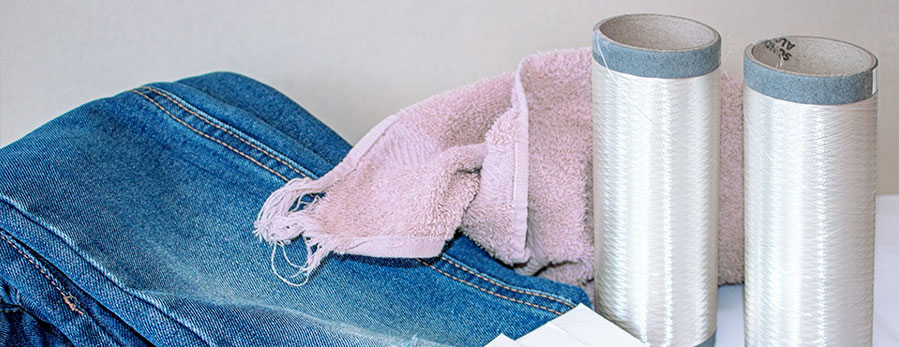
Countless closets are overflowing with clothes, yet their owners wear many of those trousers, skirts and tops rarely or not at all, as a Greenpeace survey of shopping habits recently found. People sort out even perfectly intact garb, relegating it to a garbage can or clothing bank. That is hardly ecofriendly given the vast amounts of resources, chemicals and water devoted to making apparel. Although Germany does recycle old clothes, they end up as inferior products such as cleaning cloths rather than new garments. This is because trousers, shirts and the like are often made of blends rather than a single type of fabric. To date, it has been impossible to separate these intertwined fibers. “Textiles rarely consist of pure cotton. Jeans, for example, always contain a certain amount of chemical fibers such as polyester or elastane,” says André Lehmann, a researcher at the Fraunhofer IAP in Potsdam. Working on behalf of the Swedish company re:newcell, this chemist and his team succeeded in converting the pulp from recycled cotton into viscose rayon fibers made of pure cellulose.
As good as wood-based cellulose fibers – the new viscose filament yarn
The textile industry usually uses pulp as the starter material for producing regenerated cellulosic fibers such as viscose rayon, modal and lyocell. This pulp does not melt, so it has to be dissolved into a solution and passed through a spinneret to be spun into cellulosic fibers. The feedstock for this pulp is usually wood. “However, re:newcell sent us cellulose sheets made of recycled cotton and asked us to find out if they could be converted into viscose rayon fibers. "We were able to extract the foreign fibers from the pulp by setting the right parameters for both the dissolving and spinning processes, for example, with effective filtration stages,” says the researcher. This yielded a filament yarn – that is, a continuous strand of fiber several kilometers long consisting of 100 percent cellulose, the quality of which is comparable to that of wood-based regenerated cellulosic fiber. Compatible with the standard industrial process for making viscose rayon, the new fibers spun from this cotton pulp are suitable for mass manufacturing. “We were able to meet re:newcell’s high purity standards for the new fiber,” says Lehmann, who calls this filament yarn a cotton-based regenerated cellulosic fiber. It holds up well in comparison to commercially available viscose rayon fibers and exhibits the same properties.
This was no easy task. Producing viscose rayon is a complex process: The pulp is first activated with lye and then chemically derivatized. This yields a very pure alkaline viscose solution. Spinnerets riddled with several thousand 55 ?m diameter holes then spin this solution in an acidic bath. The thousands of liquid jets emerging from the polymeric solution enable the derivatized cellulose to regenerate and continuously precipitate in the spinning bath to form a filament. The next step is to steadily reverse the chemical derivatization, and then wash and dry the filament for it to be wound onto a spool. Made of pure cellulose, this filament is ecofriendly. Rather than adding to the mountains of microplastics that pollute the oceans, it readily decomposes. This is a huge advantage over petroleum-based polyester fibers, which still predominate on the global market with a share of some 60 percent.
More sustainable fashionwear
“Cotton clothing is usually incinerated or it ends up in the landfill. Now it can be recycled several times to contribute to greater sustainability in fashion,” says Lehmann. This will also broaden the base of raw source materials for pulp production in the textile industry. “The starter material for viscose rayon fibers has been wood-based cellulose. By optimizing the separating processes and intensifying the filtration of foreign fibers in the spinning process, we will eventually be able to establish recycled natural cotton fiber as a serious alternative source of cellulose and base raw material.”