[pageLogInLogOut]

#Recycling / Circular Economy

NEUMÜHLE launches mono-material hoodie designed for textile recycling

AI-generated visuals of people wearing the Circular Mono Hoodie by Nataliia Avramenko for NEUMÜHLE. © 2026 NEUMÜHLE
With the Circular Mono Hoodie, Zurich-based label NEUMÜHLE introduces a new essential designed around a single-material principle. The textile construction is cotton throughout, right down to the sewing thread. Entirely free from elastane, the hoodie launches as a Limited Drop for CHF 139. Take-back, collection and existing recycling partnerships complement its circular design.

Designed as a mono-material garment

The Mono Hoodie fabric is made from 100% organic cotton. The sewing thread is also cotton and is Cradle to Cradle Certified®. By eliminating elastane, the design avoids introducing other fibre types into the textile construction. Future recycling is therefore considered from the outset.

Soft, heavyweight fabric, clean lines and a subtle NEUMÜHLE logo define the hoodie for everyday wear.

Why mono-material matters

A study published in 2026 by Wageningen University & Research found that 61% of discarded textiles in the Dutch clothing system studied consist of material blends. The authors conclude that mono-material designs or easily separable components are significantly better suited to efficient, high-quality textile-to-textile recycling.[1]

Empa also emphasises that material blends make recycling more difficult, and that knowing a material's composition and quality is crucial.[2] These findings support NEUMÜHLE's approach of considering future recycling at the material selection stage.
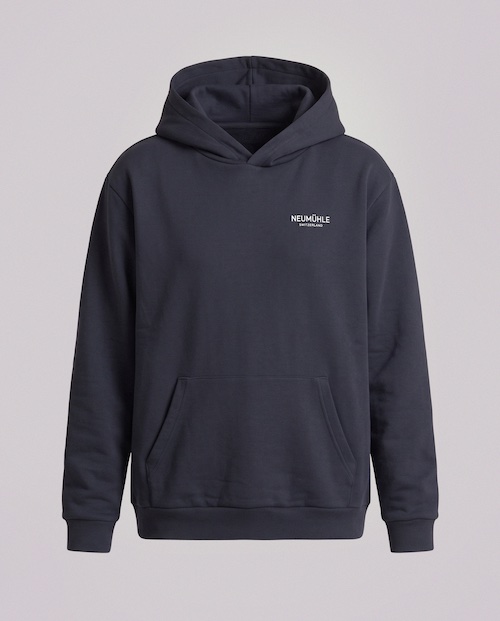
Circular Mono Hoodie © 2026  NEUMÜHLE
Circular Mono Hoodie © 2026 NEUMÜHLE


Take-back and recycling partnerships

NEUMÜHLE works with various recycling partners. The label collects returned materials itself and consolidates the returns, with the aim of putting the collected materials back into use through these partnerships. Customers returning a Mono Hoodie receive a voucher for 20% off their next purchase.

Explaining the design approach, Andreas Fehr, co-founder of NEUMÜHLE, says:

“We are rethinking clothing. It should be worn for years, bring joy and eventually return to a material stream. That is why we consider the end of a garment’s life right from the design stage – and work backwards from there.”

The Mono series grows

The Mono Hoodie continues an approach that NEUMÜHLE developed with the Mono Vest and Mono Shirt. The Mono Vest received the German Federal Ecodesign Award in 2023. With the hoodie, the label applies this principle to another everyday garment, combining design, long-term use and the prospect of future recycling.

Manufactured in Europe, the Circular Mono Hoodie is made entirely from organic cotton, including a cotton sewing thread that is Cradle to Cradle Certified®. The garment contains no elastane and is available in sizes S to XL. It is being launched as a Limited Drop priced at CHF 139. Customers who return a Mono Hoodie through NEUMÜHLE’s take-back scheme receive a 20% voucher towards their next purchase.


More News from Neumühle Switzerland GmbH

More News on Recycling / Circular Economy

#Recycling / Circular Economy

nova-Institute launches groundbreaking Advanced Recycling Database for strategic market insight

The new Advanced Recycling Database reduces complexity by providing industry stakeholders with up-to-date expert-reviewed intelligence on companies, technologies, plants, capacities, locations, products and partnerships across the global advanced recycling landscape.

#Europe

Textile ETP launches bioeconomy strategy for Europe’s textile industry

On 22 September 2026, Textile ETP's Circular & Biobased Textiles Innovation Hub published its strategy for the biobased and circular transformation of Europe's textile and apparel industry.

#ITMA 2027

20 Start-Ups selected for CEMATEX Start-Up Grant at ITMA 2027

CEMATEX has selected 20 emerging start-ups from nine countries to receive the CEMATEX Start-Up Grant and showcase their innovations at Start-Up Valley during ITMA 2027 in Hanover. Their participation will be fully funded by CEMATEX, giving promising early-stage companies access to the world’s leading textile and garment technology platform.

#Recycling / Circular Economy

Moving Advanced Recycling from Innovation to Implementation

The Advanced Recycling Conference 2026 explores technologies, markets, financing and scale-up of innovative recycling solutions for waste streams including mixed plastic waste, textiles and PVC. Europe’s chemical and materials sector faces growing pressure to close carbon loops, strengthen raw-material safety and resilience and meet increasingly ambitious EU recycling targets. Against this backdrop, the Advanced Recycling Conference (ARC) will bring together industry leaders, technology providers, researchers, innovators and policy-makers on 17–18 November 2026 in Cologne, Germany.

Latest News

#Raw Materials

New Cotton Review examines competitiveness, market risk, and opportunities

From moving record volumes of Brazilian cotton to market, to managing price volatility, unlocking Ethiopia’s production potential, and strengthening African textile trade, the latest edition of Cotton: Review of the World Situation examines some of the most consequential opportunities and challenges facing the global cotton industry.

#Knitting & Hosiery

Long John puts KARL MAYER's RDJ 7/3 into operation and strengthens its position as a market leader

KARL MAYER has just unveiled its new RDJ 7/3 Jacquard Double Needle Bar Raschel Machine in the international trade press, and the innovation is already causing a stir in the market: The Long John Group, a leading manufacturer of performance footwear fabrics and a long-standing partner of renowned brands, was the first customer to invest in the new machine and celebrated its official launch at its Indonesian plant on August 20.

#Research & Development

An eco-friendly alternative to fluorocarbon treatments

Protective and outdoor clothing derives its durable water-, dirt- and oil- repellent properties from the application of fluorinated polymers or per- and polyfluorinated low-molecular- weight chemicals (PFCs). The beneficial properties thus achieved on textiles are offset by environmental and human health risks. For manufacturers of sports, medical, protective and automotive textiles, researchers at the Sächsisches Textilforschungsinstitut e.V. and the Leibniz Institute for Polymer Research have developed liquid-applied dispersions and solutions to functionalise textiles without the use of fluorine.

#ITMA Asia + CITME 2026

TMAS members drive textile technology innovation ahead of ITMA Asia

As the global textile machinery industry prepares to meet at ITMA ASIA in Shanghai this November, Swedish textile technology companies are responding to a rapidly changing market with investment, innovation and new solutions.

TOP