[pageLogInLogOut]

#Recycling / Circular Economy

Asahi Kasei and Microwave Chemical launch joint demonstration project for chemical recycling of polyamide 66 using microwave-based technology

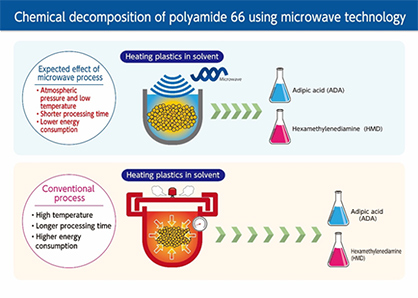
Asahi Kasei and Microwave Chemical launched a joint demonstration project in April 2023 with the objective of commercializing a chemical recycling process for polyamide 661 (PA66, also called nylon 66) using microwave technology. The process utilizes microwaves to depolymerize2 PA66 and directly obtain the monomers hexamethylenediamine (HMD) and adipic acid (ADA), which is expected to be accomplished at high yield with low energy consumption.

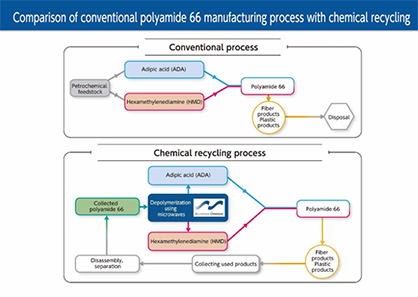
The monomers obtained can then be used to manufacture new PA66. In the demonstration, scraps from manufacturing and post-use waste material of PA66 for airbags and automobile parts are depolymerized. 

Asahi Kasei currently produces fossil fuel–derived HMD and ADA as intermediates to manufacture Leona™ PA663, an engineering plastic featuring outstanding heat resistance and rigidity. PA66 is used in various applications, including plastic parts for automotive and electronic products, and yarn for airbag fabric, and its demand is expected to increase worldwide.

As the world moves toward carbon neutrality, attention is increasingly focused on manufacturing processes for reducing greenhouse gas (GHG) emissions from chemical products derived from fossil fuels. Microwave Chemical is promoting technological and business development to achieve carbon neutrality in the industrial sector focused on process development using microwaves, which can directly and selectively heat target substances with high energy efficiency. For chemical recycling, Microwave Chemical is advancing its proprietary PlaWave™ technology platform for decomposing plastic using microwaves.

Through development combining Asahi Kasei's experience in manufacturing HMD and ADA for more than half a century together with Microwave Chemical's achievements in the industrialization of microwave technology, the two companies aim to commercialize a manufacturing process for PA66 that can reduce GHG emissions compared to the conventional manufacturing process.
© 2023 Ashai Kasei
© 2023 Ashai Kasei


Laboratory-scale studies that began in fiscal 2021 have confirmed the high-yield depolymerization of PA66 using microwaves, as well as the principle of the separation and purification process after depolymerization. Bench-scale equipment will now be assembled at Microwave Chemical’s Osaka Factory by the end of fiscal 2023, and a small-scale demonstration trial using this equipment will be performed in fiscal 2024 to collect basic process data for commercialization.

Microwave Chemical’s PlaWave™ technology platform for decomposing plastic using microwaves can depolymerize PA66 with low energy and obtain HMD and ADA monomers in high yield. The manufacturing process for PA66 using HMD and ADA obtained by depolymerization with this technology is expected to reduce GHG emissions compared to the conventional PA66 manufacturing process, while further reduction of GHG emissions may be achieved by the use of renewable energy for the power required to generate the microwaves.

By verifying the process from depolymerization to separation and purification in an integrated manner, this demonstration project aims to enable resource circulation of PA66 for further reduction of GHG emissions.


© 2023 Ashai Kasei
© 2023 Ashai Kasei


Moving forward, based on the results of the small-scale demonstration trial, a decision on the possibility of commercialization will be made by fiscal 2025 following detailed analysis. Concurrently with the small-scale demonstration trial, construction of a business model that involves the entire value chain in the chemical recycling of PA66 will be advanced, aiming to achieve a circular economy together with stakeholders in the PA66 value chain.

Asahi Kasei aims to be a global partner for its PA66 customers by providing optimal solutions for their carbon neutrality initiatives through studies of the practical application of material recycling and chemical recycling as well as trials for the commercialization of PA66 made using biomass-derived intermediate4.

Microwave Chemical is working to increase the scale of equipment and to make PlaWave™ more generally applicable in order to achieve the practical application of the chemical recycling of polymethyl methacrylate (PMMA, also called acrylic resin), automotive shredder residue (ASR), plastic containers and packaging, flexible polyurethane foam, etc.


1) The main types of polyamide are polyamide 66 and polyamide 6, which have different chemical structures. With superior heat resistance and strength, polyamide 66 is widely used in industrial applications such as automotive and electronics.

2) The opposite of polymerization, depolymerization is the process of breaking down a polymer into a monomer or monomers by heat and other means.

3) Asahi Kasei is a manufacturer of engineering plastics such as polyamide 66, which is made from HMD and ADA, polyamide 6I, and polyamide 612, as well as polyamide 610, which is made based on plant-derived raw materials such as castor oil, and supplies optimal materials suited to various needs ranging from molding materials for automotive and electronics applications, airbag yarn and fabric, and tire cord.

4) Please refer to the press releases dated March 16, 2022:?

Genomatica and Asahi Kasei Partner on Renewably-Sourced Nylon 6,6?

https://www.asahi-kasei.com/news/2021/e220316_2.html

Asahi Kasei to accelerate trials for commercialization of polyamide 66 made using biomass-derived intermediate

https://www.asahi-kasei.com/news/2021/e220316.html

More News from Asahi Kasei

#Textiles & Apparel / Garment

ROICA: Where distinction and intention shape the future of apparel industry at Milano Unica

At Milano Unica, held at Fiera Milano (Rho) in Milan from January 20–22, nine select European partners unveil collections shaped by ROICA™—the premium stretch fiber by Asahi Kasei. ROICA™ does not stand alone on the show floor, but its presence is quietly interlaced into each creation, chosen by those who seek distinction and depth in modern textiles. Through these dedicated collaborations, ROICA™ continues to sup-port the apparel industry with advanced stretch, comfort, and environmental care, offering something unique for brands who value true craftsmanship and thoughtful innovation.

#Yarns

January 2026 marks Asahi Kasei’s restart of Bemberg production in restored sections of the Nobeoka facility

Beginning January 2026, production at the Asahi Kasei Nobeoka facility – Bemberg’s only production site – will gradually resume, marking a new chapter following the partial shutdown caused by the April 2022 incident. This progress is the result of significant investments and continuous work toreinforce safety measures, restore full operational capacity, and establish long- term stability.

#Fabrics

SENSIL® by NILIT and ROICA™ by Asahi Kasei collaborate to reduce apparel’s footprint

Rapidly transforming apparel into a lower-carbon industry requires collaboration, innovation, and creativity. In this spirit, SENSIL® by NILIT and ROICA™ by Asahi Kasei have collaborated to introduce the concept of a new fabric with less environmental impact, combining SENSIL® ByNature, a NILIT Biomass Balanced Nylon 6.6 yarn, and Biomass Balanced ROICA™ premium stretch fiber, both designed for high-performance apparel.

#Fabrics

ROICA™ showcases responsible stretch innovation at ISPO Munich 2025

Asahi Kasei’s premium stretch fiber brand, ROICA™, continues to take a responsible approach to innovation, advanced functionality, and trusted quality for the evolving sports apparel industry. At ISPO Munich 2025, ROICA™ will once again be featured as a valued element of the Asahi Kasei booth, presenting the latest developments in responsible stretch fiber technology.

More News on Recycling / Circular Economy

#Recycled_Fibers

Reju announces site selection for French Regeneration Hub in Lacq advancing Europe’s circular textile infrastructure

Reju, the textile-to-textile regeneration company based in France, announces the site selection for an industrial sized Regeneration Hub, in Lacq, in the Pyrénées-Atlantiques, on the Induslacq platform. Reju, a Technip Energies owned company, is deepening its roots in France through the development of this new Regeneration Hub.

#Technical Textiles

Covestro showcases monomaterial concept in autonomous SUE People Mover

UE | STUDIOS has unveiled the fully autonomous electric minibus “Self-driving Urban E-Shuttle” (SUE), placing strong emphasis on sustainable material design. Developed within a project funded by the Federal Ministry for Economic Affairs and Energy (BMWE) and the European Union, the vehicle will begin public road testing this year. At the core of the concept is the consistent use of recyclable monomaterials to improve circularity at end of life.

#Recycled_Fibers

Circ announces New Fiber Club partners to accelerate commercial adoption of recycled textiles

Circ®, a global leader in textile‑to‑textile recycling, announced the scaling of its Fiber Club initiative. Building on the success of the inaugural program, Circ is bringing together a new group of brand partners: the lifestyle brand Madewell (under J.Crew Group), sustainable fashion brand Reformation, and European retailer C&A, alongside supply chain partners Lenzing and Linz Textil.

#Recycling / Circular Economy

Circulose restarts commercial-scale production at Ortviken plant in Sundsvall

Circulose today announced the restart of its commercial-scale production plant at Ortviken in Sundsvall, Sweden, marking a significant step in scaling next-generation materials for the global fashion industry. The company plans to resume production of CIRCULOSE®, a recycled pulp made entirely from discarded cotton textiles, in the fourth quarter of 2026.

Latest News

#Raw Materials

Esquel Group adds two new extra-long staple cotton varieties approved

Esquel Group’s Xinjiang Research & Development Center has successfully developed two new Sea Island cotton (Extra-Long-Staple cotton, ELS cotton) varieties named “Yuan Loong 37” and “Yuan Loong 42,” which have been officially approved and granted registration numbers. Both varieties have also obtained Plant Variety Rights certificates, marking another significant breakthrough for the Group in cotton breeding and commercial application.

#Weaving

Itema America acquires Palmetto Loom Reed, strengthening local manufacturing and service in the U.S.

Itema America, the U.S. subsidiary of Italy-based Itema Group, has acquired – through an Assets Purchase Agreement – Palmetto Loom Reed, a Greenville, South Carolina-based manufacturer of weaving reeds and one of the last remaining domestic producers of these precision components in the United States.

#Functional Fabrics

lululemon introduces Unrestricted Power™ — A new sensation for strength training

lululemon (NASDAQ: LULU) has unveiled Unrestricted Power™, a new innovation platform engineered for heavy lifts and demanding gym sessions. The assortment, which launches in North America, is backed by thousands of hours of research and development, providing secure support without compromising comfort and mobility, enabling a distraction-free fit built to match every move.

#Raw Materials

Aid by Trade Foundation reaches new milestones in supply chain transparency

The Aid by Trade Foundation (AbTF) is reaching new milestones as it leads the way towards greater physical traceability for Cotton made in Africa® (CmiA) cotton. With around 700 suppliers and producers in a total of 25 countries, the Aid by Trade Foundation has reached a new record number of partners who can trace CmiA cotton from the product back to its origin. This is more than double the previous year’s figure.

TOP