[pageLogInLogOut]

#Raw Materials

2021 Cotton Biotechnology Award recipient – Dr. Shuangxia Jin

Dr. Shuangxia Jin was selected as the winner of the 2021 Cotton Biotechnology Award. He is a full professor at Huazhong Agricultural University (HZUA). Dr. Jin earned his Ph.D. in 2006 from HZAU and then was a postdoctoral scientist from 2007 to 2012 at the University of Pennsylvania.

Dr. Jin has been working in plant biotechnology for 15 years and his current research involves insects (whitefly/aphid/lygus), cotton / host molecular interaction, and genome editing. Dr. Jin has published more than 60 peer reviewed papers in high impact journals such as Advanced Science, Genome Biology, Nature Communications, Trends in Plant Science, Plant Physiology, and New Phytologist. He is a Senior Editor of Plant Biotechnology Journal (PBJ) and Journal of Cotton Research.

Dr. Jin has made unique and significant contributions to the field of biotechnology in cotton. Dr. Jonathan Wendel, Distinguished Professor at Iowa State University, says this about Dr. Jin: “He is the global leader in cotton transformation technology, having led the development of new genotypes for transformation and regeneration, created the best CRISPR-Cas9 and CRISPR-Cas 12 (12a and 12b) systems for genomic editing, and published methods for revealing unanticipated or undesired (“off-target”) editing.” His research group developed two elite cotton genotypes, YZ-1 and Jin668, with the highest plant regeneration ability and transformation efficiency, increasing the cotton transformation efficiency from 20% in Coker 312 to 90% in YZ-1 and Jin 668.


The Cotton Biotechnology Award, endowed by a gift from Dr. Norma Trolinder in 2000, has been presented on eight previous occasions. The recipient receives a monetary award and a plaque. It is presented to a scientist or group of scientists for outstanding biotechnology research in cotton and is administered by the Agricultural and Environmental Research Department at Cotton Incorporated.


Dr. Shuangxia Jin © 2021 Cotton Inc.


More News from TEXDATA International

#Texprocess 2026

Texprocess 2026: Automation, digitalisation and AI redefine textile processing

Making investment decisions in textile processing has become significantly more demanding. Increasing energy costs, a shortage of skilled labour and ongoing geopolitical uncertainties are compelling companies to focus on technologies that deliver clear gains in efficiency and process reliability. This applies equally to apparel manufacturing and to the processing of technical textiles and high-performance materials. As a result, modernisation initiatives are assessed more carefully – even as the need to upgrade production systems continues to intensify.

#Techtextil 2026

Techtextil 2026: Between innovation pressure & market reality

From 21 to 24 April 2026, Techtextil in Frankfurt am Main will once again become the central meeting point for the international technical textiles and nonwovens industry. Running in parallel, Texprocess will focus on the industrial implementation of textile processing technologies as the leading platform in this field. Together, the two trade fairs form a closely integrated presentation and working platform along the entire textile value chain – from material development to finished applications.

#Techtextil 2026

Between geopolitical pressure and industrial resilience

In this interview, Dr. Janpeter Horn (VDMA) discusses the current challenges facing textile machinery manufacturers, shaped by geopolitical tensions, regulatory developments and subdued investment. He also outlines why innovation strength, integrated solutions and strategic positioning remain key to global competitiveness.

#Texprocess 2026

Between investment restraint and modernization pressure

Texprocess 2026 takes place in a complex market environment shaped by uncertainty and innovation pressure. In this interview, Elgar Straub (VDMA) explains why the trade fair is particularly relevant this year and which technologies are driving efficiency and competitiveness.

More News on Raw Materials

#Raw Materials

China projected to increase cotton production, yields, and imports in 2026/27

World cotton production in the 2026/27 season is projected at 25.9 million tonnes, exceeding global consumption of 25.2 million tonnes, according to the May 2026 issue of Cotton This Month. That means both production and consumption are expected to remain close to current season levels, while global cotton trade is projected to decline by 2.7% to approximately 9.6-9.7 million tonnes.

#Raw Materials

ICAC launches Carbon Credits Initiative to deliver new income streams to cotton farmers

The International Cotton Advisory Committee (ICAC) has announced a new initiative designed to unlock additional income streams for cotton farmers through participation in carbon credit markets, linking sustainable production practices directly to financial returns.

#Raw Materials

ECCO introduces first shoe featuring innovative protein-based fibre

ECCO, in partnership with Spinnova, announces the launch of the limited edition ECCO BIOM® 720, a first-of-its-kind shoe utilising an often overlooked leather by-product, transformed into a protein-based fibre. The fibres are produced using patented technology that advances material innovation while reducing waste and supporting full resource use across the leather and textile industry.

#Raw Materials

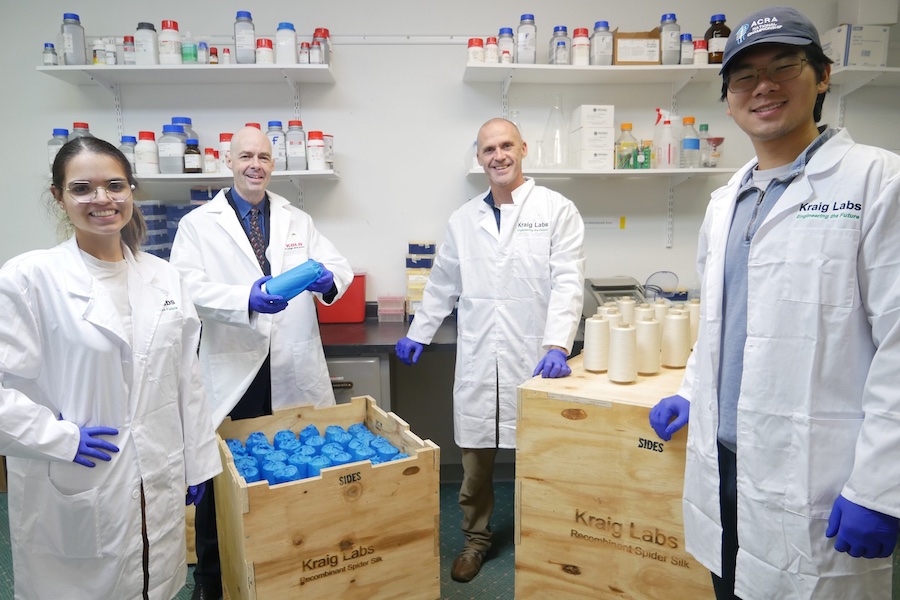
Kraig Biocraft Laboratories reports major progress converting record-setting spider silk cocoon production into reeled silk

Kraig Biocraft Laboratories, Inc. (OTCQB: KBLB) (“the Company”, “Kraig Labs”, or “Kraig’s”), a world leader in spider silk technology*, today announced significant progress in the processing of its recently produced recombinant spider silk cocoons into reeled silk.

Latest News

#Recycling / Circular Economy

Europe’s textile future at a turning point: New 2030 Circularity Blueprint aims to scale recycling and unlock investment opportunities

The EU textile system is at a critical crossroads. Today, less than 1% of discarded garments are recycled into new garments, despite EU-wide obligations for separate collection. In response, Global Fashion Agenda (GFA) is launching the 2030 Circularity Blueprint, in partnership with ReHubs. This ambitious initiative is designed to support the transformation of the EU textile ecosystem to advance textile-to-textile recycling and drive the transition to a circular economy.

#Research & Development

Regional hemp bast for lightweight construction profiles

The cultivation of fibre hemp for the production of ropes and clothing has a long tradition in Saxony. Due to its excellent fibre properties, it is also suitable as a renewable raw material for reinforcement in fibre composites. At the STFI and IWU in Chemnitz, the CannaPul project is cur- rently investigating how a regional value chain for hemp-based lightweight construction profiles can be established. To this end, the technical processing of hemp fibres into continuous fibre strands and their embedding in a suitable bio-based matrix are being investigated.

#Digital Printing

Kornit Digital launches Konnections 365

Kornit Digital (NASDAQ: KRNT) (“Kornit” or the “Company”), a global pioneer in sustainable, on-demand digital fashion and textile production today announced the launch of Konnections 365 - a year-round movement designed for the people moving the apparel, print, and retail industries forward. The strategy is built on the overwhelming success of Konnections 2026 held in Hollywood, Florida, featuring more than 500 customers, partners, and collaborators who together are driving the future of apparel and textiles.

#Techtextil 2026

Techtextil 2026: KARL MAYER impresses as an innovative sector partner

KARL MAYER looks back with satisfaction on its participation in Techtextil 2026. From April 21 to 24, the international industry leader used the trade show in Frankfurt to meet with numerous key customers at its booth and, at the same time, establish many new contacts. Most visitors came from Germany, followed by major markets such as Poland, the United Kingdom, Turkey, France, and Portugal.

TOP