[pageLogInLogOut]

#Recycling / Circular Economy

Renaissance Textile successfully starts up the first textile recycling line in France delivered by ANDRITZ
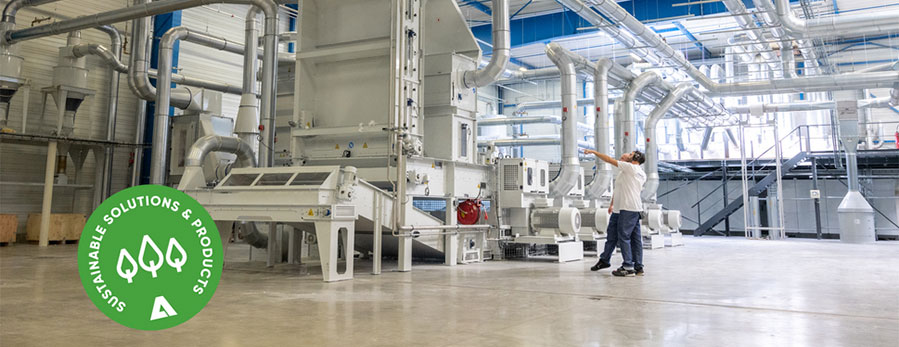
Tearing line by ANDRITZ in operation at the Renaissance Textile plant © Robin Inizan - Lucas Pavy Production
Renaissance Textile in Laval, France has successfully started up a complete textile recycling line, delivered, installed, and commissioned by ANDRITZ Laroche, part of the international technology group ANDRITZ.

Sustainable textile technology from ANDRITZ Laroche enables to carry out a breakthrough project based on the circular economy 

The state-of-the-art ANDRITZ textile recycling equipment enabled Renaissance Textile to become the first French recycling platform dedicated to industrial end-of-life textiles. The project aims to produce new fibers from the collected post-consumer apparel, which will be used to weave new recycled fabrics in the end.

The new 12,000 m² plant is equipped with a complete tearing line whose unique design is the result of close collaboration between R&D specialists from ANDRITZ Laroche and Renaissance Textile, as well as customized trials carried out jointly by the two parties at the ANDRITZ technical center in Cours, France.

The new clothing produced based on this type of circular economy model thus reflects the social and sustainability commitments of Renaissance Textile in terms of decarbonizing the textile industry, the fight against global warming, autonomy in raw material sourcing, and promotion of local staffing, particularly for people who have been unemployed for a long time or are seeking to enter the labor market for the first time.


It is the first milestone of a pioneering project that ANDRITZ is proud to actively support. By 2025, for example, Renaissance Textile plans to create no less than 110 direct jobs.

Nicolas Nojac, director of Renaissance Textile, comments: “Our first recycling line is dedicated to white polycotton textiles that mainly come from the healthcare and food processing industries. This equipment enables us to recycle 3,000 tons of textiles every year, representing 10 million items of clothing. We also plan to install two additional lines by the end of 2023 and 2025, respectively, to enlarge the range of recycled textiles by adding different colors and fibers”.



More News from Andritz Küsters GmbH

More News on Recycling / Circular Economy

Latest News

#Textiles & Apparel / Garment

VIATT 2026 to debut German Pavilion, strengthening European participation alongside key Asian textile hubs

Vietnam’s textile and garment sector continues to be a major contributor to the country’s economic growth, with export revenues expected to reach USD 46 billion in 2025, a 5.6% increase from 2024 . From 26 – 28 February, the Vietnam International Trade Fair for Apparel, Textiles and Textile Technologies (VIATT) is set to contribute to economic growth opportunities by accelerating digital transformation and green transition across the entire textile value chain. The upcoming edition will respond to the rising demand for advanced technologies and sustainable materials with the introduction of the German Pavilion, alongside strong exhibitor participation from key Asian sectors, as well as several high-profile fringe events.

#Sustainability

Ying McGuire becomes new CEO of Cascale

Cascale today announced the appointment of Ying McGuire as Chief Executive Officer, effective June 1, 2026.

#Technical Textiles

Sustainable, lightweight, and sound absorbing: Polyester-based front trunk solution for BEVs

As car manufacturers look to further reduce their carbon footprint, Autoneum has developed an innovative front trunk solution for battery electric vehicles (BEVs), made entirely from polyester-based textile. The Ultra-Silent Frunk offers significant weight reduction, improved acoustic and thermal insulation, and uses up to 70 percent recycled material, supporting sustainable and efficient vehicle design. Autoneum, global technology leader in acoustic and thermal management for vehicles, has already received orders for the new frunk from three major OEMs in Asia and Europe to be built in three BEV models. Series production for two BEVs has been underway in China and Germany since last year.

#Raw Materials

Modern testing methods for raw cotton

The 38th International Cotton Conference Bremen will take place from 25 to 27 March 2026 at the Bremen Parliament. This conference has traditionally stood for in-depth expertise and international exchange. The program will focus on technical innovations, market trends, and regulatory frameworks across the entire value chain – from agriculture to the circular economy. With high-profile speakers, the conference is regarded as the key meeting point for the global cotton industry. Today’s focus: Cotton quality and testing methods.

TOP