[pageLogInLogOut]

#INDEX 20

ANDRITZ to supply a neXline wetlace hybrid line to Albaad, Israel
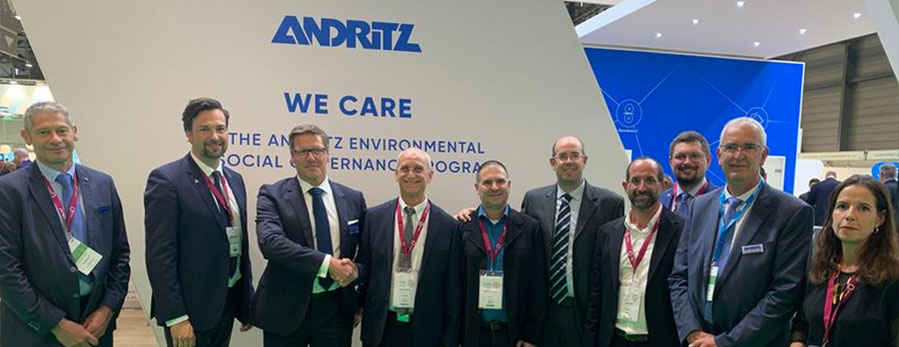
Albaad orders neXline wetlace hydrid - handshake at INDEX show © ANDRITZ
International technology group ANDRITZ has received an order from Albaad Massuot Yitzhak Ltd. to supply a neXline wetlace hybrid line for their Dimona facilities, Israel.

The line will produce a wide variety of pulp-based wet wipes and is scheduled for start-up during the third quarter 2023.

The state-of-the-art neXline wetlace hybrid is the perfect combination of inline drylaid and wetlaid web forming with hydroentanglement and drying, including quality control equipment and a Metris Industry 4.0 package. All components will be delivered by ANDRITZ and are designed to produce first-class fabrics, including biodegradable, carded-pulp and flushable/dispersible nonwovens for end uses as wipes.

Tobias Schäfer, Vice President Sales at ANDRITZ Nonwoven, comments: “Our innovative production line gives Albaad enormous flexibility in the production of wipes. In addition, the Metris digitalization package by ANDRITZ will provide Albaad with highly efficient and smart operation.”

Dan Mesika, CEO and President of Albaad, says: “We are dedicated to developing new products – such as eco-friendly, biodegradable wipes. As pioneering manufacturers of our Hydrofine® flushable wipes, we are committed to environmental sustainability. Thanks to the new ANDRITZ line, we will enlarge the product portfolio at our Dimona production site with innovative fabrics and high efficiency.


Gadi Choresh, President of the Nonwovens Division at Albaad, says: “Our knowledge and experience in drylaid and wetlaid technology, together with the state-of-the-art equipment supplied by ANDRITZ, will enable us to provide the market with natural-source nonwovens and the best answer to the market demand.”

Albaad is one of the world’s three largest wet wipe manufacturers and is committed to delivering excellent wipes for every need. The company runs world-leading production facilities on three continents, each equipped with the latest technologies. Albaad produces spunlace and flushable fabrics in its facilities as well as purchasing from other roll goods suppliers in order to support production of a wide variety of wipes.




More News from Andritz Küsters GmbH

More News on INDEX 20

Latest News

#Associations

Automation, digitalization and new business models are shaping the future of footwear and leather technology

The European footwear and leather machinery industry is facing profound transformations. Global competitive dynamics, technological innovation, automation and digitalization are fundamentally reshaping markets, production processes and business models. This is one of the key findings of the new study “Threads of the Future – Footwear and Leather Technology Edition”, which was presented today by VDMA Textile Care, Fabric and Leather Technologies (VDMA TFL) during a press conference at SIMAC Tanning Tech in Milan.

#Knitting & Hosiery

SHIMA SEIKI to showcase flat knitting and digital design solutions at Egypt Stitch & Tex

Leading Japanese computerized flat knitting technologist SHIMA SEIKI MFG., LTD. of Wakayama, Japan, together with its sales representative in Egypt, TTS (EL MASRIA FOR TRADE & TECHNICAL SERVICES), will participate in the upcoming 24th International Exhibition for Textile & Carpet Machineries, Printing Technologies and Accessories (Egypt Stitch & Tex) to be held in Cairo, Egypt this month.

#Associations

EURATEX calls for urgent action on industrial competitiveness

EURATEX, the European Apparel and Textile Confederation, welcomes today’s State of the Union Address by European Commission President, Ursula von der Leyen, and in particular her recognition of Europe’s need to rebalance unfair trade, cut red tape, and strengthen its industrial and strategic autonomy.

#Raw Materials

Cotton made in Africa puts farmer dialogue at the heart of agricultural training

A new manual created by the Aid by Trade Foundation and African People & Wildlife shows how Cotton made in Africa aims to transform cotton cultivation through dialogue rather than directives.

TOP