[pageLogInLogOut]

#ITMA Asia + CITME 2020

Loepfe will present YarnMaster® PRISMA in Shanghai

Loepfe showcases in Hall 8 – Booth C22 the market-leading YarnMaster® PRISMA along with its well-established counterpart YarnMaster® ZENIT+. With this dual offering, Loepfe uniquely leads both on technology and performance as well as on the proven reliability and price dimensions.

YarnMaster® PRISMA dazzles with its innovative use of four distinct sensor technologies – a unique blend that for the first time combines infrared optical, RGB optical, capacitive and triboelectric sensors and collaborating in perfect harmony, along with connectivity for the digital age. These elements not only allow the detection of previously invisible yarn faults and irregularities, but also the collection and analysis of data for effective online quality management through Loepfe’s MillMaster® TOP management cockpit.

Loepfe’s Head of Product & Solutions, Guido Wieland commented: “YarnMaster ZENIT+ is highly regarded as our workhorse and has been well-established over the years. And while our competitors are still using sensor technology that has been developed more than a decade ago, with YarnMaster® PRISMA we have clearly set the global benchmark for yarn clearing sensor technologies. Drawing on today’s smart technology, we have taken performance in its various applications to a whole new level. The whole team is excited to see the enthusiasm generated by the YarnMaster® PRISMA – and our motivation to deliver even more intelligent solutions is at an all-time high. Watch this space!”


Due to the prevailing Covid-19 travel restrictions, Loepfe will be represented at ITMA Asia 2021 by its partners C.N.T. - CIMACO Ltd. and Point Hope (Textile Machinery) Ltd., while Loepfe representatives will be available for ad-hoc conference calls at any time.

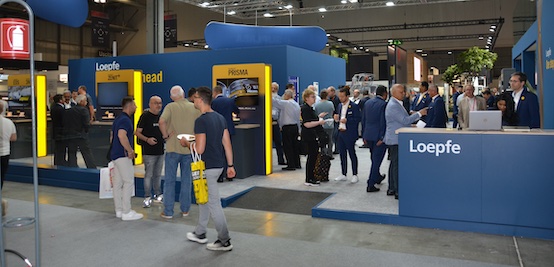
© 2021 Loepfe
© 2021 Loepfe


More News from LOEPFE BROTHERS LTD.

More News on ITMA Asia + CITME 2020

Latest News

#Spinning

Ibrahim Fibres and Trützschler: A strong partnership enters its next phase with the TC 30Si

For more than two decades, Ibrahim Fibres and Trützschler have grown side by side, driven by a shared ambition to continuously improve spinning performance, strengthen technology leadership and set new benchmarks in the textile industry. Today, Ibrahim Fibres is a leading yarn and polyester staple fiber manufacturer in Pakistan. The company operates the largest number of Trützschler cards in the country, with more than 200 machines running across its mills in Faisalabad, and plays an important role in one of Asia’s largest textile industries.

#Digital Printing

USColorworks expands digital platform with Kornit Atlas MATRIX and Atlas MAX PLUS solutions

Kornit Digital Ltd. (NASDAQ: KRNT), a global pioneer in sustainable, on-demand digital fashion and textile production, today announced that USColorworks, a North Carolina-based apparel decoration and fulfillment company specializing in custom and on-demand printing for retail and promotional markets, has expanded its Kornit digital production platform with the addition of Atlas MATRIX and Atlas MAX PLUS systems to deliver high-quality, on-demand apparel across cotton, blended fabrics and polyester.

#Functional Fabrics

CovationBio introduces two new bio-based innovations at Functional Fabric Fair New York

Covation Biomaterials LLC (“CovationBio®”) is showcasing its two new bio-based innovations, Xatryx® and Sorona® elasterell-p fiber, at this year’s Functional Fabric Fair in New York City, July 7–9, 2026. Attendees can visit CovationBio at Booth #404 to explore this next generation of bio-based performance materials.

#Research & Development

Geotextiles made from recycled materials: GREEN leads the way into the industry

For the industry, recycled materials are creating new opportunities in geotextile production. In the GREEN project, the Fraunhofer Cluster of Excellence Circular Plastics Economy CCPE demonstrates that recycled polypro-pylene (PP), polyethylene terephthalate (PET), and high-density polyeth-ylene (HDPE) can be processed into nonwovens, fibers, and membranes that meet industrial requirements. This creates opportunities for use in existing production lines and new value chains in the geotextile market.

TOP