[pageLogInLogOut]

#INDEX 23

Thinking sustainability further: Sandler to focus on holistic material concepts at INDEX™

At this year‘s Index™, Sandler will showcase high-performance quality nonwovens, that pave the way for environmentally friendly product solutions – optimized from raw material selection to recycling.

Nonwovens manufacturer Sandler will present innovations and initiatives to implement performance and sustainability throughout the product life cycle and beyond.

For the hygiene industry, nonwovens for fluid transport (ADL) as well as backsheets set standards, made from 100% raw materials from renewable sources. In wipes applications, nonwovens made up to 100% from natural fibers offer new alternatives for single-use products in cleaning and personal care. In this segment, Sandler also utilizes its expertise of different production technologies: Latest developments for wipes show the way towards climate neutrality through the use of more energy efficient manufacturing processes. With the established Sandler standard of quality, these substrates combine a soft touch and optimized cleaning owing to an enlarged surface. Owing to the special production process an increased choice of alternative raw materials can be used – including 100% based on renewable sources. In addition, the use of this specific process allows for an up to 70% reduction of CO2 compared to established production processes for wipes substrates.

Together with customers and partners along the supply chain Sandler continues to expand its initiatives for sustainable product solutions, Sandler is also testing ways of recycling and reusing trims or faulty material in the production of its technical nonwovens. Thus keeping resources in a closed cycle, Sandler is implementing the concept of circular economy and reducing the carbon footprint of its products.

Sandler also offers a sustainable solution for the automotive industry: Fast Forward Fabric – the symbiosis of maximum performance and resource conservation.

These textile materials are the base material for a variety of self-supporting moulded parts in interior and exterior applications. Made from 100% polyester with up to 80% post-consumer recycled fibers these nonwovens reduce the use of virgin resources while being fully recyclable themselves at the end of their service life.


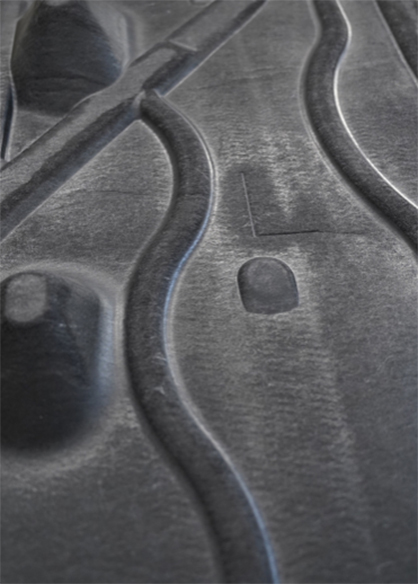
In this way, Fast Forward Fabric creates closed material cycles and fulfills the most demanding sustainability requirements. The nonwovens support the implementation of specific design concepts in in all types of vehicles. Processing results in highly stable moulded parts, realizing even complex component geometries. At the same time, the materials feature a significantly lower weight compared to standard materials, high temperature stability and resistance to all common engine compartment fluids Their open-pore structure combines noise dampening and thermal management. Specific material configurations enable optimized vehicle acoustics – inside the passenger compartment as well as towards the surroundings. Through targeted processing, specific surface structures can be generated, making the nonwovens a design component in the vehicle as well.

Visit Sandler at INDEX™ 2023 and and share our ideas for our common future. Out team from Sales and Product Development is looking forward to welcoming you at booth 1530.
© 2023 Sandler
© 2023 Sandler


More News from Sandler AG

#Nonwovens

Sandler turns financial stability into a catalyst for shaping the future

The Sandler Group has presented its financial figures for the past fiscal year (01/01/2025-12/31/2025). Like previous years, the year 2025 was also marked by industry-wide structural challenges and geopolitical uncertainties. Turnover was virtually stable at EUR 321 million (2024: EUR 326 million). High energy costs continue to weigh heavily on profitability. The number of employees was 975 (2024: 980). The family-owned company, which was founded in 1879 and has been run by the fifth generation since August 2025, continues to invest millions in its Schwarzenbach site despite the high production costs in Germany. As part of the long-term corporate strategy, the management team is focusing on strict cost management, further development of the product portfolio, and greater efficiency in production and administrative processes. The company does not expect a market recovery in 2026 and 2027.

#Nonwovens / Technical Textiles

Sandler AG & Phoenix Non Woven—new partnership, new opportunities

Sandler AG invests in wet-laid technology to strengthen its innovation pipeline and broaden market reach. Schwarzenbach an der Saale, Germany, July 24, 2025. Sandler AG, a global leader in nonwoven textiles, has acquired a 24.9% stake in Phoenix Non Woven GmbH & Co. KG, a pioneering company based in Lenningen, Baden-Württemberg, Germany. Phoenix emerged as an innovative spin-off from the former Scheufelen paper factory and specializes in the production of high-performance nonwovens using wet-laid technology.

#Nonwovens / Technical Textiles

Philipp Ebbinghaus appointed as the new CEO at Sandler AG

At its meeting yesterday, the Supervisory Board of Sandler AG made significant decisions regarding the company’s future leadership. Effective August 1, 2025, Philipp Ebbinghaus (40), currently CFO, will assume the role of CEO of Sandler AG. As the nephew of the current CEO, Dr. Christian Heinrich Sandler, he represents the fifth generation of the founding family to lead the company.

#Nonwovens / Technical Textiles

Sandler Gruppe launches finexus® brand: Sustainable nonwovens for molded parts in vehicles

finexus® - the solution for sound insulation, thermal insulation, and sustainability in vehicles. These nonwovens prove themselves in a variety of molded part applications in the mobility sector. In interior or exterior applications of passenger and commercial vehicles, the single-polymer material finexus® offers what was previously implemented using multilayer structures. From underbody to headliner and from wheel arch liner to trunk liner; with conventional drives or in electromobility.

More News on INDEX 23

Latest News

#Composites

KARL MAYER strengthens partnerships in the composites industry at JEC World 2026

KARL MAYER further strengthened its role as a reliable and competent partner to the composites industry at JEC World 2026. The global market leader in textile machinery manufacturing used the trade show to meet key customers, establish numerous new contacts, and engage in in-depth technical discussions.

#Recycling / Circular Economy

ABB and Syre partner to explore technologies for industrial-scale textile recycling

ABB has signed a Memorandum of Understanding (MoU) with Swedish textile impact company Syre to jointly explore technologies to support the development of Syre’s first textile-to-textile recycling plant in Vietnam. The agreement establishes a framework for collaboration to investigate how ABB’s automation, electrification and digital technologies could contribute to safe, efficient and scalable operations. It will also explore how these capabilities could further optimize process and quality control performance as Syre advances its ambition to produce circular polyester at industrial scale.

#Techtextil 2026

From Nature Performance to Circular Economy: Techtextil 2026 focuses on the future market for technical textiles

Alternative materials and recycling technologies are one of the most important future segments and drivers of innovation in technical textiles. Sustainability goals and regulatory requirements increase their relevance, while advances in performance and economic viability enhance their market competitiveness. Taking place from 21 to 24 April 2026, Techtextil reflects this key industry trend with a growing number of specialised exhibitors. With the new “Nature Performance” label, the leading global trade fair bundles relevant market offerings and facilitates access to new solutions – from natural fibres and yarns to bio-based materials and circular approaches.

#Research & Development

Textile cascade filter for removing microplastics from wastewater

Microplastics are now found almost everywhere, even in remote regions of Antarctica. They enter the human body through the food chain. Studies indicate that microplastics may have negative effects on the human health.

TOP