#IDEA 2022
Customer- and market-oriented systems solutions for the nonwovens world
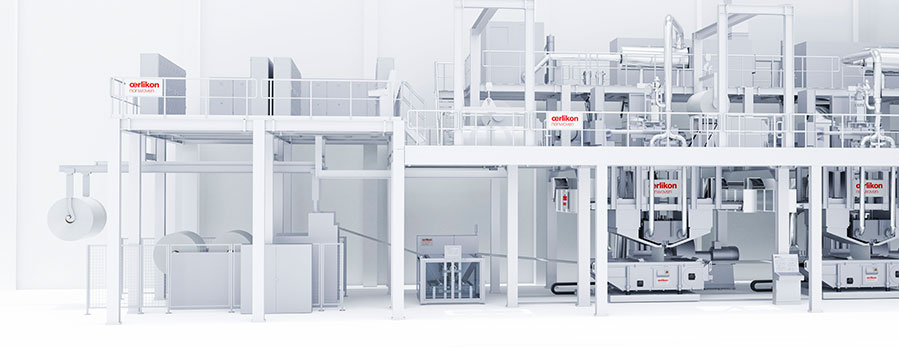
The Phantom technology is revolutionizing the nonwovens process
With its Phantom platform, Oerlikon Nonwoven offers an innovative co-form technology for manufacturing various wet wipes from pulp and polymer fibers. Here, the spunmelt and airlaid processes are combined in a manner that perfectly unites the properties of the starting materials. The material mix can comprise up to 90% cellulose fibers. Alternatively, cotton or synthetic fibers can also be added.
Compared to processes such as classical spunlace (hydroentangled carded nonwovens) produced to date, the patented Phantom technology offers ecological, performance and cost advantages. The sustainable process stands out above all with regards to energy efficiency and water consumption as well as user-friendliness. Dispensing with hydroentanglement renders subsequent drying of the material redundant. Product parameters, such as softness, tenacity, dirt absorption and liquid absorption, can be optimally set. The Phantom technology enables the manufacture of both flexible and absorbent structures and highly-textured materials.
Airlaid technology for sustainable nonwovens
Pulp or cellulose fibers as raw material for manufacturing nonwovens are currently virtually unrivaled with regards to sustainability and environmental compatibility. The Oerlikon Nonwoven airlaid process is the ideal solution for processing this raw material into high-end products for a wide range of applications. Today, there is huge demand for manufacturing solutions for high-quality, lightweight airlaid nonwovens with economically-attractive production speeds and system throughputs. Here, the patented Oerlikon Nonwoven formation process is setting standards – for homogeneous fiber laying and superb evenness even for nonwovens with low running meter weights. Furthermore, it permits the homogeneous mixing of the most diverse raw materials, including pulp, short- and long-staple natural and manmade fibers (up to 20 mm) and powders, as well as the utilization and combination of the most diverse mechanical, thermal and chemical tangling methods for creating the requisite product properties.
Oerlikon Nonwoven’s airlaid technology is also perfectly suited to expanding typical spunlace systems in order to add a cellulose layer to the product that, for example, improves the water absorbency of wipes using a low-cost and biodegradable raw material.
QSR: attractive spunmelt systems for the hygiene and medical market
For manufacturing hygiene and medical nonwovens, the QSR (Quality Sized Right) technology offers a financially-attractive solution for producing these highly-diverse spunbond and meltblown composites (SSMMS, SMMS, SSS, etc.) in accordance with globally-accepted standards. As a result of intensive collaborations and partnerships, close-knit quality assurance measures and extensive interaction with its technology partners, Oerlikon Nonwoven is able to equip this type of system with unique features that enable producers to distinguish themselves within their respective markets with special nonwoven properties such as higher volumes, softness and customer-specific embossed patterns, for example.
Filtration: leading meltblown competences from Neumünster
Unique and highly-sophisticated nonwovens for filtration, insulation and sorption applications can be simply and efficiently manufactured thanks to Oerlikon Nonwoven’s meltblown technology. The polymers used to produce the filter media and membranes are as diverse as their field of applications. The spectrum ranges from classical polyolefins (PP, PE), PET, PLA, PBT and PA all the way through to special plastics such as PPS and TPU. All these, and other raw materials, can be reliably processed using the Oerlikon Nonwoven meltblown technology.
Filter media can be efficiently electrostatically charged with the ecuTEC+ electro-charging unit developed by Oerlikon Nonwoven for increasing the filtration performance of meltblown media without reducing air permeability. It distinguishes itself from other concepts currently available on the market as a result of its extreme flexibility. Users can choose from numerous possible variations and hence set the optimum charge intensity for their respective filter applications. However, ecuTEC only represents the beginning of an era of new charging and treatment systems available from Oerlikon Nonwoven for further increasing media filtration performance and product diversity.
Comprehensive spunbond portfolio – always the right solution
For industrial nonwovens, Oerlikon Nonwoven systems are capable of high production capacities and yields with simultaneously low energy consumption. To this end, geotextiles made from polypropylene or polyester can be efficiently manufactured with running meter weights of up to 400 g/m2 and filament titers of up to 9 dtex, for example. And Oerlikon Nonwoven also offers specialized spunbond processes for producing nonwoven substrates for roofing underlays (PP or PET spunbonds) and so-called bitumen roofing substrates (needled PET spunbonds) for bitumen roofing membranes.
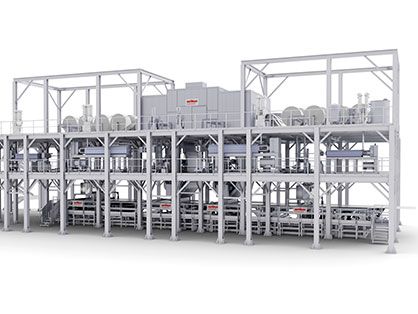
Furthermore, spunbond products are also becoming increasingly important in filtration applications – both as backing materials for filter media and as the filter media themselves. A flexible nonwoven structure permits the inclusion of customer-specific requirements for various functions. It is Oerlikon Nonwoven’s many years of core-sheath bi-component experience in particular that enable the creation of completely new nonwoven structures and hence the incorporation of various functions in a single material. The core-sheath bi-component spinning process permits various combined fiber cross-sections and also simultaneously different fibers to be produced from a single or different polymers. The spectrum ranges from core-sheath and side-by-side bi-component filaments, splitable fibers all the way through to so-called mixed fibers.