[pageLogInLogOut]

#Functional Fabrics

“Action helps us change what we do!”
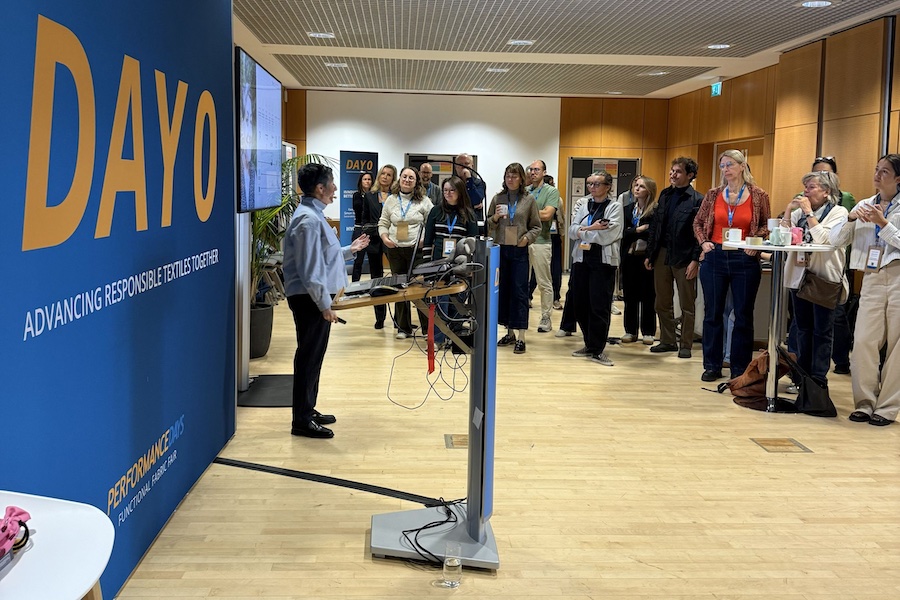
Bowie Miles speaking at DAY 0 © 2026 PERFORMANCE DAYS
DAY 0 takes place deliberately before PERFORMANCE DAYS begins. It is conceived as a space for reflection, dialogue and active engagement — a moment to pause before the fair, rethink established systems and address sustainability not as a trend, but as a fundamental transformation challenge. Under the guiding metaphor “Turn the Tap Off”, DAY 0 focuses on root causes rather than symptoms, systemic change rather than isolated solutions, and collective responsibility rather than individual silos.

In this conversation, Bowie Miles, who is guiding through this interactive workshop-experience in March again, reflects on why transformation must start upstream, why participation matters more than presentations, and how real change can move from ambition into action.

A conversation about rethinking sustainability, circularity and real impact in the textile industry

Why is DAY 0 positioned before PERFORMANCE DAYS?

Bowie Miles: The exact timing matters less than the connection. DAY 0 should not feel like an add-on, but as an integral part of the PERFORMANCE DAYS experience. Its messages need to flow into the fair itself — through visibility, communication, and continuity. A stronger bridge between DAY 0 and PERFORMANCE DAYS would increase relevance, impact, and long-term value.

Why do we need collaborative spaces instead of traditional listening formats?

Bowie: Because knowledge already exists — the real value lies in shared learning and connections. Active participation creates deeper engagement. People connect on a deeper level when they are part of the process rather than passive listeners. Co-creation leads to commitment, action, and long-term impact.

What does “Turn the Tap Off” represent for the textile industry?

Bowie: It represents the need to stop uncontrolled resource extraction. If we don’t consciously turn the tap off, it will eventually run dry. The metaphor highlights a shift from managing consequences to addressing root causes — from extraction to regeneration, from footprint to handprint. Real change starts at the source, not at the overflow. And at the end – we all should understand, that having a shower is more efficient.

Why does sustainability still focus so much on end-of-life solutions?

Bowie: Because they are easier to grab and fit existing business models. End-of-life solutions manage the symptoms but often depend on the problem continuing to exist. Real transformation requires addressing the source of the problem — slowing down, controlling, or turning off the flow rather than managing the overflow.

Where are the biggest leverage points for change upstream?

Bowie: In controlling production volumes. The industry must return to a needs-based model — producing what is needed, not what can be sold. Designing durable, long-lasting products reduces consumption, waste, and overstock. Business models must shift from volume growth to quality, longevity, and responsible production.

How does understanding material flows change circularity?

Bowie: It shifts the focus from isolated actions to the full value chain. The biggest impacts happen upstream — in raw materials, fiber, yarn, dyeing, and processing. When brands understand these flows, they can make better decisions early in the process, where real leverage exists.

Why is hands-on work essential for sustainability?

Bowie: Because it makes sustainability tangible and real. Active participation creates understanding that lasts. When people map systems themselves, learning becomes personal, practical, and transformative — not theoretical. I am sure: “Action helps us change what we do!”

What should participants take away from DAY 0?

Bowie: A mindset shift. Sustainability is not a job role or working-hours topic — it’s a lifestyle responsibility. Change starts with awareness, small actions, and personal accountability. Small wins create momentum.

Why must individual responsibility connect with industry change?

Bowie: Because sustainability is shared responsibility. Systems are shaped by people, and real change happens when personal values align with organizational action. Long-term resilience depends on collective accountability.

How do we move sustainability from ambition into real-world action?

Bowie: Through engagement, dialogue, and our experiences. Sustainability must be felt, understood, and internalized — not just written into strategies. Only then does it become embedded and authentic.

What role does honesty play?

Bowie: Honesty enables real connections. Without openness and vulnerability, conversations remain superficial. Honest dialogue allows industries to move beyond roles and titles toward shared responsibility and real progress.

What must change in the next 5–10 years?

Bowie: The industry must stop repeating the same discussions without action. Overproduction, resource scarcity, and social pressures make the current model unsustainable. The future depends on conscious decisions: producing less, producing better, and aligning business with planetary limits.

What gives you hope that transformation is possible?

Bowie: Human adaptability. Crises show that people can change quickly. Hope lies in compassion, connection, and a shift in values — away from accumulation and toward experience, relationships, and meaning.

Why should people join DAY 0 — even if they already know a lot about sustainability?

Bowie: Even for those who already have a strong understanding of sustainability, DAY 0 offers a different kind of value. It creates a space for openness, honesty, and reflection—allowing participants to engage with complex and sometimes uncomfortable topics in a way that goes beyond theory. Rather than relying on passive listening, DAY ZERO emphasizes active participation and shared experience. Being involved in the process encourages reflection, accountability, and action, even if those actions begin with small steps. This hands-on approach helps translate knowledge into behavior and supports meaningful change. By working together, participants can inspire one another and build a sense of positive accountability. In this way, DAY ZERO is not about learning more facts, but about reconnecting with purpose, perspective, and the practical steps needed to move forward.


DAY 0:

DAY 0 takes place intentionally before PERFORMANCE DAYS as a moment to pause, reflect, and reset. It creates space to step back from business as usual and address sustainability at its roots—before products, strategies, and decisions take shape. Rather than focusing on trends or end-of-life solutions, DAY 0 invites participants to engage with systemic change, shared responsibility, and practical action. It is a starting point for honest dialogue, collaboration, and a shift from ambition to real-world impact.

BOWIE MILES:

Bowie Miles has been responsible for DAY 0 since the Autumn edition of PERFORMANCE DAYS and leads the workshop with a strong focus on dialogue, participation, and real-world impact. With a deep understanding of sustainability, material flows, and systemic change, she brings both strategic insight and personal conviction to the format. Her approach connects industry expertise with hands-on engagement, creating a space where complex topics can be addressed openly and translated into meaningful action.

Learn more about the complete schedule of DAY 0 here:

https://www.performancedays.com/the-fair/day-0-conference/tickets-and-program.html


More News from PERFORMANCE DAYS ® functional fabrics fair

#Functional Fabrics

PERFORMANCE DAYS: Focus topic shifts to the beginning of the value chain

Following the last Focus Topic in October 2025, which placed Textile-to-Textile Recycling at its core, PERFORMANCE DAYS continues to drive the conversation around circularity – this time with an expanded and more upstream perspective. The upcoming Focus Topic, “Textile to Textile: The Role of Collectors and Sorters,” presented during the spring edition on March 18–19, will spotlight one of the most essential yet often overlooked components of a functioning circular textile system: the efficient collection and sorting of post-consumer textiles.

#Functional Fabrics

PERFORMANCE DAYS sets benchmarks with record attendance & strong industry presence

With around 4,500 professional visitors and 515 exhibitors, PERFORMANCE DAYS closed its doors on October 30, 2025, after two highly successful days in Munich. Expanded show areas, an international audience, a top-class Expert Talks program, and an inspiring DAY 0 Conference with an innovative concept underlined one thing clearly: PERFORMANCE DAYS has become the leading business platform for the functional textile industry.

#Technical Textiles

PERFORMANCE DAYS Autumn Fair 2025: full house in Munich

On October, 29–30, 2025, PERFORMANCE DAYS opens its doors in Munich – fully booked, with bustling halls, top-tier exhibitors, and a diverse supporting program, the leading trade fair for functional fabrics and sustainable textile innovations once again confirms its relevance for the industry. Visitors can look forward to a varied program with high-profile exhibitors, new areas, inspiring Trend Forums, the current Focus Topic, and an expanded Footwear Area. Another highlight: the Innovation Hub by FFE, a curated area in cooperation with the Future Fabrics Expo.

#Textiles & Apparel / Garment

PERFORMANCE DAYS spring edition sets strong impulses

Once again, PERFORMANCE DAYS has proven to be the most important gathering for the functional textile industry. The Spring 2025 edition, held from March 5–6 at Messe München, attracted numerous industry experts and trade visitors, offering a unique platform for networking, business, and knowledge exchange. With 588 booths and 3,367 visitors, the event significantly surpassed previous years’ numbers. In comparison, the previous spring edition had fewer than 500 booths and 2,999 visitors.

More News on Functional Fabrics

#Fabrics

MUNICH FABRIC START: Between Attitude and Sensuality

The future begins where we reimagine it. After seasons of restraint, Spring.Summer 27 marks a conscious counter-trend: optimism, sensuality, and creative freedom are replacing pragmatism and neutrality. Physical presence and individuality are regaining importance – as a response to uncertainty, exhaustion, and algorithmic predictability. The overarching theme of PLEASURE stands for fashion as an emotional space, as an expression of attitude and cultural reflection. Colours, surfaces, and materials become vehicles for self-confidence and joie de vivre.

#Fabrics

MUNICH FABRIC START: Frank Junker steps down as Creative Director and Shareholder

The organisers of MUNICH FABRIC START Exhibitions GmbH today announced Frank Junker's decision to step down as Creative Director and shareholder of MUNICH FABRIC START Exhibitions GmbH after around 20 years. The long-standing advisor to the international fabric trade show in Munich wishes to devote himself to new entrepreneurial tasks and projects in the event industry.

#Functional Fabrics

Getzner Textil launches new getzspace® three-dimensional weaving at Functional Fabric Fair

Getzner Textil AG, global leaders in technical textiles made for a wide range of applications, is proud to announce the launch of their new getzspace® three-dimensional weaving technology.

#Fabrics

Pioneering functional excellence and trusted innovation for the evolving sports apparel industry

ROICA™, the premium stretch fiber by Asahi Kasei, proudly announces its highly antici-pated debut at Performance Days this October in Munich. As the sports apparel industry continues its rapid evolution, ROICA™ steps onto this global stage to showcase its ad-vanced functionality, trusted brand reliability, and commitment to environmentally con-scious innovation.

Latest News

#Textiles & Apparel / Garment

Pets in fashion: functional and sustainable textiles find new market at Intertextile Apparel

China’s pet economy is booming, especially amongst younger generations, and pet apparel – from designer outfits to functional garments – was a RMB 3.5 billion (over USD 500 million) market in 2024, growing more than 20% annually¹. To help exhibitors harness this trend, Intertextile Shanghai Apparel Fabrics – Spring Edition 2026 will launch the Pet Boutique, presenting a range of innovative, sustainable materials that prioritise both functionality and comfort for pets.

#Sustainability

VAUDE eliminates PFAS from all products

PFAS (per- and polyfluoroalkyl substances) are now detectable worldwide – in drinking water, soil and the human body. These so-called “forever chemicals” are considered hazardous to health and potentially carcinogenic, as they do not break down and remain in the environment permanently. Despite these risks, PFAS are still used in a wide range of products. More than 15 years ago, VAUDE made a strategic decision to gradually eliminate PFAS from all product categories.

#Man-Made Fibers

Lenzing AG to become majority owner of TreeToTextile AB and accelerates industrialization of new fibers

The Lenzing Group is taking another strategic milestone by acquiring a controlling majority in the Swedish innovation company TreeToTextile AB. This step strengthens Lenzing’s position as a leading provider of sustainable, wood‑based specialty fibers and expands its innovation pipeline with a highly scalable, patent‑protected technology platform. The transaction is executed through the issuance of new shares.

#Raw Materials

Better Cotton Initiative marks certification anniversary with progress update and accreditation

One year since becoming a certification scheme, the Better Cotton Initiative (BCI) has announced that more than 3,000 supply chain actors have been certified. At farm level, more than 30% of farms and producer units supplying BCI Cotton have received a positive audit outcome.

TOP