[pageLogInLogOut]
You can feel it's Benninger!

#Dyeing, Drying, Finishing

Monforts ATC adventures in aquaculture
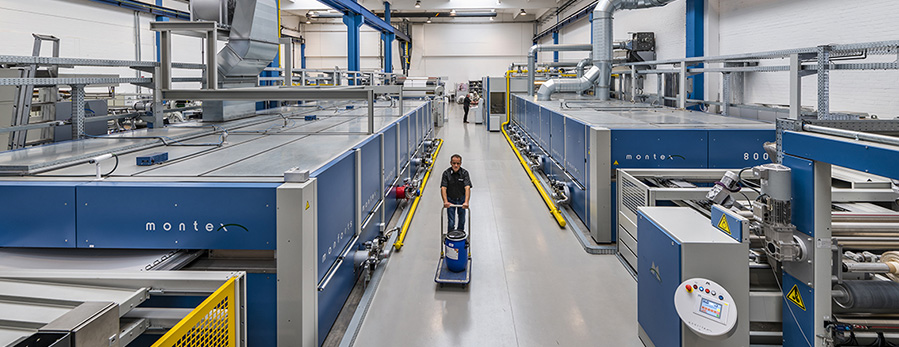
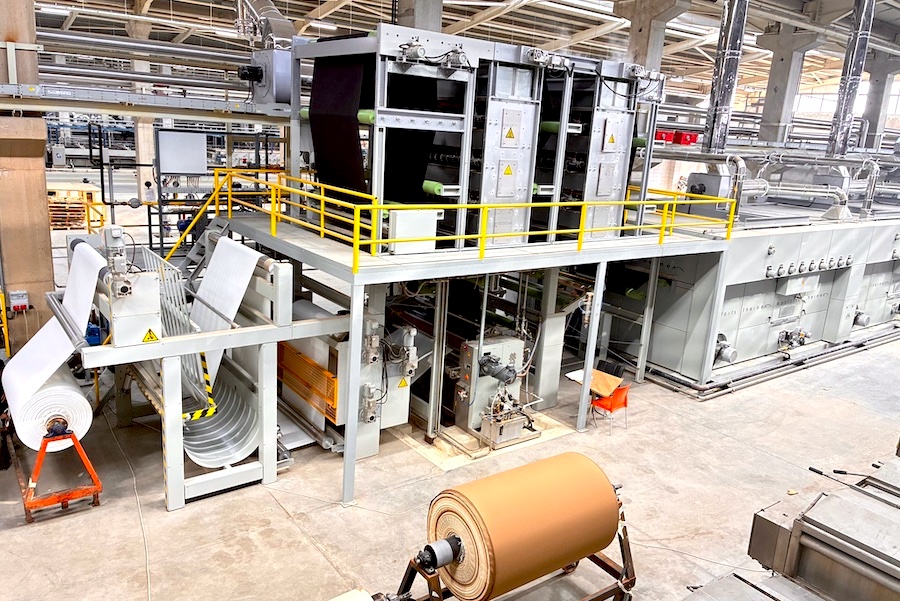
Over €3 million has been invested in industrial-scale equipment at the Monforts Advanced Technology Centre (ATC) in Mönchengladbach, Germany (c) 2020 Monforts
Monforts has recently been involved in a number of R&D trials aimed at improving the performance of the fishing cage nets employed in fish farming operations at its Advanced Technology Centre (ATC) in Mönchengladbach, Germany.

The cultivation of both freshwater and saltwater fish populations under controlled conditions is a global industry valued at around $200 billion annually and only made possible with the use of huge aquaculture nets.

Biofouling

“These nets are very prone to biofouling and to avoid its negative impacts, high-pressure robotic jets are now used to clean them,” explains Monforts Head of Technical Textiles Jürgen Hanel. “Net cleaning is expensive and can also damage current antifouling coatings on the nets, causing contamination as well as fish health and welfare risks.

“The abrasion resistance of the nets is also extremely important, because in addition to the general wear and tear of the underwater environment, they also contain a lot of potential food for predatory bigger fish, such as sharks. Even sea lions have been known to be attracted to these fish farming cages, but have the advantage of being able to jump over the top of them if they’re not sufficiently protected.”

The development of more effective antifouling coatings for fishing cage nets has been one aspect of R&D work at the Monforts ATC, while the use of how alternative fibres could potentially be coated or finished to replace the polyamide which is currently most widely used has also been explored.

The issue of plastics and synthetic fibres in the oceans has generated global media attention recently, and the aquaculture industry is exploring all avenues that will lead to more sustainable practices.

Diverse applications

“We are asked to investigate a wide range of fabric finishes and coatings at the ATC, where our customers can test their own textiles and technical fabrics on Monforts dyeing, finishing and coating machines under fully confidential, real production conditions,” says Jürgen Hanel.
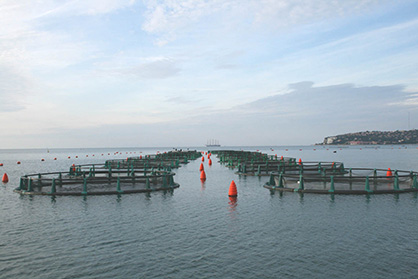
A modern seawater fish farm off the coast of Slovenia (c) 2020 Monforts


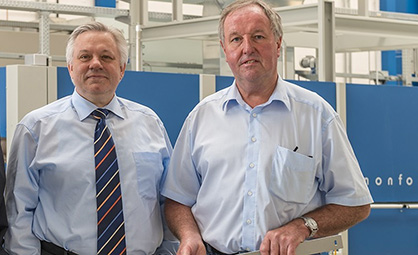
Monforts Head of Technical Textiles Jürgen Hanel (left) with ATC manager Fred Vohsdal, who has now worked for the company for 51 years and has a wealth of accumulated know-how to share with customers (c) 2020 Monforts


“The range of textiles finished or coated with Monforts technologies is already extremely diverse, including standard knits and wovens, as well as advanced denim. When it comes to technical textiles, our lines are already being used commercially for treating substrates for digitally-printed soft signage, carbon fabrics for composites, filter media which must perform in extreme temperatures and flame retardant barrier fabrics, to name just four applications, but the list gets longer all the time.”

Expansions

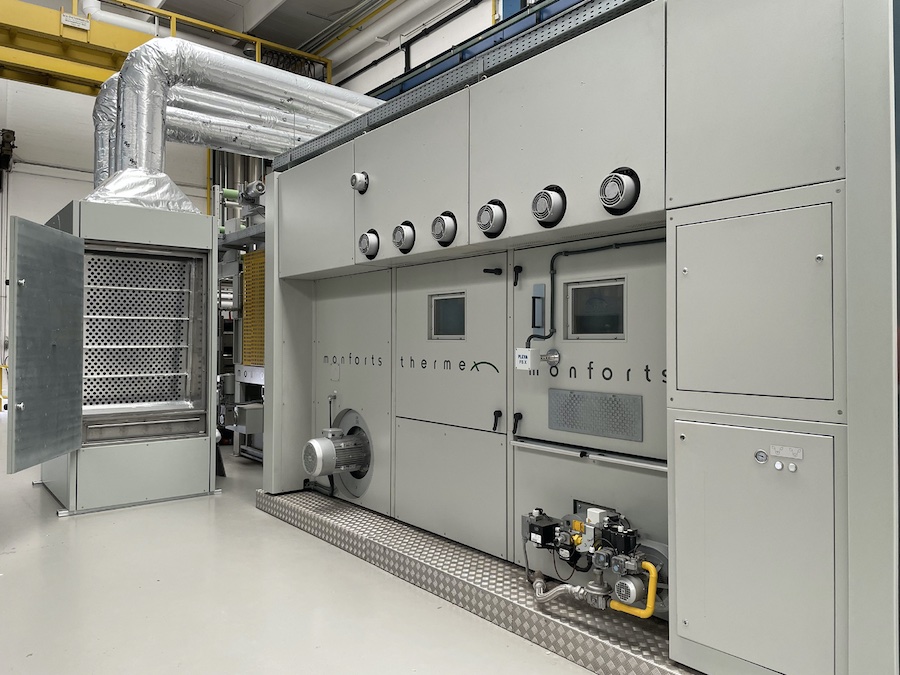
Since its opening in 2013, over €3 million has been invested in equipment at the Monforts ATC, which over an area of 1,200 square metres houses two full finishing lines, engineered to accommodate an extremely diverse range of processes, in addition to a Thermex range for the continuous dyeing of denim.

Recent expansions have included the installation of the latest Monforts texCoat coating system, with its multi-head capability, and the CYD yarn dyeing system for denim, both of which received an enthusiastic reception at last year’s ITMA show in Barcelona.

“We have subsequently demonstrated the potential of these new technologies to many customers during their visits to the ATC, in addition to running full trial programmes on our industrial-scale machines,” Jürgen Hanel concludes. “The intended end-uses may not always be as unusual as fishing cage nets, but whatever the application, trials in real production conditions yield the results that enable us to make many recommendations for improving fabric finishes and coatings.”
More News from A. Monforts Textilmaschinen GmbH & Co. KG

More News on Dyeing, Drying, Finishing

#Dyeing, Drying, Finishing

Smart Quality Control for Technical Textiles

In the end, what matters is the result: a filter that performs reliably, a membrane that remains stable in storm conditions, a composite material with precisely defined properties. But the path to achieving this is demanding. In the production of technical textiles, numerous parameters interact – and even the smallest deviations can have major consequences.

#ITM 2026

The address for environmentally friendly dyeing and finishing systems: ITM 2026

Dyeing and finishing technologies, one of the most critical and value-added areas of the textile sector, have gained strong growth momentum on a global scale. Technologies that are pioneers of this transformation focused on sustainability, quality and efficiency will meet with sector professionals at the ITM 2026 International Textile Machinery Exhibition. Dyeing and Finishing Hall (11–12) will host the latest technologies that increase efficiency, optimize resource use and reduce environmental impact in textile finishing processes.

#Techtextil 2026

iNTERSPARE presents latest developments and upgrade solutions for technical textile finishing at Techtextil

iNTERSPARE Textilmaschinen GmbH will present its latest solutions for technical textile finishing at Techtextil 2026 in Frankfurt (VDMA joint stand, Hall 12 / Stand C55A). The focus will be on further developments within the Krantz, Artos and Babcock (BTM) product lines, in particular the Krantz K30 stenter as well as the reintroduction of the Artos Vari-Flex foulard. The presentation will be complemented by modular solutions for upgrading existing installations and new approaches in automation and digitalization.

Latest News

#INDEX 2026

“We clearly see that reliability, flexibility, service and total cost of ownership are becoming increasingly important again.”

The nonwovens industry continues to face a challenging market environment. Nevertheless, AUTEFA Solutions reports successful projects, new line sales and growing demand for energy-efficient and flexible solutions. In this interview, André Imhof of AUTEFA Solutions talks about competitiveness against Chinese suppliers, new service and recycling concepts, the growing importance of application development and the opportunities created by countercyclical investments.

#INDEX 2026

“Needle punching technology is more universal and sustainable than ever!”

Needle punching technology was long regarded as a rather traditional and comparatively slow technology within the nonwovens industry. In this interview, Johann Philipp Dilo explains why needle punching is more relevant than ever today – ranging from energy efficiency and resource conservation to hygiene applications, new machine concepts and design-oriented nonwoven solutions.

#Research & Development

Textile climate control system in workwear – exhibition at the 2026 SME Innovation Day!

Conventional protective workwear often reaches its limits during strenuous physical activity. In particular, the transport of sweat and excess body heat poses a problem. The German Institutes of Textile and Fiber Research (DITF) conducted research on flow-optimized, air-conducting textile structures that enable targeted climate control directly on the body. These structures can be integrated straight into protective work garments. The textile climate control system supports the body’s natural thermoregulation. This contributes to improved workplace safety and comfort.

#Nonwovens

PET spunbond from China – EDANA welcomes imposition of provisional anti-dumping measures

On 13 May 2026, after eight months of investigation, the European Commission imposed provisional anti-dumping duties of 45.6-50.0% on imports of PET spunbond from China. EDANA welcomes this expression of the Commission’s clear determination to protect EU industries from the unfair trade practices of Chinese producers.

TOP