[pageLogInLogOut]

#Digital Printing

Beyond DTG: Redefining sustainable mass digital apparel production

Flying Colours meets Kornit: A new era for garment printing
(c) 2025 Kornit Digital
The print industry is undergoing rapid transformation, driven by demands for speed, sustainability, and limitless creativity. For more than 30 years, Flying Colours, a specialist in artwork and colour separation services for printers worldwide, has been at the forefront of this evolution. Now, partnering with Kornit Digital, the company is demonstrating how decades of screen-printing expertise can unlock the full potential of Mass Digital Production.

“Digital printing is no longer just an alternative, it’s a new standard for quality, speed, and creativity,” says Engin Ibrahim, Flying Colours founder.

Meeting the Demands of Today’s Market

The apparel production market is shifting rapidly under the influence of consumer demand for personalisation, sustainability, and fast fulfilment. Shorter runs, complex designs, reduced waste, and premium quality are no longer optional, they are expected.

Kornit’s Mass Digital Production technology meets these challenges, enabling printers to respond to brand and consumer needs with on-demand, cost-effective, sustainable solutions. Rather than competing with screen printing, Kornit Digital’s systems complement and expand capabilities, opening the door to designs and effects that traditional methods cannot achieve.

Flying Colours, Precision in File Preparation

Artwork and file preparation are at the heart of Flying Colours’ expertise. The company has supported silk-screen printers and merchandising firms in more than 15 countries, specialising in complex colour separations and digital print files.

Now, as Kornit pushes Mass Digital Production technology forward, Flying Colours applies its expertise to maximise efficiency, reduce setup time, and emulate the look of screen printing at digital speed. This includes tasks such as intelligently removing backgrounds to use garment colours, enhancing tonal detail, and preserving subtle gradients.

Why Kornit?

Kornit’s mission is not only to empower printers but to transform the fashion and apparel industry into one that is sustainable and waste-free. By eliminating overproduction, reducing ink and energy use, and enabling local on-demand production, Kornit is pioneering a more responsible future for the industry

  • Apollo: Delivers up to 400 impressions per hour, with a 20” x 20” print area on a non-standard pallet, and supports multiple ink channels (CMYKRG, White, Q-Fix, Intensifier).
  • Atlas MAX Plus: Produces up to 150 impressions per hour, featuring a 23.6” x 35.4” print area on a Super (or Grand) Pallet.

The result: output that meets screen-printing standards and goes far beyond. With Kornit, printers can achieve photo-realistic detail, neon effects, textured XDi prints, and endless creative possibilities in a single system.

The Test at Kornit Digital in Germany

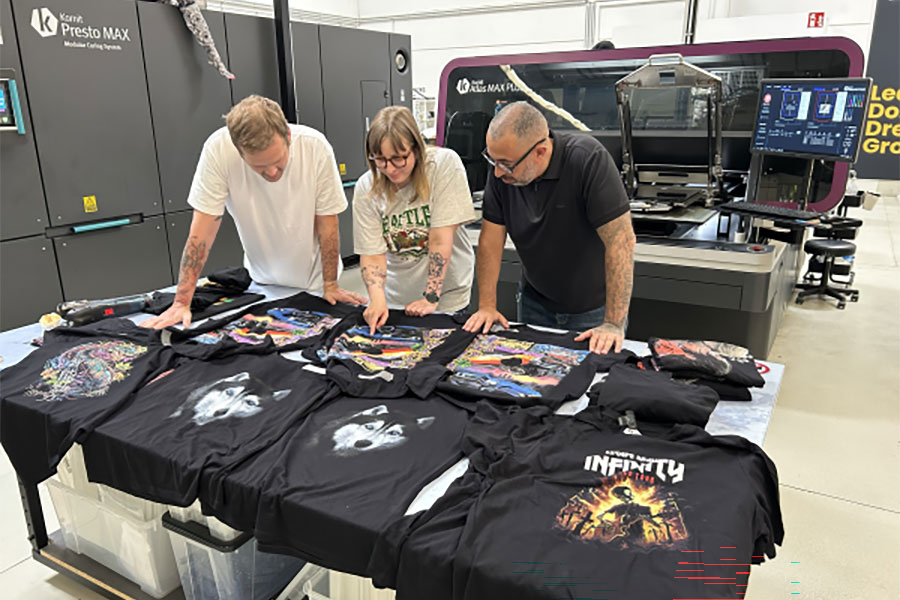
Flying Colours recently visited Kornit’s Düsseldorf facility in Germany to create print files demonstrating how closely DTG could emulate screen print quality. The challenge was to produce files that preserved the craft of screen printing while optimising ink usage through Under Colour Removal (UCR) using the garment’s black to replace black ink wherever possible without losing detail.

Jason Beevor, Studio Manager, spent weeks preparing multiple workflows and artwork files before arriving on-site. Over two intensive days he collaborated with Marie Kuehl, Pre-Sales Application Engineer at Kornit Digital, testing different versions of a complex, detail-heavy image.

Day One was dedicated to experimentation and pushing boundaries, perfecting workflows and testing initial approaches. Day Two built on this foundation, focusing on applying all the insights, data and custom Photoshop actions developed the previous day. It was a full day of printing multiple shirts and designs, observing, adjusting, and evaluating outcomes. The goal was clear: to produce DTG prints that matched the original artwork, retained fine detail and captured the look and feel of traditional screen printing. Through rigorous testing and refinement, Flying Colours developed a formula that successfully worked on an overwhelming majority of designs for Kornit.

After the planning phase of the first day, Jason Beevor was satisfied with the formula that Flying Colours had successfully produced and the eventual end-product, stating: “By focusing on one complex image first, we could perfect the workflow then expand it across multiple designs. The prints speak for themselves.”

Flying Colours + Kornit: Innovation in Action

At Kornit’s Düsseldorf facility, Flying Colours tested complex, detail-heavy artworks to prove how closely Kornit’s digital technology could replicate the craft of screen printing, while maximizing efficiency.

Through advanced workflows and intelligent under-colour removal, Flying Colours achieved a 50% reduction in ink usage on photographic designs. This breakthrough not only cuts costs but also supports Kornit’s commitment to sustainability: less ink, less waste, lower environmental impact.

“The real game-changer was the reduction in ink usage,” says Engin. “We sacrificed nothing in order to achieve a more sustainable product. This could change the entire industry.”

The Power of MAX Technology

Kornit’s MAX technology elevates digital production further:

  • Wet-on-wet printing for seamless gradients and vibrant saturation.
  • Advanced ink formulations with integrated pre-treatment that replace multiple production steps. This chemistry delivers durability, premium hand-feel, wash resistance, and creative effects such as neon colours and XDi 3D textures, all in a single process.

The result: garments that don’t just look great, they last longer, feel better, and unlock new levels of creativity while reducing waste and operational complexity.

A Catalyst for a New Market Space

Over the past decade, digital printing has reshaped print-on-demand, e-commerce, and drop shipping. With Kornit’s Atlas MAX Plus and Apollo systems, digital is no longer confined to short runs. It now defines the mid-volume, mass digital category.

By bridging the gap between one-offs and high-volume screen printing, Kornit is creating and leading a new market space: Mass Digital Production. Together with partners like Flying Colours, Kornit is shaping the future of apparel production: faster, cleaner, and more creative than ever before.
More News from Kornit Digital

#Digital Printing

Kornit Digital redefines apparel production for the on-demand era unveiling Atlas MATRIX at Konnections 2026

Kornit Digital Ltd. (NASDAQ: KRNT, “Kornit Digital”, “Kornit”, or the “Company”), a global pioneer in sustainable, on-demand digital fashion and textile production, today unveiled its Atlas MATRIX at Konnections 2026, redefining apparel production in the on-demand era.

#Digital Printing

Former ASOS CEO Nick Beighton joins Kornit Digital to help shape the future of on-demand fashion

Kornit Digital LTD. (NASDAQ: KRNT) ("Kornit" or the "Company"), a global leader in sustainable, on-demand digital fashion and textile production technologies, today announced it has appointed Nick Beighton, former Chief Executive Officer of ASOS, as a strategic advisor to the Company and its Board of Directors. His appointment reflects Kornit’s continued focus on strengthening its connection to global brands, retailers, and digital commerce platforms as the industry transitions toward on-demand production. The Company plans to nominate Mr. Beighton for election to the Board at Kornit’s 2026 Annual Shareholder Meeting.

#Digital Printing

UK Manufacturer Basic Prints commits to digital-first production model with dual investment in Kornit Digital’s Apollo

Kornit Digital, a global leader in sustainable, on-demand digital fashion and textile production technologies, today announced that UK clothing manufacturer Basic Prints has expanded its digital production capacity with a second Kornit Apollo Direct-to-Garment (DTG) system. This marks a strategic shift supporting Basic Prints’ digital-first manufacturing model.

#Digital Printing

Hybris Productions scales licensed apparel production moving from screen to digital with Kornit Digital

Kornit Digital, a global pioneer in sustainable, on-demand digital fashion and textile production technologies, today announced that Hybris Productions has adopted Kornit’s direct-to-garment (DTG) digital production technology to scale licensed apparel manufacturing with greater speed, design flexibility, and on-demand production capabilities supporting retail and e-commerce growth.

More News on Digital Printing

#Digital Printing

Mimaki takes DTF performance to the next level with TxF300-75Plus

Mimaki Europe, a leading manufacturer of industrial inkjet printers and cutting plotters, announces the TxF300-75Plus, an upgraded model within its high-productivity direct-to-film (DTF) printing portfolio. Following on from the success of the original TxF300-75, this enhanced version reflects Mimaki’s commitment to continuously evolving its solutions to meet the changing demands of the market.

#Digital Printing

FESPA confirms participation from leading exhibiting suppliers and brands for inaugural textile event

FESPA has confirmed a strong exhibitor line-up for its inaugural Textile show, a dedicated new event that will run as part of FESPA 2026, alongside co-located events: Global Print Expo, Personalisation Experience, European Sign Expo, WrapFest and the brand-new Corrugated.

#Digital Printing

Keeping print inclusive: Empowering women in the print industry

Across all industries, cultivating a diverse and inclusive workplace is increasingly recognised as valuable and essential to long-term success. However, despite the print industry’s significant advancements in technology and innovation, visible representation of women remains limited. As the sector grapples with low recruitment, it’s important to challenge outdated perceptions. Creating real change, however, requires collective effort - no single company can do it alone.

#Digital Printing

Express Print boosts production using an expanded fleet of Mimaki technologies

Express Print, a fast-growing Bulgarian provider of visual communication and soft signage solutions, has significantly enhanced its production workflow with a comprehensive portfolio of Mimaki digital printing systems. Based in Varna and active for more than 10 years, the company maintains a strong focus on the advertising sector. Over the years, it has steadily expanded its operations, driven by a clear vision to bring the full spectrum of large-format printing services in-house, avoiding outsourcing and ensuring complete control over production quality.

Latest News

#Techtextil 2026

Techtextil 2026 recognition for the UK’s FET

Fibre Extrusion Technology (FET) will receive the Techtextil 2026 New Production Technology Innovation Award at next week’s Techtextil in Frankfurt (April 21-24). The Leeds-based member of the British Textile Machinery Association (BTMA) has developed the FET-500, a new toxic solvent-free gel small scale system for the production of ultra-high-molecular-weight polyethylene (UHMWPE).

#Techtextil 2026

Lower CO2, stronger bonds: Indorama Ventures enables customers’ performance at Techtextil

At Techtextil 2026 in Frankfurt am Main, Indorama Ventures presents its latest material innovations aimed at supporting customers in achieving both performance and sustainability targets. The company highlights solutions based on recycled and bio-based raw materials as well as advanced binder fibers, addressing current market demands for lower CO₂ emissions, improved efficiency, and reliable supply.

#Recycled Fibers

Recover™ and Prosperity Textile announce strategic denim partnership

Recover™, a global producer of low-impact, high-quality recycled cotton fiber at scale, has announced a strategic partnership with Prosperity Textile, a vertically integrated denim fabric manufacturer operating at industrial scale.

#Techtextil 2026

Stylish design made from sustainable materials – two DITF research projects receive Techtextil Innovation Awards

Materials made from domestic, renewable raw materials reduce CO₂ emissions, prevent microplastics from entering the environment, and close the material cycle. The German Institutes for Textile and Fiber Research Denkendorf (DITF) are developing nature-based alternatives to synthetically produced and predominantly petroleum-based materials. Two research projects have received a prestigious Techtextil Innovation Award. NUO Flexholz and the lignin-coated material FormLig demonstrate that sustainable concepts can meet high standards of functionality and design. Both projects were carried out in close collaboration with industry.

TOP