#Digital Printing
EFI Reggiani celebrates 75 Years of innovative solutions for the textile world
With three quarters of a century of innovation, research and technological excellence, EFI Reggiani has become the trusted partner for integrated, scalable solutions for the entire textile process – from yarn treatment to fabric printing and finishing. EFI Reggiani has always had its customers in the forefront, enabling their business’ success and growth.

“Textile has been in our DNA since the beginning,” said EFI Reggiani Senior Vice President and General Manager Adele Genoni. “We are always moving to the next level, thinking ahead and developing high-tech, quality and reliable products as well as new textile industry solutions and processes. We are proud of achieving this 75 years of innovation milestone.
“We are also pleased to be a part of the success of so many global textile manufacturers and apparel brands over the past seven decades and into the future,” she added. “We have very close relationships with our customers, and the collaboration we have together allow us to develop groundbreaking new technologies. The three new printers we are launching this year speak to the legacy and expertise for solutions that have made our technologies a benchmark of productivity and quality ever since the creation of the first Reggiani textile printer in 1946.”
Transforming the textile industry with innovation
Always striving to be at the cutting edge of technology, EFI Reggiani delivers world-class products offering boosted uptime and reliability, high performance throughput, unparalleled printing uniformity, and accuracy – all while helping customers increase the sustainability of their textile manufacturing activities.
From the creation of its first traditional printer to its latest technological innovations, EFI Reggiani’s tradition and dedication to its products have contributed to the global transformation of the textile market. EFI Reggiani solutions are used in high-quality, highly productive operations in all of the world’s major textile manufacturing centers. New EFI Reggiani innovations also help facilitate the spread and localization of industrial textile manufacturing closer to end users in new geographic markets.
75 years of history and excellence
Reggiani Tessile – which was one of the largest fabric manufacturing companies in Italy – created the company to meet its needs in machinery development. Then known as Reggiani Macchine, the company grew tremendously over five decades thanks to continuous product innovation and close customer relationships.
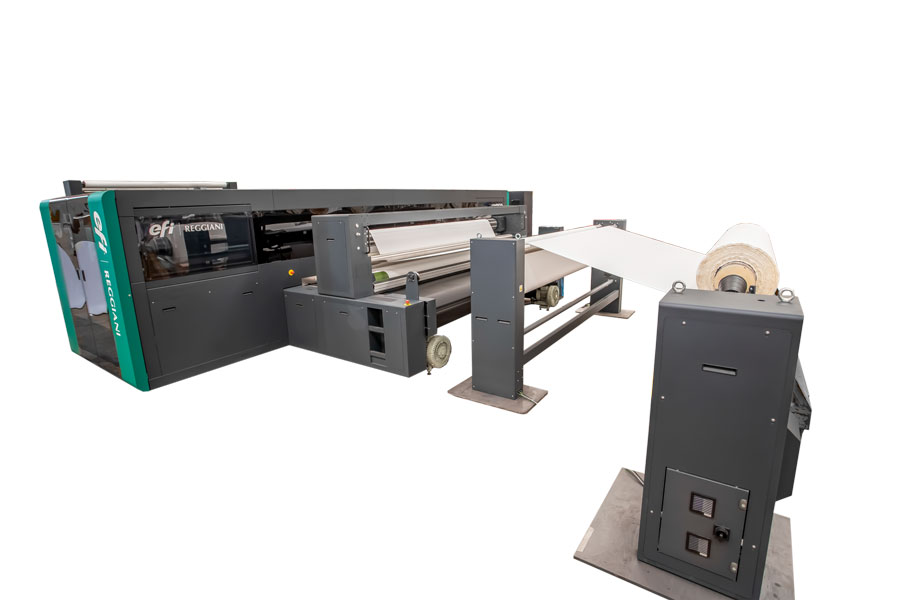
Reggiani Macchine started a new chapter in the early 2000s with the introduction of digital printing technology to their product range. Then, in 2015, Reggiani Macchine joined the Electronics For Imaging family. Since then, the company, based in Bergamo, Italy, has accelerated its mission in driving the transformation of analogue to digital imaging in the textile segment. EFI Reggiani’s product portfolio has continued to expand, ranging from rotary and flatbed printing machines to scanning/multi-pass digital printers to the world’s fastest digital textile printer – the award-winning EFI Reggiani BOLT single-pass inkjet printer launched in 2018. The company has also substantially advanced its ink offerings, becoming a recognized leader as one of the only manufacturers of a full range of inks used in industrial textile manufacturing.
Driving customer success for the future
Today, EFI Reggiani’s leadership in innovation is the result of extensive research targeted at improving productivity and quality, optimizing the textile manufacturing process, and reducing energy use, water consumption and overall environmental impact.
While the COVID pandemic made 2020 a difficult year for all involved in textile printing, EFI Reggiani took the opportunity to further strengthen its research and development activities – all to ensure that its customers have the right solutions as the market recovers.
Genoni believes productivity is key to any solution that will help customers recover and thrive post-pandemic, and one of the company’s new launches will specifically target a noticeable gap in the market.
“We want to help support our customers in their digital transformation,” she said. “One of our three new printers is going to target the industrial high-speed segment of the multi-pass textile printing sector. The new printer will not only be the fastest multi-pass printer that EFI Reggiani has ever developed, but we are also expecting it to be the fastest of its kind in the market.”
In the growing industrial, entry-level segment of the market, EFI Reggiani is strengthening its multi-pass offering by introducing two new scanning machines, which will help facilitate customers’ needs to manufacture closer to the end consumer. The pair of scanning printers EFI Reggiani is bringing to market in 2021 will enable new customers to take their first steps in industrial textile digital printing. The new printers will not only be easy to use, but, as with all of the company’s solutions, they will also give customers access to the best technology platforms and innovation for digital industrial printing with EFI Reggiani’s renowned quality and reliability.