[pageLogInLogOut]

#Composites

SGL Carbon receives SPE Innovation Award for glass fiber leaf spring

On November 10, 2021, the Automotive Division of the Society of Plastics Engineers (SPE®) in Michigan hosted its 50th annual Automotive Innovation Awards Gala, the oldest and largest awards ceremony in the automotive and plastics industries. In all, awards were presented in 10 categories for the most innovative use of plastics. This year, Ford Motor Co. beat out the rest of the nominees with its innovative spring system for Ford's F-150 pickup model. The hybrid leaf spring from supplier Rassini was selected as the award winner in the chassis/hardware category. This award also honors the supply chain.
  • Recognition with SPE Innovation Award for innovative spring system for Ford's F-150 pickup model in the chassis/hardware category
  • Oldest and largest awards ceremony in the automotive and plastics industries
  • SGL Carbon is involved with production of state-of-the-art glass fiber fabrics and supply of finished leaf spring components

SGL Carbon is involved in two aspects of this project: Firstly, with the production of state-of-the-art glass fiber fabrics at the SGL site in Wackersdorf, and secondly, with the supply of finished leaf spring components, which SGL manufactures in its component production facility in Ort im Innkreis, Austria.
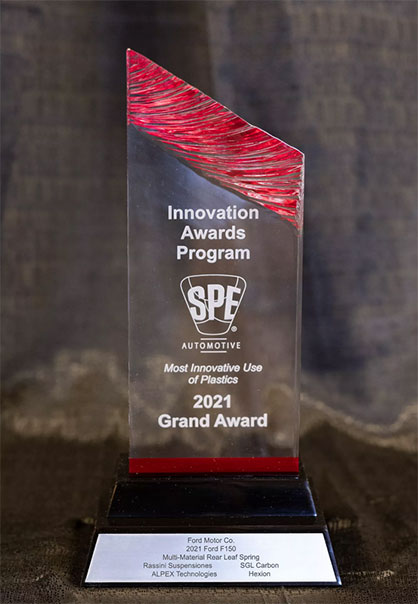
© SPE: Innovation Award 2021


"In addition to the almost fully automated and high-volume series production, the technical innovation for the excellent spring system also consists of the intelligent interaction between conventional steel leaf springs and our novel composite materials. Here, the conventional steel leaf spring is supported by our additional spring made of GFRP, so that the vehicle is cushioned reliably and comfortably even with heavy load. Compared to steel, the design of the composite leaf spring also enables a weight saving of over 50%. ", explains Robert Hütter, responsible for Large Scale Solutions at SGL Carbon's Composites Division.

"We congratulate Ford and Rassini and are proud to contribute to the innovative suspension system of the F-150 with our fiber materials and composite solutions. While our carbon fibers, with their high tensile strength and light weight, are particularly suitable for body components, our glass fiber fabrics, with their especially elastic material properties and equally low weight, are an optimal set-up for making modern leaf spring systems even lighter and offering a real alternative to the classic steel leaf spring. This applies to combustion engines as well as to electric mobility. ", adds Markus Stieglbauer, Director Sales Management of the Business Line Textiles at the Fiber Division in Wackersdorf.


The significant weight reduction of composite components also ensures a higher range and more efficiency for e-cars (BEV) as well as lower fuel consumption. At the same time, CO2 emissions are reduced and the rigidity of the vehicle is increased.

© SPE
© SPE


Variety of composites components

For use in the automotive industry, SGL Carbon produces a wide range of different parts and components made of carbon and glass fiber-reinforced plastics, from body components and battery cases to friction linings made of carbon fiber material. The company supplies a wide range of automotive manufacturers worldwide. The automotive components also include leaf springs made of glass fibers, which contribute to a significant reduction in weight. SGL Carbon manufactures the leaf springs in a highly automated process, both as transversal and longitudinal leaf springs.

© SPE / SGL carbon
© SPE / SGL carbon


More News from SGL CARBON SE

More News on Composites

#Composites

JEC World 2026 confirms its standing as the unmissable event for composites and their applications

JEC World 2026 confirms its position as the leading global event for the composite materials industry and its applications across multiple sectors, bringing together the entire composites ecosystem in Paris for three days of business, innovation, and collaboration. True to its Pushing the Limits motto, the 2026 edition delivered outstanding results despite travel disruptions worldwide. The numbers speak for themselves: more than 1,400 exhibitors from over 50 countries, including over 150 first-timers, presented a global panorama of products, equipment, and services across the entire composites value chain.

#Composites

KARL MAYER strengthens partnerships in the composites industry at JEC World 2026

KARL MAYER further strengthened its role as a reliable and competent partner to the composites industry at JEC World 2026. The global market leader in textile machinery manufacturing used the trade show to meet key customers, establish numerous new contacts, and engage in in-depth technical discussions.

#Composites

Kordsa showcases its global expertise in material technologies at JEC World 2026

Kordsa, a subsidiary of Sabancı Holding, shared its global expertise in material technologies with participants at JEC World 2026, held in Paris. The company’s solutions developed for a wide range of industries—particularly aviation, energy, and automotive—stood out among its key innovations at the exhibition. Throughout the event, Kordsa also presented its vision for sustainable growth and its strategic transformation in composite technologies to international stakeholders.

#Composites

JEC Composites Startup Booster: 2026 winners announced

The leading global startup competition for composites and advanced materials has crowned its 2026 champions, ahead of a landmark 10th anniversary edition next year. The winners of the JEC Composites Startup Booster 2026 were announced on Wednesday, 11 March, at JEC World, recognizing the most promising emerging companies reshaping the future of composites and advanced materials.

Latest News

#Raw Materials

New study shows low environmental impact by Cotton made in Africa Organic Cotton from Tanzania

Today, the Aid by Trade Foundation (AbTF) is announcing the results of a comprehensive life-cycle analysis (LCA) for cotton produced in Tanzania under the Cotton made in Africa Organic (CmiA Organic) standard. The study emphasises the small ecological footprint of CmiA Organic verified cotton. This can largely be traced back to the absence of synthetic pesticides, artificial fertilisers, and artificial irrigation. Consequently, CmiA Organic cotton can help the textile industry meet regulatory requirements as well as science-based targets. The results also show that the consequences of climate change threaten the livelihoods of these cotton farmers, even though the type of agriculture they practise barely contributes to climate change.

#Raw Materials

Better Cotton Initiative strengthens regenerative focus in standard update

The Better Cotton Initiative (BCI) has strengthened the regenerative focus of its field-level standard with the launch of a new version of its Principles & Criteria (P&C), which marks the next step in the organisation’s journey to becoming a regenerative standards system.

#Man-Made Fibers

Selenis and Kintra Fibers partner to scale 100% bio-based synthetic fiber technology

Selenis, a leading global specialty polyester manufacturer, today announced a strategic manufacturing partnership with materials science company Kintra Fibers to scale Kintra’s patented fiber-grade PBS resin - a 100% bio-based and biodegradable material designed for textile applications.

#Functional Fabrics

PERFORMANCE DAYS proves its relevance as the industry’s key meeting point

Held on March 18–19, 2026, PERFORMANCE DAYS once again confirmed its position as a leading international platform for functional textiles. A total of 3.366 trade visitors and around 560 exhibitors gathered in Munich, with the event already kicking off successfully on DAY 0, which received highly positive feedback for its interactive format. Despite challenging conditions caused by the public transport strike in Munich, the event saw strong attendance and a consistently high level of activity across both exhibition days.

TOP