#Spinning
First half of 2019 characterized by low demand in the new machinery business
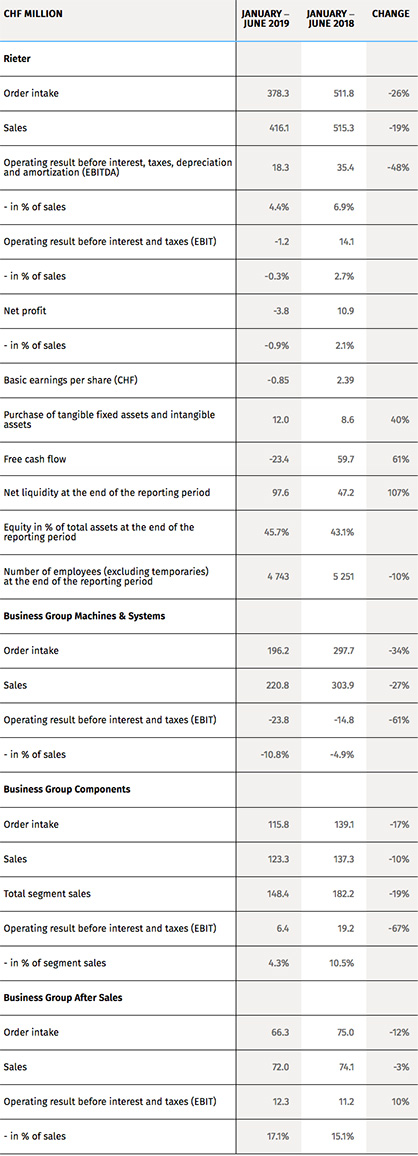
- Order intake in the first half of 2019 amounted to CHF 378.3 million, 26% below the previous year period
- At CHF 416.1 million, sales were 19% down on the previous year period
- EBIT of CHF -1.2 million and net profit of CHF -3.8 million
- Implementation of cost-cutting measures proceeding according to plan
- Innovations successfully launched at ITMA 2019 in Barcelona
- Major order from Egypt signed – worth around CHF 180 million
- Completion of real estate sale in Ingolstadt (Germany) expected in the third quarter 2019
- Outlook unchanged compared to spring 2019
Sales in the first half of 2019 amounted to CHF 416.1 million (first half year 2018: CHF 515.3 million), which represents a decline of 19% compared to the previous year period. This development is mainly attributable to lower demand in the new machinery business (Business Group Machines & Systems: -27%).
EBIT, Net Profit and Free Cash Flow
The significant decline in sales in the machinery business resulted in an operating loss (EBIT) of CHF -1.2 million in the first half of 2019 (first half year 2018: CHF +14.1 million). The cost-cutting measures introduced had a positive effect on the result from the second quarter of 2019.
Net profit was CHF -3.8 million (first half year 2018: CHF +10.9 million). Due to the seasonal increase in net working capital, free cash flow amounted to CHF -23.4 million (first half year 2018: CHF -59.7 million). Net liquidity as at June 30, 2019, was CHF 97.6 million (December 31, 2018: CHF 150.2 million). The equity ratio as of June 30, 2019, stood at 45.7% (December 31, 2018: 44.6%).
Regions
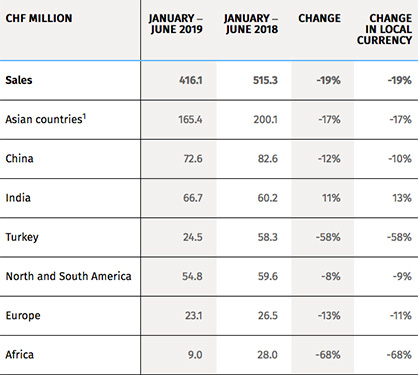
Sales in the first half of 2019 declined by 19% to CHF 416.1 million (first half year 2018: CHF 515.3 million). In the Asian countries (excluding China, India and Turkey), sales fell by 17% to CHF 165.4 million. In Vietnam and Pakistan, by contrast, sales increased compared to the previous year period. In China, sales declined by 12% to CHF 72.6 million. In contrast, sales in India increased by 11% to CHF 66.7 million. In Turkey, sales fell by 58% to CHF 24.5 million in the first half of 2019. Sales in North and South America declined by 8% to CHF 54.8 million. In the Europe region, sales amounted to CHF 23.1 million (-13%) and in Africa to CHF 9.0 million (-68%).
Business Groups
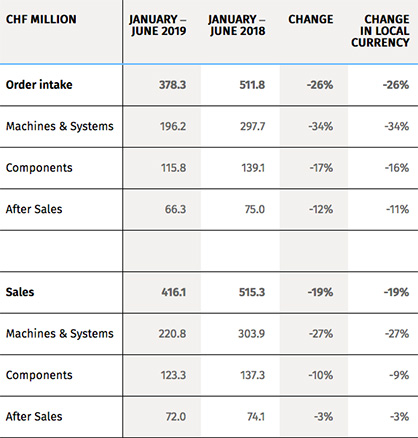
Order intake by the Business Group Machines & Systems fell by 34% to CHF 196.2 million (first half year 2018: CHF 297.7 million). The reasons for the customers’ reluctance to invest were, primarily, overcapacity in the spinning mills, the trade conflict between the USA and China, and political and economic uncertainties in other regions of importance to Rieter. In addition, some customers have been holding back on investment decisions and waiting for the innovations presented at ITMA in Barcelona in June 2019. For the Business Group, sales were CHF 220.8 million (first half year 2018: CHF 303.9 million), around 27% below the previous year period. This reflects the low demand for new machinery, which has prevailed since the fourth quarter of 2018. Despite the ongoing cost reduction measures, due to lower volumes EBIT amounted to CHF -23.8 million (first half year 2018: CHF -14.8 million).
The Business Group Components posted an order intake of CHF 115.8 million (first half year 2018: CHF 139.1 million), which was around 17% down on the previous year period. The decline was related, in particular, to the business activities of SSM and Suessen, mainly as a consequence of the investment restraint in the market, as already described. At CHF 123.3 million, sales were 10% down on the prior year level (first half year 2018: CHF 137.3 million). This again related, in particular, to SSM and Suessen. Business for wear and tear parts for spinning mills, however, is running at a good level. EBIT amounted to CHF 6.4 million (first half year 2018: CHF 19.2 million). In addition to the decline in sales to third parties, a downturn in volume of deliveries to the Business Group Machines & Systems was also evident here.
Order intake in the Business Group After Sales fell by 12% year-on-year to CHF 66.3 million (first half year 2018: CHF 75.0 million). This was mainly attributable to the lack of installation volume for new machinery. However, the spare parts business for spinning mills is at a good level. At CHF 72.0 million, sales were 3% down on the previous year (first half year 2018: CHF 74.1 million). Despite lower sales, EBIT reached CHF 12.3 million and was therefore higher than the previous year period (first half year 2018: CHF 11.2 million).
Implementation of Cost-Cutting Measures Proceeding According to Plan
In March 2019, in response to the market situation Rieter announced and began to implement capacity adjustment and cost reduction measures. These measures included a reduction of the workforce by around 5% worldwide. Implementation of the measures is proceeding as planned. On June 30, 2019, Rieter employed 4 743 people worldwide (December 31, 2018: 5 134 employees).
Changes to the Group Executive Committee
Since May 1, 2019, Rieter Group has two new Group Executive Committee members: Kurt Ledermann is Chief Financial Officer and Rico Randegger is Head of the Business Group After Sales.
Innovations Successfully Launched at ITMA 2019 in Barcelona
At ITMA 2019, Rieter presented a comprehensive range of innovations for all four spinning mill systems established on the market. These innovations are aimed at reducing the raw material, energy and labor costs while increasing productivity and flexibility in the spinning mill. Rieter also presented new solutions for the production of innovative yarns and the automation and flexibility of existing systems, as well as the further development of the digital platform ESSENTIAL. The innovations presented were received very positively by the many customers that Rieter welcomed at the trade fair. Rieter therefore achieved an important milestone in the implementation of its corporate strategy and is now focusing on the successful market launch.
Major Order from Egypt Signed – Worth around CHF 180 Million
At ITMA 2019, the Rieter Group signed contracts with Cotton & Textile Industries Holding Company, Cairo (Egypt). The contracts cover seven projects with a total volume for Rieter of around CHF 180 million. The agreement includes deliveries of compact and ring-spinning systems over the next two years. The order is part of a comprehensive modernization program for the Egyptian textile industry. Order intake is expected to be realized in 2019 with sales posted in the 2020/2021 financial years.
Completion of Real Estate Sale in Ingolstadt (Germany) Expected in the Third Quarter 2019
As already reported, Rieter is selling its real estate in Ingolstadt. Completion of the transaction is expected during the third quarter of 2019. Rieter anticipates an extraordinary profit contribution at the level of net profit of around EUR 60 million. The employees remaining in Ingolstadt will move into a new building in 2021. There, Rieter will create a modern working environment for innovative research and development work and the respective support functions.
Outlook
Demand for new machinery remained at a low level in the first half of 2019. Rieter does not anticipate a significant upturn in the market in the second half year period. For the full financial year 2019, compared to the previous year Rieter expects a significant decline in sales, EBIT and net profit (before extraordinary income from the sale of the real estate in Ingolstadt). The cost-cutting measures introduced will continue to be implemented as planned. Rieter is focusing on the successful market launch of the innovations which were presented and received positively by the customers at ITMA 2019 in Barcelona.
Key Figures