#Techtextil 2015
13th Techtextil Innovation Award 2015 honours eight outstanding developments
They include printers for three-dimensional woven structures, embroidered electrodes for long-term ECGs, algae-based snow, an artificial womb and maritime textile for cultivating kelp. All products can be seen in a special exhibition in Hall 6.1 until 7 May 2015.
The Techtextil Innovation Award winners:
The Techtextil Innovation Award 2015 is given in six categories. One of the winners in the ‘new technology’ category is Sosa Fresh for its 3DWeaver, a 3D printer that can produce three-dimensional woven structures step-by-step. The other winner in this category is Emil Stutznäcker for its high-performance sewing technology with automatic handling in the sewing area, which can produce preforms, i.e., multi-layer woven and nonwoven fabrics for textile-reinforced lightweight structures, at the record speed of around 3,000 stitches a minute.
The Techtextil Innovation Award in the ‘new product’ category goes to the Empa Research Institute for an embroidered electrode that can be used for long-term ECGs and thus takes account of the growing demand for textiles in medical applications.
Two companies have been singled out for the Award in the ‘new concept’ category: Switch Embassy for a washable LED screen that can be used in many areas of application, from clothing to interior furnishings, and the ITV Denkendorf Research Institute for BioGlizz, a biological alternative to artificial snow, which is based on an algae-covered textile layer.
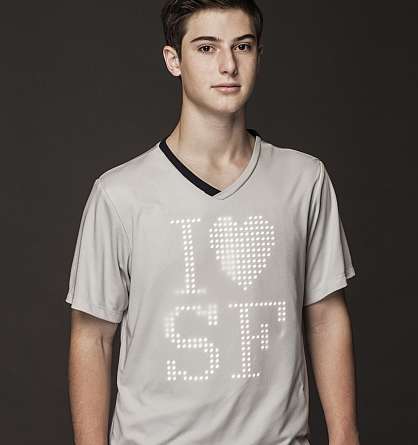
Pic: The washable LED Screen by Switch Embassy on a T-Shirt .
The winner in the ‘new application’ category is the Hohenstein Institute for Textile Innovation with ARTUS, a technical textile that can be used as an artificial womb for premature babies and, inter alia, reproduces the mother’s movements and heartbeat.
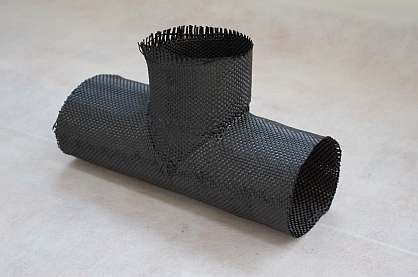
The ‘new composite’ category has been won by a technology that makes it possible to weave fibre-reinforced 3D structures in T and LI forms that can, for example, contribute to weight reduction in automobiles and machinery. The new process was developed by the Forschungskuratorium Textil e. V. textile research association.
In the ‘new material’ category, the jury gave the award to Sioen Industries for developing a maritime textile that makes it possible to cultivate kelp and alternative, sustainable biomasses.
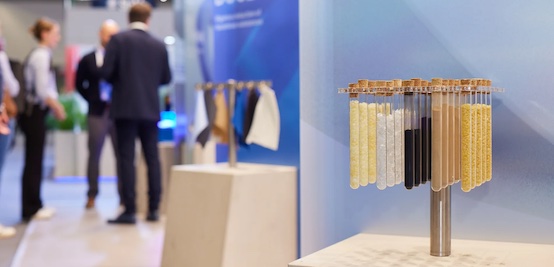
During Techtextil 2015, the award-winning products can be seen in a special exhibition in Hall 6.1 (C47). The exhibition offers insights into the materials used, production details and areas of applications.
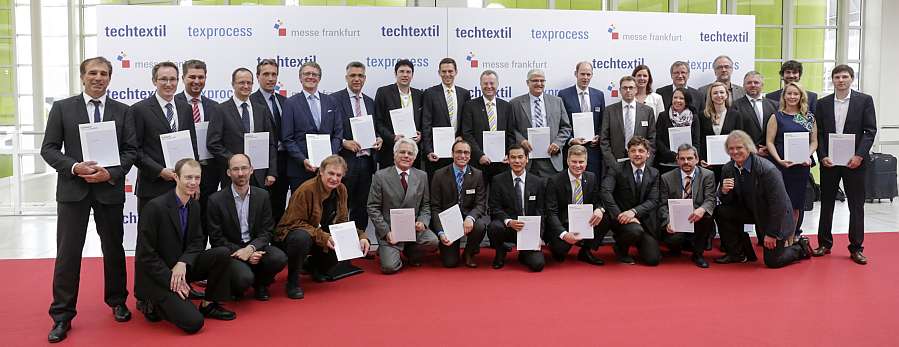
The jury: Braz Costa, CITEVE Centro Tecnológico das Indústrias téxtil e do Vestuário de Portugal Sabine Gimpel, TITV Textilforschungsinstitut Thüringen-Vogtland e.V. Dr. Klaus Jansen, Forschungskuratorium Textil e.V. Dr. Jan Laperre (Chairman), Centexbel Dr. René Rossi, EMPA Swiss Federal Laboratories for Materials Science and Technology Pascal Rumeau, IFTH The French Institute of Textiles and Clothing Prof. Dr. Roshan Shishoo, Shishoo Consulting AB Dr. Thomas Stegmaier, ITV Institute of Textile Technology and Process Engineering Denkendorf Dr. Hartmut Strese, VDI/VDE Institute for Innovation and Technology
The concurrent Texprocess, Leading International Trade Fair for Processing Textile and Flexible Materials, honours technological developments by Texprocess exhibitors with the Texprocess Innovation Award